The world-wide community of planetary scientists is invited to submit an abstract for a presentation of their recent work at the Europlanet Science Congress (EPSC) 2026, which will take place in The Hague, The Netherlands, 6–11 September 2026.
EPSC2026 will be organised as a fully hybrid meeting and will allow virtual access to all oral and poster sessions. The ethos for EPSC2026 is to create a simple, flexible, and inclusive meeting that provides multiple opportunities for interaction, scientific discussion, and networking. The programme of the congress will contain oral and poster sessions, as well as workshops and panel discussions.
The current list of sessions is organised around the following Programme Groups:
Small Bodies (comets, KBOs, rings, asteroids, meteorites, dust) (SB)
Exoplanets, Origins of Planetary Systems and Astrobiology (EXOA)
Outreach, Diversity, Amateur Astronomy, and Community (ODAC)
Please browse the list of sessions and identify the session that most closely matches your area of interest; your abstract can be submitted directly to that session. Applications for a financial support bursary can be made at the end of the abstract submission process.
For future deadlines including (early) registration, refer to the deadlines & milestones of the conference.
Information on registration and social events, as well as a separate online form for requesting splinter meetings & workshops will also be available soon on the meeting website.
Call for Observation Time on Optical Telescopes Now Open
The Europlanet Telescope Network is cooperating with the OPTICON Alliance to support access to optical facilities. Observers from the planetary community are encouraged to apply.
Optical call for proposals 2026A
We are pleased to announce that the OPTICON 2026A call for proposals is now open, with observing time available on the participating facilities.
As the number of participating facilities in this call is limited, applicants are also encouraged to check the relevant telescope or observatory website in case any facility requires specific additional information. Applicants may request observing time on multiple facilities through a single proposal. Late applications will not be considered. Please note that, for this call, applications are invited from the international community excluding USA-based observers. It is expected that future calls will broaden eligibility to include USA-based observers. Applicants submitting a proposal will be expected to provide feedback on at least one anonymised proposal as part of the review process.
Note: TBL and Aristarchos facilities will be available for future calls, but are currently in the process of being upgraded. Please also consider the BHTOM network of telescopes for time-domain observations.
The call for proposals will close on April 17th 2026 at UT 23:59.
The EPEC Committee and EPEC Annual Week Local Organising Committee (LOC) are pleased to announce that the 8th edition of Annual Week will be held at the Laboratoire De Planétologie Et Géosciences (LPG), Nantes, France from 25 – 29 May 2026. Applications are now officially open!
Details
Dates: 25 – 29 May 2026 Venue: Laboratoire De Planétologie Et Géosciences (LPG), Nantes, France Registration period: 16th March – 17th April 2026
The EPEC Annual Week is an opportunity for the EPEC community to better get to know each other, to strengthen their connections with the international science community in a conference exclusively catered to early careers. The programme for EPEC Annual Week 2026 (EPEC AW26) consists of science talks, invited speakers and a chance for our members to present their work in a low-stakes setting to build their confidence and scientific communication skills. Furthermore, the school brings together scientists from different career stages to provide a networking platform where science discussion and collaboration are stimulated via a series of group activities.
Participants must be enrolled in a B.Sc., M.Sc., or Ph.D. programme (or equivalent) in the field of planetary/space science, or have obtained their degree within the past seven years. Note that in order to apply to the training school you are NOT required to be a member of EPEC, although this is encouraged.
Hungarian Space Research Draws Strong Interest at London’s Space-Comm Expo Europe
Hungarian space research and technology attracted significant interest at Space-Comm Expo Europe in London, one of Europe’s leading events for the space research and space industry sector. The Hungarian stand – featuring astronauts, plants engineered for space and Hungarian-developed radiation measurement technologies – became one of the most popular at the conference.
Researchers from the HUN-REN Hungarian Research Network, together with astronauts representing the HUNOR programme, presented Hungary’s latest space research results and experiments conducted aboard the International Space Station (ISS) as part of the HUNOR programme, as well as their potential applications for industry and the economy. The delegation was led by Zsolt Szalay, Vice-President for Engineering and Natural Sciences at HUN-REN.
The stand attracted strong interest from the more than 5,000 professionals attending the event, including researchers, industry representatives and government stakeholders. Visitors also had the opportunity to meet the Hungarian research astronaut of the Axiom-4 mission, Tibor Kapu in person, as well as Gyula Cserényi, the backup astronaut selected for the mission.
Hungary’s presence was further highlighted by Tibor Kapu’s keynote presentation on the Axiom-4 mission and its scientific experiments carried out as part of the HUNOR programme. He later joined a panel discussion with British astronaut Tim Peake, strategic adviser to Axiom Space, and Zsolt Szalay. During the discussion, the astronauts stressed that human-led space missions remain essential even in an era of rapidly advancing robotics.
Panel discussion moderated by the Hungarian Ambassador to the United Kingdom, Ferenc Kumin, with British astronaut Tim Peake, strategic adviser to Axiom Space, Hungarian astronaut, Tibor Kapu, and Zsolt Szalay, Vice-President for Engineering and Natural Sciences at HUN-REN, during the Space-Comm Expo Europe event in London. Credit: HUN-REN Communications.
According to Zsolt Szalay, the fast-growing global space industry offers significant opportunities even for smaller countries to gain a competitive advantage by focusing on carefully selected strategic areas.
Within the HUN-REN network, space-related research is currently conducted in eight institutes by around two dozen research groups and nearly 160 researchers. Four institutes represented this community at the exhibition, demonstrating the strength of coordinated cooperation across disciplines and institutions.
“Our comprehensive space research programme, launched last month, aims to strengthen collaboration between research groups and better connect Hungarian research with leading international partners from both science and industry,” said Zsolt Szalay. “During the two-day event we received numerous enquiries from leading global companies, and discussions on potential collaborations will continue in the coming weeks.”
Tibor Kapu, Gyula Cserényi, Zsolt Szalay and Dr Balázs Nagy R&D Director of HUNOR (the Hungarian Space Programme) also participated in a panel discussion at the Hungarian Embassy in London on 5 March. ‘Proven in Orbit: Implementing Scientific Experiments on the International Space Station’ was hosted by the Hungarian Ambassador His Excellency Ferenc Kumin, Phd. The discussion, which was moderated by Europlanet Research Infrastructure Coordinator, Nigel Mason, provided practical insights into building national space capability and fostering international partnerships, offering relevant lessons for both emerging and established space nations.
Hungarian space research has achieved internationally recognised success in radiation measurement and dosimetry. The PILLE dosimeter first flew in space in the 1970s and has been standard equipment aboard the International Space Station since 2003. It remains the only device capable of measuring the additional radiation dose astronauts receive during spacewalks.
Hungarian researchers have also made significant advances in small satellite development and space weather research. The country’s scientific infrastructure – including the Zero Magnetic Laboratory near Sopron and the accelerator facilities of the Institute for Nuclear Research in Debrecen capable of simulating solar wind – also provides internationally competitive research capabilities.
Hungary and the HUN-REN Hungarian Research Network aim to play an increasingly active role in international scientific and industrial collaborations, including programmes of ESA and NASA. The strong interest generated at Space-Comm Expo Europe confirmed that presenting Hungary’s space research capabilities in an integrated way can open the door to new international partnerships.
The HUN-REN stand, astronaut ‘meet and greet’ with Tibor Kapu and Gyula Cserényi, and panel discussion with Ferenc Kumin, British astronaut Tim Peake, Hungarian astronaut, Tibor Kapu, and Zsolt Szalay, Vice-President for Engineering and Natural Sciences at HUN-REN.
The Europlanet Career Medals are an opportunity to honour outstanding contributions from individuals of three different scientific career stages to the scientific fields covered by the Europlanet Science Congress (EPSC).
One Europlanet Medal is awarded every year in each of the categories: Early-Career, Mid-Career and Lifetime Achievement. The categories are based on the scientific age of a researcher at time of submission. The Europlanet Mid-Career Medal honours the memory and the outstanding figure of Paolo Farinella (1953-2000), an extraordinary scientist and person, in whose name the Paolo Farinella Prize (2011-2024) was previously awarded.
Mauve – ‘First light’ From the First Commercial Space Science Satellite Heralds a New Era for Astronomical Data
Blue Skies Space has successfully achieved ‘first light’ with Mauve, beginning a new era in astronomical data delivery from small, rapidly built space telescopes. It marks the first time that a commercial space science satellite has successfully launched and sent back data to astronomers about our universe.
Mauve will study stars in the ultraviolet and visible light, enabling a greater understanding of their magnetic activity, powerful flares, and their impact on the habitability of exoplanets.
The satellite carries a 13 cm telescope and is designed to deliver spectrophotometric observations across the 200-700 nm range. Following launch on 28 November 2025, contact with the satellite was established, and commissioning activities were initiated. All spacecraft subsystems and the payload instruments have been powered on and are operational.
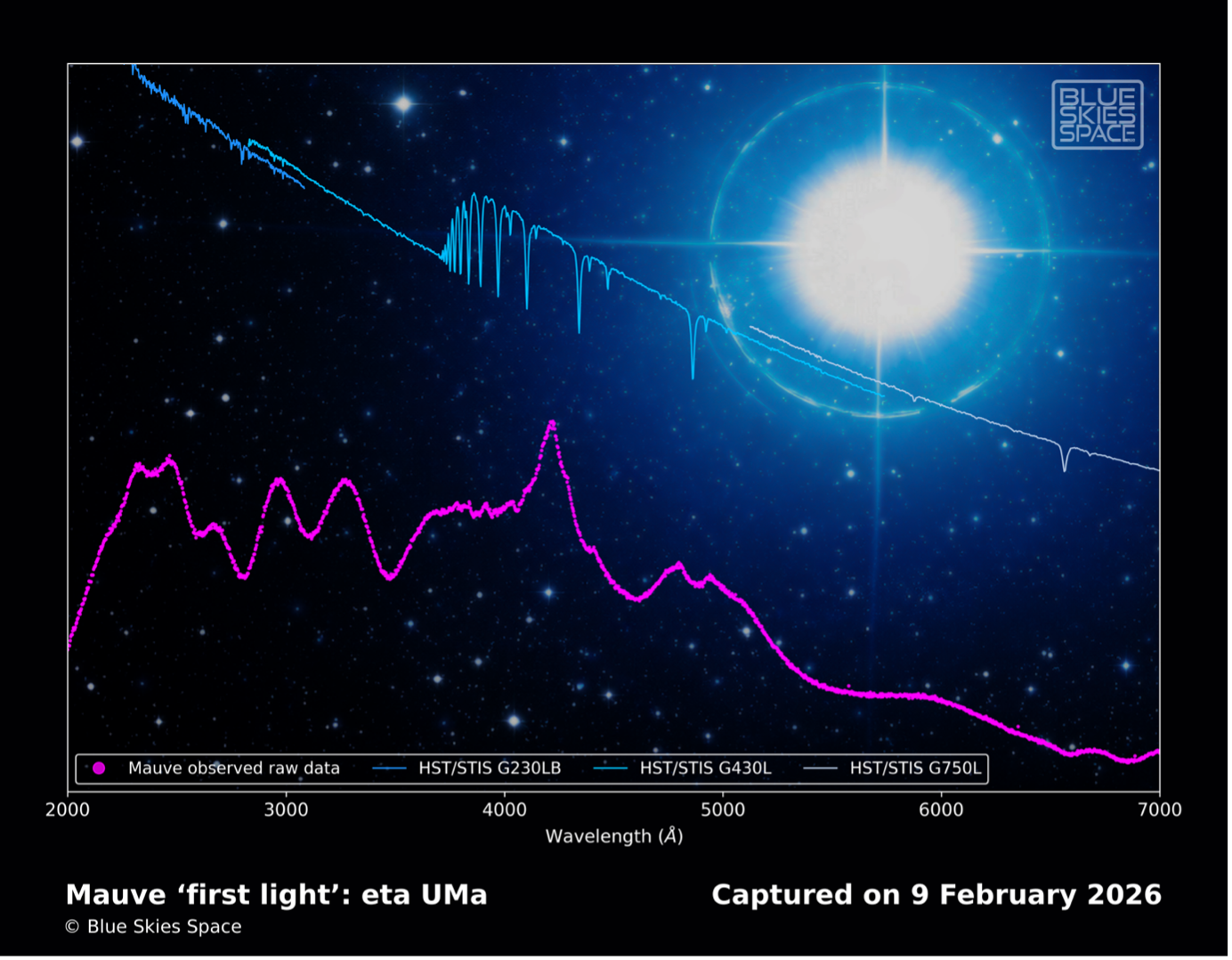
As part of early commissioning, Mauve was pointed at its first calibration target, eta Ursae Majoris (eta UMa), a bright star in the constellation Ursa Major, approximately 104 light-years from Earth, for a 5-second observation. Eta UMa is a hot, blue-white star, much hotter than our Sun. Eta UMa shines brightly in ultraviolet light, making it an ideal calibration target for a UV observatory like Mauve.
“Achieving first light with Mauve is a fantastic milestone. It’s great to see Mauve perform brilliantly in orbit. Full instrument performance will be established over the coming weeks as we continue calibration and observe progressively fainter targets,” said Ian Stotesbury, Lead Systems Engineer at Blue Skies Space.
Mauve ‘first light’. Pink: Spectrum of eta UMa acquired in a single capture by Mauve on 9 February 2026 with a 5s integration time. Blue: Hubble Space Telescope STIS spectra of the same star recorded by three grisms. (C) Blue Skies Space.
Dr Arianna Saba, Science Performance Analyst at Blue Skies Space, commented: “We selected eta UMa, a well-observed B-type star, to capture ‘first light’. Eta UMa exhibits a strong ultraviolet continuum and a pronounced Balmer jump, caused by the absorption of hydrogen atoms in the outer layers of the star’s atmosphere. This is a perfect star to start calibrating Mauve’s instrument.”
The science programme for the first year of operations is described here. Scientists interested in acquiring access to Mauve’s data are invited to contact Blue Skies Space.
—ENDS—
Image of eta UMa generated using ESA Sky:
Image of eta UMa generated using ESA Sky. Credit: ESA/DSS2 (Digitised Sky Survey).
About Mauve
Mauve, Blue Skies Space’s first satellite, was launched on 28 November 2025 aboard SpaceX’s Transporter-15 on a three-year mission to measure the activity of nearby stars, helping scientists understand the impact of powerful stellar flares on exoplanets and the prospects of harbouring life.
Mauve is a small satellite operating in a low-Earth orbit, equipped with a 13 cm telescope to observe stars in the ultraviolet and visible wavelengths (200-700 nm).
Mauve was built by a consortium of European companies and launched within 3 years of conception, a fast timeline for science satellites. C3S LLC (Hungary) is the spacecraft’s prime and platform provider, with ISISPACE (Netherlands) providing the pointing solution. The telescope, supplied by MediaLario (Italy), is connected via optical fibres from CeramOptec (Latvia) to spectrometers provided by Avantes (Netherlands).
Wavelength Coverage
200 – 700 nm (UV – Visible)
Telescope
13 cm Cassegrain
Spectral Resolution
10.5 nm (R= 20-65)
Detector
CMOS Linear Array
Mass
18.6 kg
Orbit
LEO 10:30 LTDN, 510 km
Mauve’s data is made available to participating researchers through a three-year science programme, with those who sign up early being able to lead and shape the observational programme each year. Mauve’s current research priorities are:
Stellar flares: Some of the coolest stars are subject to large explosions (flares) that produce high-energy emissions, occasionally outshining the star itself. Studying these events helps scientists understand how magnetic fields accumulate and release large amounts of energy, and understand similar events produced by our Sun.
Young exoplanet hosts: Young stars with planets still taking shape around them reveal the early stages of planetary evolution. By studying these systems, scientists trace how planets grow, migrate, and settle into their mature orbits — offering clues to the history of our own Solar System.
Hot stars: Hot stars emit abundant ultraviolet radiation, and Mauve will study both the youngest ones, surrounded by clouds of gas and dust, and some of the older ones, rapidly rotating and shedding material into surrounding disks of gas, affecting their evolution.
Binary stars: Systems where two stars orbit one another are vital for testing theories of gravity, stellar mass, and evolution. Because their mutual orbits can be measured precisely, binaries offer the most accurate way to determine stellar masses, anchoring models of how all stars live and die.
Research institutions worldwide have already secured subscriptions to access data collected by Mauve. These include Boston University, Columbia University, INAF’s Osservatorio Astrofisico di Arcetri, Konkoly Observatory, Kyoto University, National Astronomical Observatory of Japan, Maynooth University, Rice University, Vanderbilt University, and Western University.
The project has received funding from the European Union’s Horizon Europe research and innovation programme under grant agreement No. 101082738 and was supported by the UK Research and Innovation (UKRI)’s Horizon Europe Guarantee Scheme.
About Blue Skies Space
Blue Skies Space is a company pioneering a new model to deliver high-quality space science data in accelerated timescales to the global scientific community, helping them to answer humanity’s greatest scientific questions. Through a fleet of low-Earth orbit satellites, the company aims to serve the global demand for high-quality science data across many research areas, including the monitoring of stars, understanding what the atmospheres of faraway exoplanets are made of, as well as the composition of asteroids in our Solar System.
With offices in the UK and Italy, Blue Skies Space has assembled an experienced team that has previously worked at organisations such as NASA, Airbus, Surrey Satellite Technology, Caltech and UCL, bringing a wealth of expertise in space science, satellite engineering, satellite construction and operations.
Europlanet has opened a call for funding proposals of up to 5000 € to support the activities of its members. Proposals should be submitted by the Chair (or designated representative) of a Europlanet Regional Hub, Committee or Working Group (WG).
The deadline for the call is 16 March 2026. Projects proposed in the current call should be completed by the end of 2026.
To find out more about the call and application process, please see the call page.
You can also find out about projects funded in previous rounds of this scheme here.
Tiny Enceladus Exercises Giant Electromagnetic Influence at Saturn
Europlanet Press Release – For Immediate Release
Enceladus, a tiny moon of Saturn, trails a wake of electromagnetic ripples that extends over half a million kilometres.
A major study by an international team of researchers using data from the NASA/ESA/ASI Cassini spacecraft has revealed a lattice-like structure of crisscrossing reflected waves that flow downstream behind the moon in Saturn’s equatorial plane, but also reach up to very high northern and southern latitudes. The analysis of data from four instruments aboard Cassini, collected over the mission’s 13-year duration, demonstrates the crucial role that Enceladus plays in circulating energy and momentum around Saturn’s space environment.
Plumes of water vapour and dust stream through cracks in the icy surface of the southern hemisphere of Enceladus. The water molecules and particles from these geysers become ionised when exposed to radiation, creating an electrically-charged plasma that interacts with Saturn’s magnetic field as it sweeps past Enceladus.
“Enceladus, Saturn’s small icy moon, is famous for its water geysers, but its actual impact and interaction with the giant planet has remained partly unknown. This result from Cassini transforms our vision of the moon’s role in the Saturnian system,” said Lina Hadid of the Laboratoire de Physique de Plasmas (LPP) in France, who led the study.
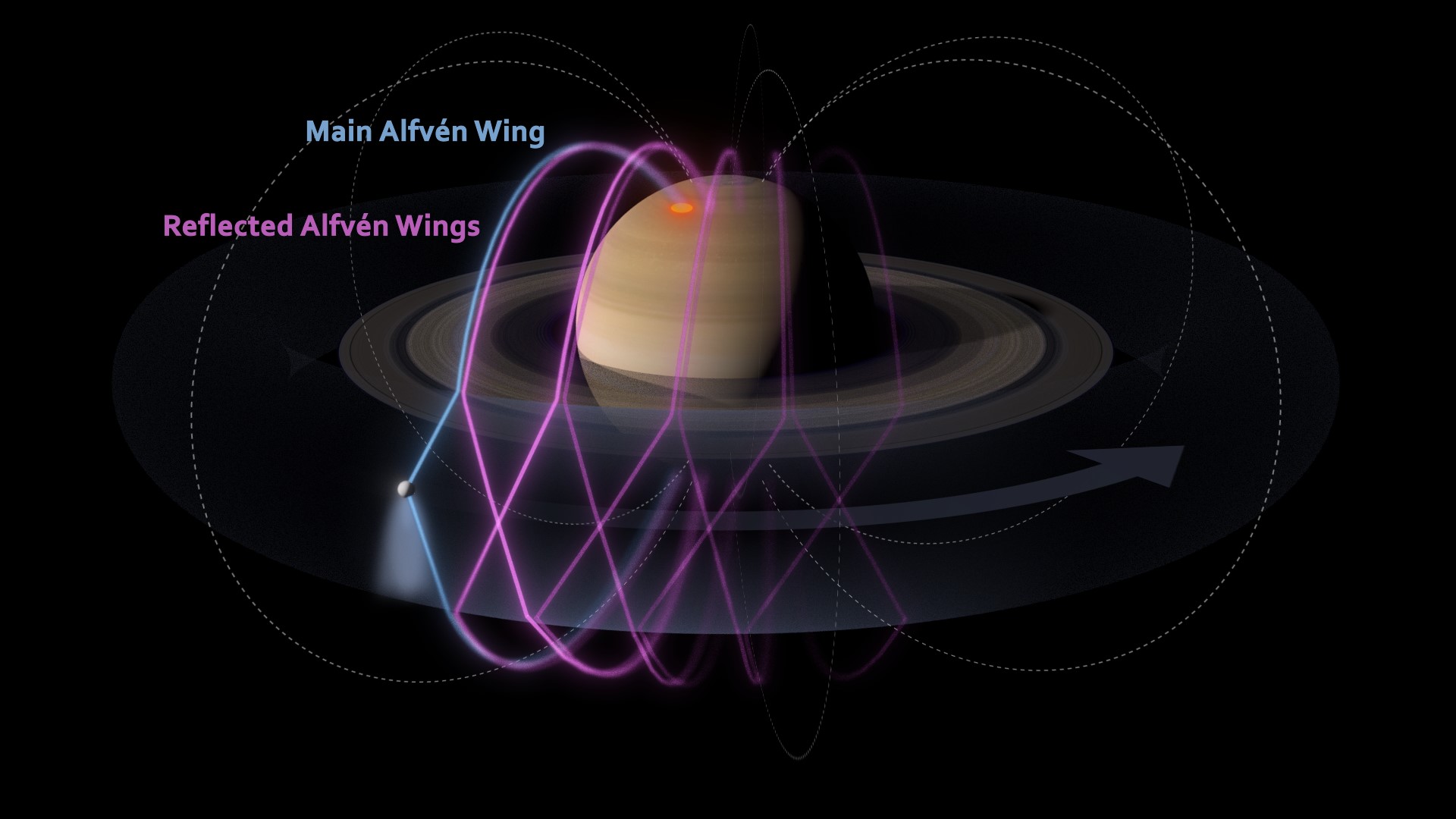
The study, published in the Journal of Geophysical Research: Space Physics, shows how wave structures, known as ‘Alfvén wings’, travel like vibrations on a string along magnetic field lines connecting Enceladus to Saturn’s pole. The initial ‘main’ Alfvén wing is reflected back-and-forth both by Saturn’s ionosphere and the plasma torus that encircles Enceladus’s orbit, resulting complex and structured system. By using a multi-instrumental approach, researchers were able to show that the influence of Enceladus extends over a record distance of over 504,000 km – more than 2,000 times the moon’s radius.
“This is the first time such an extensive electromagnetic reach by Enceladus has been observed, proving that this small moon acts as a giant planetary-scale Alfvén wave generator,” said Thomas Chust of LPP, co-author of the study. “This work sets the stage for future studies of other systems, such as the icy moons of Jupiter or exoplanets, by showing that a small moon with an electrically-conducting atmosphere can influence its host over vast distances on the scale of the giant planet itself.”
The researchers examined archive data from the suite of instruments carried by Cassini to study electromagnetic wave and particle interactions, looking for flyby and non-flyby paths near Enceladus that showed evidence of magnetic connections between the moon and Saturn. On 36 occasions, they found signatures related to Alfvén waves, including at much further distances than they originally anticipated.
As well as the large-scale structures, the team found evidence that turbulence teases out the waves into filaments within the main Alfvén wing. This fine-scale structure helps the waves bounce off Enceladus’s plasma torus and reach the high-latitudes in Saturn’s ionosphere where auroral features associated with the moon form.
“These results highlight the importance for future missions to Enceladus, such as the planned ESA orbiter and lander in the 2040s, to carry instrumentation that can study these electromagnetic interactions in even more detail,” said Hadid.
The study was led by LPP in collaboration with researchers from French laboratories including IRAP, ISAE-SUPAERO, LATMOS, LAM, and LIRA/Observatoire de Paris. International institutions participating in the study included ESA, IRFU in Sweden, MPS in Germany, CAS in the Czech Republic, Johns Hopkins APL, UCLA, the Universities of Michigan, Boston, and Iowa in the United States, DIAS in Ireland, MSSL/UCL, and Imperial College London in the United Kingdom. The CDPP/AMDA tool used in the study was supported through the Europlanet 2024 Research Infrastructure project with funding from the European Commission.
Publication
Hadid, L. Z., Chust, T., Wahlund, J.‐E., Morooka, M. W., Roussos, E., Witasse, O., et al. (2026). Evidence of an extended Alfvén wing system at Enceladus: Cassini’s multi‐instrument observations. Journal of Geophysical Research: Space Physics, 131, e2025JA034657. https://doi.org/10.1029/2025JA034657
Images and Animation
Animation Caption: Animation of the electrodynamic interaction between Enceladus and Saturn. The primary Alfvén wing is shown in blue, and the reflected Alfvén wings in magenta. The arrow indicates the corotation direction of the Enceladus plasma torus. Relative sizes of Saturn and Enceladus are not to scale. Design & Animation: Fabrice Etifier – École Polytechnique.
Image Caption: Illustration of the electrodynamic interaction between Enceladus and Saturn. The primary Alfvén wing is shown in blue, and the reflected Alfvén wings in magenta. The arrow indicates the corotation direction of the Enceladus plasma torus. Relative sizes of Saturn and Enceladus are not to scale. Design & Animation: Fabrice Etifier – École Polytechnique.
Image Caption: Plumes of water vapour and dust stream through cracks in the icy surface of the southern hemisphere of Enceladus. The water molecules and particles from these geysers become ionised when exposed to radiation, creating an electrically-charged plasma that interacts with Saturn’s magnetic field as it sweeps past Enceladus. Credit: NASA/JPL/Space Science Institute.
Europlanet (europlanet.org) is a non-profit association and membership organisation that provides the planetary science community with access to research infrastructure, services and training. The Europlanet Association Sans But Lucratif (AISBL), established in 2023, builds on the heritage of a series of projects funded by the European Commission between 2005 and 2024 (Grant Numbers 871149, 654208, 228319 and RICA-CT-2004-001637) to support the planetary science community in Europe and around the world.
Europlanet Transnational Access Call 2026 – Free Access to Facilities
Europlanet has launched a new call for Transnational Access (TA), which enables researchers who are members of Europlanet (individual members or staff working for organisational members) to visit participating facilities that offer simulation and analysis capabilities relevant to planetary science.
The Europlanet TA Programme 2026 offers access to 25 facilities in ten internationally renowned research centres in Europe and South Korea. The facilities are tailored for the simulation or characterisation of planetary conditions and materials. The programme supports all travel and local accommodation costs for researchers during their visit to participating facilities.
If you are interested in submitting an application to the Europlanet TA Call 2026, check out the call page to find more information about the call and how to submit your application. Please note that you must contact the facility to discuss the feasibility of your proposal before submitting your application. The call will close on 16 March 2026.
You should plan for your visits to take place between the end of April and December 2026. Please note that some facilities are only available in certain months, or have pre-requirements for applications. See the individual facility pages for details.
Building on the European Commission-funded TA programme from 2009-2024, Europlanet now offers a sustainable programme of annual TA calls funded through membership subscriptions.
For the 2026 Call, we are delight to welcome new institutions and/or new facilities that will be offered for Transnational Access through Europlanet for the first time. These include:
The Call for Sessions for the Europlanet Science Congress (EPSC) 2026 is now open!
EPSC2026 will be held at AMARE in The Hague, Netherlands, from 6–11 September 2026.
The success of EPSC is founded on the excellence of the scientific sessions organised by the session conveners. The community is therefore encouraged to submit session proposals through the conference website by 4 March 2026.
Please suggest new sessions, with conveners and a description, within the programme group (PG) that is most closely aligned with the proposed session’s subject area. Co-organisations with other PGs can be requested in the session proposal.
Small Bodies (comets, KBOs, rings, asteroids, meteorites, dust) (SB)
Exoplanets, Origins of Planetary Systems and Astrobiology (EXOA)
Outreach, Diversity, Amateur Astronomy, and Community (ODAC)
From 2026, EPSC actively encourages the proposal of sessions on community-based topics (e.g. early-career activities, sustainability and/or environmental impact, capacity-building, interdisciplinary and cross-community collaborations) as part of the renamed ODAC PG.
New Year’s Day 2026 is Europlanet’s 21st birthday. To celebrate, we highlight 21 things that Europlanet has achieved since its foundation on 1 January 2005.
The Europlanet Science Congress
Opening ceremony of EPSC-DPS2025. Credit: Europlanet.
First held in Berlin in 2006, the Europlanet Science Congress (EPSC) is the largest annual meeting on planetary science in Europe and regularly attracts over 1200 participants. Its interdisciplinary, interactive and adaptive format makes EPSC an ideal place for the global planetary community to share ideas and build new connections. Joint meetings with the American Astronomical Society’s Division of Planetary Sciences (DPS) and the European Astrobiology Network Association (EANA) have brought together even bigger international and cross-disciplinary audiences, with the recent EPSC-DPS2025 in Helskinki becoming the largest planetary meeting to date in Europe with 1800 participants.
Research and Technology Infrastructure
The Laboratory of Electron Induced Fluorescence at Comenius University. Credit: Comenius University.
Europlanet provides access to state-of-the-art research and technology infrastructure (RTI) to support planetary science and space exploration. The distributed RTI includes facilities for the simulation of planetary environments, analysis of planetary samples, testing and development of space technologies, and support of interdisciplinary studies. Our Transnational Access (TA) programme is designed to allow researchers from anywhere in the world, and at all career stages, to have access to facilities to support scientific and technological excellence in planetary/space research and to foster international collaborations. To date, Europlanet has funded over 600 research visits, amounting to in excess of 5,500 days of access (15 years), involving over 800 individual researchers accessing 23 laboratories (with over 80 individual facilities), 12 planetary analogue field sites and 17 telescopes.
Europlanet is a grass-roots organisation, supported by individual members since 2018 and organisational members since 2025. Membership benefits include discounted fees for EPSC, access to facilities, expert exchanges, webinars, training, workshops, funding schemes and much more. Join now to help us continue our mission to support the planetary community around the world.
Participants at EPEC Annual Week 2025. Credit: EPEC.
The Europlanet Early Career (EPEC) network is organised by early-career researchers for early-career researchers, and includes volunteers from across the Europlanet international community. The EPEC network is open to all students, doctoral candidates and early-career planetary scientists and space professionals whose last degree (e.g. MSc or PhD) was obtained a maximum of 7 years ago (excluding parental leave, serious illness and similar delays).
EPEC’s activities, including Annual Week and EPEC@EPSC, aim to form a strong network between young professionals by organising early-career-relevant events and by engaging in different projects amongst different focus areas (outreach, diversity, early career support). As early careers comprise over half Europlanet’s individual members and attendees at EPSC, EPEC ensures that the (scientifically) young members of our community have a clear voice within Europlanet to shape the future of planetary and space sciences and engineering.
The launch of the Europlanet Colombia Regional Hub in November 2025. Credit: Europlanet Colombia.
Europlanet’s Regional Hubs support the development of planetary science at a national and regional level, particularly in countries and areas that are currently under-represented within the community. Our Hub Committees organise networking events and workshops to support the research community, as well as to build links with amateur astronomers, industrial partners, policymakers, educators, the media and the wider public. In addition to 10 European Regional Hubs, a Colombian Regional Hub was established in 2025 to support the community in Colombia and Latin America.
Projects
The launch of the European Planetology Network (EuroPlaNet) in 2005. Credit: Europlanet.
Europlanet was founded as a Coordination Action funded by the European Commission (EC) in 2005-2008 to promote networking, support the sharing of resources and overcome fragmentation in the European planetary science community. Through a series of further EC grants awarded between 2009 and 2024, Europlanet has subsequently developed into a global distributed research infrastructure that offers coordinated access to services and facilities spread over 5 continents, supporting a community of thousands of users in academia, industry and in the wider community. In total, the EC has invested €28 million in Europlanet to support the planetary community.
Europlanet has received funding from the European Commission under Grant Numbers 871149, 654208, 228319 and RICA-CT-2004-001637.
VESPA
Superimposed olivine map from OMEGA / Mars-Express in N Syrtis Major area (Jezero crater is at the bottom), displayed in the Aladin service and accessed through VESPA. Credit: Aladin.
VESPA (Virtual European Solar and Planetary Access) is a web-based search interface to identify and access planetary science and heliophysics data provided by the science community. Developed through EC-funded Europlanet projects, and hosted and maintained by the Observatory of Paris, VESPA is freely available to researchers and the general public. The VESPA portal supports user-friendly searching on metadata associated with generic observation conditions (such as target, instrument, time/space/spectral coverages, illumination conditions, etc) and metadata specific to each dataset (such as instrumental parameters) via the EPN-TAP protocol, which is now a standard of the International Virtual Observatory Alliance (IVOA) for Solar system data. Nearly 250 EPN-TAP data services of various size are declared in the IVOA registry, of which 94 are currently validated and accessible via the portal – including ESA’s Planetary Science Archive (PSA). VESPA also offers an easy solution for small teams to share newly-derived data from a publication or a research project.
SPIDER
Europlanet’s SPIDER Planetary Space Weather Services provide contextual information on predictions and alerts for planetary space weather analysis and payload or spacecraft operations. SPIDER enables researchers to take advantage of data from a suite of missions at different points in the Solar System. Applications of SPIDER’s tools have led to several high-impact publications, and have been used to support planning of the BepiColombo and Juice missions. Opportunities identified through SPIDER for synergistic observations by BepiColombo during its cruise phase with the Solar Orbiter and Solar Parker Probe missions have also been implemented by ESA and JAXA.
GMAP and Winter School
GMAP Winter School Banner 2026.
The Geological Mapping (GMAP) activity provides a complete infrastructure for the geological mapping of planetary bodies. As well as everything needed to create planetary maps, GMAP provides guidelines and insights on how to produce effective mapping products for scientific exploitation, as well as information on how to display and archive results in a structured way.
GMAP supports researchers who are interested in learning how to build their own mapping products, as well as mappers who want to learn how to incorporate other types of data analysis into their products.
One of GMAP’s major successes has been the establishment of the annual Geology & Planetary Mapping Winter School. Now in its fifth iteration, the Winter School provides training for anyone interested in planetary mapping to build knowledge and skills in planetary mapping. Participants can follow synchronously or asynchronously to accommodate different time zones. The 2026 edition will run from 26-30 January 2026.
Amateur astronomer, Florence Libotte (centre) with astronomers Erika Pakštienė (left) and Gražina Tautvaišienė (right) at the Moletai Observatory, Lithuania.
The Europlanet Telescope Network brings together medium and small telescopes to facilitate and coordinate observations related to planetary science. Founded in 2020, the telescope network has awarded 256.5 observing nights and supported 44 projects on planetary topics from near Earth objects to exoplanets, as well as astrophysical subjects including black holes and binary star systems. As well as supporting the professional scientific community, the Europlanet telescope Network has provided access and training for amateur astronomers to enable them to contribute to planetary research. Since the end of the EC-funded project, the Europlanet Telescope Network has maintained a list of telescopes willing to offer observing time to the community. The Europlanet Telescope Network currently unites 21 observatories with 32 telescopes in 16 countries.
Europlanet holds monthly webinars on a range of topics from science to policy, diversity and outreach. Quarterly webinars are also co-organised with the Science Team of the ESA Juice mission.
Europlanet webinars provide quarterly updates on the JUICE mission on its long journey to reach and explore Jupiter and its icy moons. Credit: ESA/ATG medialab/NASA/JPL/J Nichols/U Leicester/U Arizona/DLR.
Group photo of in-person participants at ERIM 2023 in Bratislava, Slovakia. Credit: Europlanet/J-D Bodénan.
In addition to EPSC and EPEC Annual Week, Europlanet organises a range of meetings, summer schools, workshops and training sessions to support the community. Our interactive online Teams Days, held 2-3 times per year, are an opportunity for the community to provide input and feedback into Europlanet’s strategy and operations. The Europlanet Research Infrastructure Meeting (ERIM) in 2023 comprised a series of interactive workshops with the aim of promoting collaboration across the Europlanet community. More recently, policy workshops organised in partnership with other research infrastructures have helped share information on upcoming opportunities and best practice for distributed RIs.
In total, over the past two decades, Europlanet has provided training for over 7,500 members of the planetary community, with a particular focus on early career researchers.
Join hundreds of other Europlanet members on our Discord server to keep up with news, events, job opportunities and to connect with colleagues around the world. The server is designed with a variety of channels to facilitate discussions and interactions, including text channels, discussion forums and voice channels. We also hold regular informal catch ups and science discussion ‘hangouts’.
Europlanet is committed to building a diverse, inclusive planetary science and ensuring that individuals within that community experience equal opportunity, regardless of gender, disability, ethnic origin, religion or belief, sexual orientation, marital status, age, nationality or socioeconomic background. The Europlanet Diversity Committee acts as a strategic task force to advise, coordinate and champion activities across Europlanet that further the association’s commitment to equality, diversity and inclusivity. As well as activities around EPSC, the Diversity Committee organises events to raise awareness of diversity, inclusivity and accessibility in the planetary community, such as through the Planetary Science Wiki Edit-a-thon.
Outreach
Outreach and education have been a core part of Europlanet initiatives since its foundation the early 2000s. Our objective is to support the planetary science community at a grass roots level to do more public engagement and educational activities, and to share best practice, training and resources to increase the impact of those efforts. Over 20 public engagement and education projects have been supported with more than 135,000€ of seed funding by Europlanet.
The Outreach Working Group coordinates activities, such as EPSC Goes Live for Schools, funding programmes, sharing of best practice and the annual prize for Public Engagement.
Policy and Industry
Europlanet exhibition in the European Parliament. Credit: Europlanet.
Europlanet engagement with policy makers and industry aim to build collaborations and create synergies between cutting-edge science and the technological challenges of planetary science and exploration.
Europlanet has organised and participated in briefings, events, conference sessions (e.g. at EPSC) and other opportunities to engage policy makers in the European Parliament and the European Commission with planetary science, as well as engage with high-level representatives of ESA, NASA and other national and international space agencies. Organising events within the European Parliament has proved an effective platform to develop relationships with MEPs and other stakeholders, enabling the community to feed into discussions on future funding and policies relevant to planetary science.
Industry engagement activities have included organising technology foresight workshops, collaborations with space industry trade associations, developing contacts and networks within industry, participating in industry conferences and events, and convening industry and policy sessions at EPSC.
Europlanet’s distributed infrastructure offers industrial partners access to simulation and testing facilities for a range of environments that planetary and space missions may encounter through launch to their destination in orbit or on a planetary surface. By accessing Europlanet facilities, companies and SMEs can increase the value of their technology by increasing the Technology Readiness Level (TRL), understanding how instrumentation operates under realistic planetary conditions, or by identifying potential issues. Several of our RTI facilities are operated by commercial organisations.
Collaborations
Collaborations stimulated through Europlanet, and involving its beneficiaries, have led to several successful proposals for new projects funded through the European Commission and national agencies. From the development of Machine Learning tools to mobilising researchers in Africa, these external projects act as multipliers for the impact of Europlanet in many different communities.
Expert Exchanges
Expert exchange to observing the DART impact in Kenya. Credit: The Travelling Telescope.
Europlanet’s Expert Exchange Programme aims to support the mobilisation of the planetary community to share expertise and best practice and to prepare new facilities and services for integration into Europlanet’s research infrastructure. The programme provides funding for short visits (up to one week) and over the last two decades, more than 200 expert exchanges have been supported.
Topics for visits have included training on the use of instrumentation, short scientific projects, improvements to facilities and the development of outreach collaborations. Evaluation of the visits show that bringing individuals together to exchange expertise often leading to synergies that would not happen otherwise, particularly for researchers from under-represented countries. The programme has also supported the professional development of early career scientists, helping them to prepare for careers outside academia.
Tactile Mars exhibit from the Planets in Your Hand exhibition funded by Europlanet in 2017. Credit: Kosmas Gazeas.
Europlanet offers funding and bursaries to support the community in various ways. Each year, we provide over 100 bursaries for early career and researchers from under-represented countries to attend EPSC. The Committee Funding Scheme offers grants of up to 5000 € to support the scientific, community-building and outreach activities of our members.
Europlanet recognises the contributions of the planetary science community through a range of medals, prizes and other awards. The Europlanet Medals, launched in 2025, honour outstanding contributions from individuals of three different scientific career-stages to the subjects covered by the Europlanet Science Congress (EPSC). The Europlanet Prize for Public Engagement with Planetary Science is also awarded to individuals or groups who have developed innovative and socially impactful practices in planetary science communication and education. The EPSC Outstanding Poster Competition recognises the work of early career researchers at EPSC.
Impact
Fernando Gomez from Argentina participated in a Transnational Access visit to facilities at the Korean Basic Science Institute (KBSI). Credit: F Gomez.
Europlanet activities are evaluated against a framework of core indicators for assessing scientific, technological, education and training, economic, and social and societal impacts. Evaluation shows that the impact of activities to date have been particularly strong in the scientific, technological, education and training areas.
The 197 Transnational Access projects supported through the most-recent Europlanet 2024 RI project are expected to lead to over 300 publications and 400 conference presentations. Interviews and follow-up surveys show that over 90% of visitors are planning future collaborations with their host facility. In particular, early career researchers and students report that the TA programme provides them with opportunities – including collaboration and network-building – that would not otherwise have been available to them, thus accelerating their career development.
Upgrades to facilities have provided increasing support for local infrastructure and associated employment, and there has been at least one SME company that was developed as a result of the TA programme.
The new Europlanet Evaluation Unit now offers evaluation support and consultancy for external organisations that would like to develop an evaluation framework or implement an impact evaluation of their activities.
Teamwork
Europlanet’s existence and continued activities would not be possible without the support of many individuals and organisations. In particular, we would like to thank our Executive Board, Committees and Working Groups for their huge investment of time and energy in making Europlanet a thriving and vibrant community. We thank our individual and organisational members for supporting us and participating in our activities. We are also indebted to the European Commission for funding over the years, as well as our project officers at the EC for their support, guidance and advice.
Europlanet 2024 RI has received funding from the European Union’s Horizon 2020 research and innovation programme under grant agreement No 871149.
A New Era in European Space Exploration and Technologies
Comment by Prof Nigel Mason, Europlanet Research Infrastructure Coordinator.
At the recent Ministerial meeting held in Bremen, Germany, on 26-27 November 2025, ESA obtained outstanding support from its Member states with a record budget of €22.3bn — a 31% increase in budget that is envisaged to be some 17% ahead of inflation. This budget ensures support for key science, exploration and technology programmes alongside a significant increase in the budget of space applications (Earth observation, navigation and telecommunications).
This announcement is good news for our community — indeed planetary and Solar System science is well represented in the core missions and programmes ESA plans for the next decades. ESA will deliver the missions described by the Cosmic Vision long-term plan, including the Rosalind Franklin Mars rover (with a launch date in 2028) and Envision to Venus, as well as preparing missions to the Moon, the most important being the Argonaut lander. Funding is allocated to support a new and highly ambitious mission to search for life on Enceladus with the large-class ‘L4’ mission to Saturn and its moons. The technology to support this programme and ESA’s other innovative missions will be developed using a substantially strengthened budget for technology enablers, critical components, digitalisation and emerging technologies
Three important missions account for the majority of funding in space safety and security: Ramses, Rise and Vigil. The Ramses mission, to be built on a tight schedule to intercept the asteroid Apophis on its close encounter with Earth in 2029 is funded, and will help to prepare for future potentially hazardous asteroids. The Vigil space weather mission is expected to undergo preliminary design review early next year. To reduce waste in space in the future, the testing of on-orbit servicing will be funded through Rise, a partnership with industry. In addition, the Moonlight programme will develop lunar communications and navigations services.
In a reflection of the times we are living in, the ESA budget must also address the critical role of space in security and resilience. Indeed, we must address the need for space infrastructures and research to be increasingly ‘dual use’ with a defence as well as a civil role. In an historic change for ESA, significant funding will go towards the use of space applications for non-aggressive defence. A letter of intent has been signed with Poland to examine the possibility of hosting a new centre specialising in security and dual-use/multi-use applications.
Thus, there is much in the ESA plans that will secure Europe at the forefront of space exploration and technologies. However, this will require a strong, integrated and well-organised planetary community, and this is an area where Europlanet can play a unique role. Indeed, in early 2026 Europlanet will hold meetings with ESA Science and Human and Robotic Exploration teams to discuss how our community can help support ESA in delivering its ambitious mission.
There has never been a better time for you as individuals and your institutions to join Europlanet to help deliver the future of space exploration and technologies!
EPSC is a scientific congress that places an emphasis on sharing values on high-quality science, inclusiveness, and transparency. In our commitment to keep the EPSC an open scientific forum for scientists at any career stage level, the EPSC Executive Committee has launched a Call for Members of the Scientific Organizing Committee (SOC).
The new mandate for the SOC is valid for the 2026/27 two-year period. The structure of the SOC will be divided into the six Programme Groups (PGs) of the EPSC conference:
Small Bodies (comets, KBOs, rings, asteroids, meteorites, dust) (SB)
Exoplanets, Origins of Planetary Systems and Astrobiology (EXOA)
Outreach, Diversity, Amateur Astronomy, and Community (ODAC)
The number of SOC members in each PG will be between 2 and 4, depending on the size of the PG itself. Ideally, each PG will be assigned both senior and early-career scientists, and the gender balance will also be considered.
To apply, please send an email with the subject “EPSC SOC 2026 membership application” to Stavro Ivanovski (stavro.ivanovski@inaf.it) and Giovanni Poggiali (giovanni.poggiali@inaf.it) expressing your interest in joining the SOC, indicating your preference for the PG you would like to participate in, with a few sentences that summarize your scientific fields of interest and expertise. Furthermore, attached to the email a CV of two pages.
New members are expected to commit to the SOC duties and to be involved in organizing the conference. In particular, SOC members have:
To solicit the scientific community to submit sessions and to create sessions if important and/or breakthrough scientific content is missing.
To review the submitted sessions
to verify that the most important areas of research relevant to the PG topic are covered, and
to add missing sessions, if necessary.
To participate actively in the EPSC SOC meetings and to respect the deadlines.
To participate in the EPSC within the limits of your possibilities and support the EPSC Executive Committee to ensure a smooth execution.
To act as session convener if necessary.
Before applying, please note that part of the activity needs to be done online in the summer months. Please also note that participating in EPSC SOC is a volunteering activity, and no reduction of registration fees or any other financial benefits are awarded to the SOC members (all EPSC Executive Committee members pay the regular fees).
Please send your applications by 13 January 2026. If you are selected, you will be notified by the end of January.
The support of the SOC members of the EPSC is fundamental, and without their enthusiastic work, the conference simply cannot be realized. In the past years, the SOC members have conducted EPSC meetings of a very high level of scientific content and effective collaborations so far. We are deeply thankful to all past SOC members for their dedicated work.
The call to host the Europlanet Science Congress (EPSC) in 2028 or 2029 is now open. EPSC is the major European meeting on planetary science, regularly attracting over 1200 participants from around the world, and is the annual meeting of Europlanet.
The deadline for applications is 15 February 2026.
Top level requirements:
EPSC 2028 and 2029 should be hosted in a European city under the responsibility of a very motivated and very capable Local Organisation Committee (LOC) led by a research institute/research organisation with close links to the local planetary science community. The proposed venue should be able to accommodate 1200-1500 participants onsite and offer options to allow hybrid access for virtual participation.
Facilities should include a large auditorium for 400+ participants, a large lecture hall for 200+ participants, 3-4 rooms for up to 200 participants, and 2-3 rooms for up to 100 participants, as well as 4-9 smaller rooms for splinters, workshops, press conferences etc.
The venue should include areas for coffee breaks, seating and working spaces, as well as the capacity to display 300 posters (300 single sided or 150 double-sided and to accommodate 15-25 exhibition booths. All facilities, including venues for proposed social event(s), should be of high-quality and accessible to all attendees, including those with reduced mobility and wheelchair users.
The venue should be in a safe and attractive location with excellent transport links (at both an international and local scale). Low-cost transportation and suitably priced accommodation for students should be available.
Process:
Candidate host institutes/organisations are welcome to apply for either or both 2028 and 2029. The preferred timing is early-mid September, avoiding holidays (e.g. Yom Kippur).
To respond to this call, please download the application pack. The application pack contains a detailed summary of the venue requirements, as well as a set of guidelines that draw on the experience of past EPSC hosts.
Applicants should fill in the application form below and submit:
A document setting out your proposal in full, addressing all the areas listed in the venue requirements.
A completed EPSC Proposal Budget Template (Excel spreadsheet in the application pack).
A completed EPSC Room Requirements Template (Excel spreadsheet in the application pack).
Apply to join the Europlanet GMAP Winter School, which will take place from 26-30 January 2026. The Winter School, which allows both synchronous and asynchronous participation, is focused on the production of planetary geological maps of a range of Solar System bodies.
Building on past editions, the 2026 edition will cover introductory knowledge about planetary data, coordinate reference systems and software tools, the geology of key features on Mars, Earth and the Moon, and feasibility studies for future exploration.
The GMAP Winter School is organised by Europlanet, a non-profit association for the advancement of planetary science, and is open to Europlanet members (both individual members and staff of organisational members).
Blue Skies Space Launches Satellite to Study the Hidden Lives of Stars
Blue Skies Space, a UK-space science data company, has successfully launched its first satellite, Mauve, marking the start of a three-year mission to study the stars and how their activity influences the habitability of distant exoplanets.
The satellite was launched aboard SpaceX’s Transporter-15 on 28 November 2025 at 18:45 GMT. This marks a major milestone for the company and the beginning of its mission to deliver science data from space in a fast and cost-effective way.
Research institutions worldwide have already secured subscriptions to access data collected by Mauve. These include Boston University, Columbia University, INAF’s Osservatorio Astrofisico di Arcetri, Konkoly Observatory, Kyoto University, National Astronomical Observatory of Japan, Maynooth University, Rice University, Vanderbilt University, and Western University.
“Mauve will open a new window on stellar activity that has previously been largely hidden from view,” said Professor Giovanna Tinetti, Chief Scientist and Co-founder of Blue Skies Space. “By observing stars in ultraviolet light, wavelengths that can’t be studied from Earth, we’ll gain a much deeper understanding of how stars behave and how their flares may impact the environment of orbiting exoplanets. Traditional ground-based telescopes just can’t capture this information, so a satellite like Mauve is crucial for furthering our knowledge.”
“Our vision is to make space science data as accessible as possible,” said Dr Marcell Tessenyi, CEO and co-founder of Blue Skies Space. “Mauve will undergo commissioning before delivering datasets to scientists in early 2026 and serve as a springboard to launch a fleet of satellites addressing the global demand for space science data.”
About Mauve
Mauve, Blue Skies Space’s first satellite, will measure the activity of nearby stars, helping scientists understand the impact of powerful stellar flares on exoplanets and the prospects of harbouring life. Mauve is a small satellite that will operate in low-Earth orbit, equipped with a 13 cm telescope to observe stars in the ultraviolet and visible wavelengths (200-700 nm).
Mauve was built by a consortium of European companies and launched within 3 years of conception, a fast timeline for science satellites. C3S LLC, based in Hungary, is the spacecraft’s prime and platform provider, with ISISPACE of the Netherlands providing the pointing solution.
Wavelength Coverage
200 – 700 nm (UV – Visible)
Telescope
13 cm Cassegrain
Spectral Resolution
10.5 nm (max R=65)
Detector
CMOS Linear Array
Mass
18.6 kg
Orbit
LEO 10:30 LTAN, 500 km
Mauve’s data is made available to participating researchers through a three-year science programme, with those who sign up early being able to lead and shape the observational programme each year. Mauve’s current research priorities are:
Stellar flares: Some of the coolest stars are subject to large explosions (flares) that produce high-energy emissions, occasionally outshining the star itself. Studying these events helps scientists understand how magnetic fields accumulate and release large amounts of energy, and understand similar events produced by our Sun.
Young exoplanet hosts: Young stars with planets still taking shape around them reveal the early stages of planetary evolution. By studying these systems, scientists trace how planets grow, migrate, and settle into their mature orbits — offering clues to the history of our own Solar System.
Hot stars: Hot stars emit abundant ultraviolet radiation, and Mauve will study both the youngest ones, surrounded by clouds of gas and dust, and some of the older ones, rapidly rotating and shedding material into surrounding disks of gas, affecting their evolution.
Binary stars: Systems where two stars orbit one another are vital for testing theories of gravity, stellar mass, and evolution. Because their mutual orbits can be measured precisely, binaries offer the most accurate way to determine stellar masses, anchoring models of how all stars live and die.
The project has received funding from the European Union’s Horizon Europe research and innovation programme under grant agreement No. 101082738 and is supported by the UK Research and Innovation (UKRI)’s Horizon Europe Guarantee Scheme.
About Blue Skies Space
Blue Skies Space is a company pioneering a new model to deliver high-quality space science data in accelerated timescales to the global scientific community, helping them to answer humanity’s greatest scientific questions. Through a fleet of low-Earth orbit satellites, the company aims to serve the global demand for high-quality science data across many research areas, including the monitoring of stars, understanding what the atmospheres of faraway exoplanets are made of, as well as the composition of asteroids in our Solar System.
With offices in the UK and Italy, Blue Skies Space has assembled an experienced team that has previously worked at organisations such as NASA, Airbus, Surrey Satellite Technology, Caltech and UCL, bringing a wealth of expertise in space science, satellite engineering, satellite construction and operations.
The first Europlanet Regional Hub outside Europe, Europlanet Colombia, was launched on 8 November 2025 during an event attended by 120 people at the Maloka Interactive Science and Technology Centre in Bogotá.
The inauguration event highlighted some of the most significant national research initiatives that relate to planetary science and provided an opportunity to find out more about and engage with Colombians who work in this area. Speakers included Dr Alejandro Guerrero-Caicedo (Universidad del Valle) and Dr Alberto Benavides-Herrán (Pontificia Universidad Javeriana) who travelled from Cali to attend. Members of RECA Educación, winners of the Europlanet Prize for Public Engagement 2025, gave a presentation on their work to engage schools and students across Colombia. Video messages were sent by Dr Heidy M. Quitián-Lara, Dr Felipe Fantuzzi, Dr Jonathan Pelegrin and Dr Tatiana Bocanegra, as well as Prof Nigel Mason, the former President of Europlanet.
The aim of Europlanet Colombia is to create a space where knowledge and passion for the cosmos intertwine, promoting collaborative networks that will drive the region’s scientific future and strengthen high-impact research. This new Europlanet contact point in Colombia will foster collaboration on cutting-edge projects across a wide range of disciplines, including:
Solar System Bodies
Astrobiology and the Origins of Life
Planetary Formation and Evolution
Planetary Environments
Space Exploration and Instrumentation
Planetary Geosciences
Astrochemistry
Astronomical Instrumentation, Data Acquisition, Management, and Analysis
Science Education and Public Outreach
Heritage Astronomy and Indigenous Knowledge Systems
Europlanet provides the research and technology infrastructure (RTI) needed to address the major scientific and technological challenges facing modern planetary science and space exploration.
Our distributed RTI provides access to state-of-the-art facilities for simulation of planetary and wider space environments, analysis of planetary samples, testing and development of space technologies, and support of interdisciplinary studies.
Europlanet’s flagship Transnational Access (TA) programme is designed to allow researchers from anywhere in the world, and at all career stages, to have access to facilities to support scientific and technological excellence in planetary/space research and to foster international collaborations.
Facilities offered through the Europlanet Transnational Access programme include the Accelerator Mass Spectrometry Carbon-14 Dating (AMS C14) at Isotoptech Zrt, the Atomki Ice Chamber for Astrophysics/Astrochemistry (ICA) at Atomki and SHRIMP at the Korean Basic Science Institute.
Call Launched for Europlanet – Korean Distinguished Scholar Invitation Programme
The Korean Basic Science Institute (KBSI) is offering Europlanet members the opportunity to spend an extended period (10-15 months) in Korea to carry out a research project. A call is now open for applications to the Europlanet – Korean Distinguished Scholar Invitation Programme, which is funded by the National Research Foundation (NRF) of Korea. This is a rolling call – applications will be reviewed on receipt.
In order to qualify for the Europlanet – Korean Distinguished Scholar Invitation Programme, applicants should have a permanent position or be recently retired.
Applications will be evaluated through an independent peer review process. While the programme is designed to primarily support planetary science (and Earth sciences), applications from other research disciplines may also be considered based on innovation and potential scientific and technological impact.
This call will support visits starting in mid-2026. Depending on whether the opportunities are filled in the first round, a further call may be announced in the summer of 2026 for visits to take place in 2027.
Find out more about the programme, the facilities that will be accessible to participants, and the application process on the Call Page.
The ‘Tea on The Moon‘ team met with Europlanet colleagues at the University of Kent to discuss the status of the project and future plans. Project collaborator, Maarten Roos, visited from the Netherlands on Friday 31 October.
The team of interdisciplinary scientists toured the plant labs, X-ray Diffraction, Ramen Spectroscopy, Scanning Electron Microscope, Space Simulation Chamber, Origins of Life and Light Gas Gun facilities at the University of Kent.
‘Impact, Industry Engagement, Research Security and Dual Use’ Workshop at Industriens Hus, Copenhagen
Around 30 representatives of a diverse range of research infrastructures gathered at Industriens Hus, Copenhagen, Denmark and online from 20 – 21 October 2025 for a hybrid workshop ahead of the Research and Technology Infrastructures (RTI) Summit 2025.
The meeting, which was co-organised by Aarhus University, the European Science Foundation and Europlanet, included a workshop on impact evaluation. Presentations and discussions covered industry engagement, research security and Dual Use, as well as upcoming opportunities within Horizon Europe and an update on a new journal focused on RIs.
The session also included an update on a White Paper on Distributed Research Infrastructures, which was discussed at the previous workshop in Krakow in June 2025. The title of the White Paper has been updated to: ‘Towards an Inclusive Framework for Europe’s Research Infrastructures: Embracing diversity in form, theme, and scale.’
In line with feedback from the Krakow meeting, additional adjustments have been made to reflect that issues in visibility in European RI policy for many RIs do not specifically originate from the size but more from the form and the prioritisation of the ESFRI Roadmap RIs and ERICs. The White Paper concludes that: ‘A resilient, adaptable, and dynamic research ecosystem requires strategic support for all RIs.’ The new version has been submitted to the European publication platform Open Research Europe (ORE) for final review.
Images
Presentations
Horizon Europe Updates – Nigel Mason (Europlanet / University of Kent)
Many thanks to Jonathan Merrison and Industriens Hus for hosting the meeting.
Europlanet 2024 RI has received funding from the European Union’s Horizon 2020 research and innovation programme under grant agreement No 871149.
Europlanet AISBL (Association Internationale Sans But Lucratif – 0800.634.634) is hosted by the Department of Planetary Atmospheres of the Royal Belgian Institute for Space Aeronomy (BIRA-IASB), Avenue Circulaire 3, B-1180 Brussels, Belgium.