EPSC-DPS2025: Study Questions Ocean Origin of Organics in Enceladus’s Plumes 

EPSC-DPS2025: Study Questions Ocean Origin of Organics in Enceladus’s Plumes 

Joint Meeting of the Europlanet Science Congress and the American Astronomical Society’s Division for Planetary Science (EPSC-DPS2025) Press Release

EMBARGOED FOR 08:00 EEST (05:00 UTC) ON TUESDAY, 09 SEPTEMBER 2025

Organic molecules detected in the watery plumes that spew out from cracks in the surface of Enceladus could be formed through exposure to radiation on Saturn’s icy moon, rather than originating from deep within its sub-surface ocean. The findings, presented during the EPSC–DPS2025 Joint Meeting in Helsinki this week, have repercussions for assessing the habitability of Enceladus’s ocean.

‘While the identification of complex organic molecules in Enceladus’s environment remains an important clue in assessing the moon’s habitability, the results demonstrate that radiation-driven chemistry on the surface and in the plumes could also create these molecules,’ said Dr Grace Richards, of the Istituto Nazionale di Astrofisica e Planetologia Spaziale (INAF) in Rome, who presented the results at the meeting.

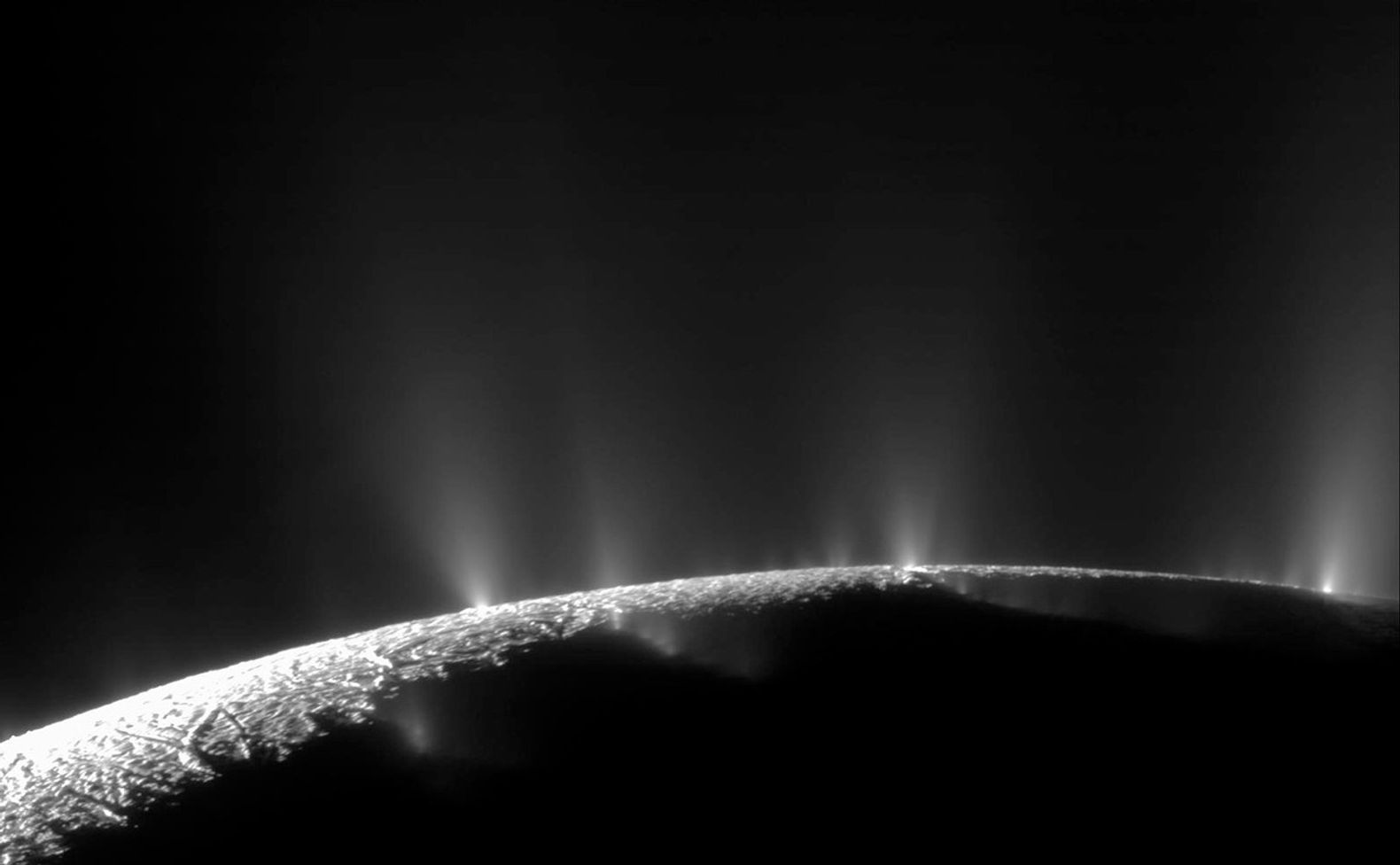
The plumes were discovered in 2005 by NASA’s Cassini spacecraft. They emanate from long fractures called ‘tiger stripes’ that are located in Enceladus’s south polar region. The water comes from a sub-surface ocean, and the energy to heat the ocean and produce the plumes is the result of gravitational tidal forces from massive Saturn flexing Enceladus’s interior.

Cassini flew through the plumes, ‘tasting’ some of the molecules within them and finding them to be rich in salts as well as containing a variety of organic compounds. As organic compounds, dissolved in a subsurface ocean of water, could build into prebiotic molecules that are the precursors to life, these findings were of great interest to astrobiologists.

However, results of experiments by Richards and her colleagues show that the exposure to radiation trapped in Saturn’s powerful magnetosphere could trigger the formation of these organic compounds on Enceladus’s icy surface instead. This calls into question their astrobiological relevance.

Richards, with funding from Europlanet, visited facilities at the HUN-REN Institute for Nuclear Physics in Hungary, where she and colleagues simulated the composition of ice on the surface and in the walls of Enceladus’s tiger stripes. This ice contained water, carbon dioxide, methane and ammonia and was cooled to -200 degrees Celsius. Richards’s team then bombarded the ice with ions – atoms and molecules stripped of an electron – to replicate the radiation environment around Enceladus. The ions reacted with the icy components, creating a whole swathe of molecular species, including carbon monoxide, cyanate and ammonium. They also produced molecular precursors to amino acids, chains of which form proteins that drive metabolic reactions, repair cells and convey nutrients in lifeforms.

Some of these compounds have previously been detected on the surface of Enceladus, but others have also been identified in the plumes. 

‘Molecules considered prebiotic could plausibly form in situ through radiation processing, rather than necessarily originating from the subsurface ocean,’ said Richards. ‘Although this doesn’t rule out the possibility that Enceladus’s ocean may be habitable, it does mean we need to be cautious in making that assumption just because of the composition of the plumes.’

Understanding how to differentiate between ocean-derived organics and molecules formed by radiation interacting with the surface and the tiger stripes will be highly challenging. More data from future missions will be required, such as a proposed Enceladus mission that is currently under consideration as part of the Voyage 2050 recommendations for the European Space Agency (ESA)’s science programme up until the middle of the century.

Further information

EPSC-DPS2025-264 Water-Group Ion Irradiation Studies of Enceladus Surface Analogues

Grace Richards, Richárd Rácz, Sándor Kovács, Victoria Pearson, Geraint Morgan, Manish Patel, Simon Sheridan, Duncan Mifsud, Béla Sulik, Sándor Biri and Zoltán Juhász, https://doi.org/10.5194/epsc-dps2025-264

This study was supported by the Europlanet 2024 RI Transnational Access programme, which received funding from the European Union’s Horizon 2020 research and innovation programme under grant agreement No 871149. Funding was also received from the COST Actions CA20129 MultIChem and CA22133 PLANETS, supported by COST (European Cooperation in Science and Technology). Grace Richards is grateful for doctoral funding from the Research England ‘Expanding Excellence in England’ fund (grant code 124.18).

Images

An artist’s impression of plumes erupting onto the surface of Enceladus. Its fellow moon Titan is seen in the sky, and the distant Sun beyond. Image credit: ESA/Science Office.

https://www.esa.int/var/esa/storage/images/esa_multimedia/images/2021/06/moons_of_the_giant_planets/23344780-1-eng-GB/Moons_of_the_giant_planets.jpg

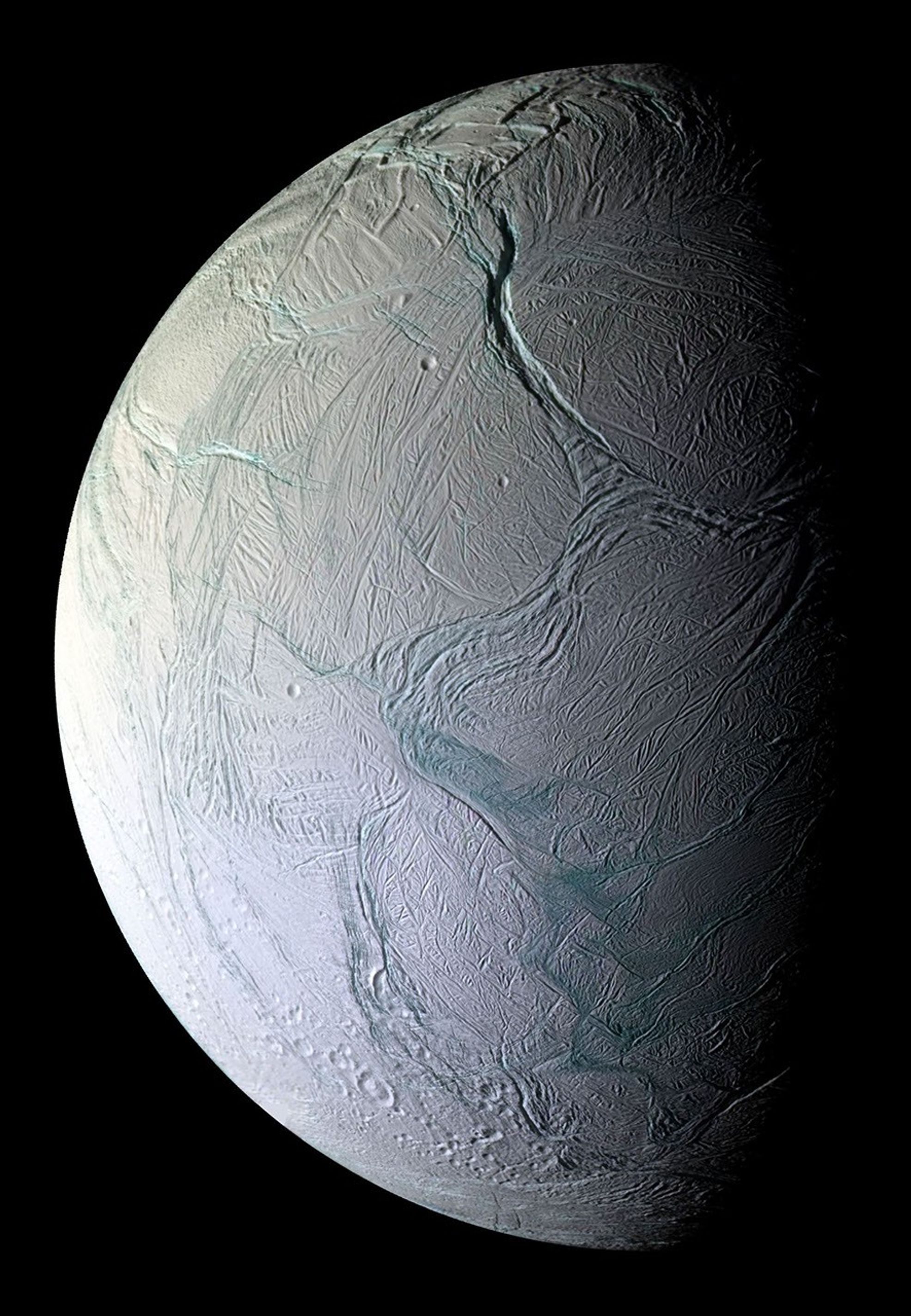
Enceladus, imaged by the Cassini spacecraft. Image credit: NASA/JPL/Space Science Institute.

https://assets.science.nasa.gov/dynamicimage/assets/science/psd/solar/2023/07/PIA11133.jpg?w=1972&h=2848&fit=clip&crop=faces%2Cfocalpoint

Enceladus’s plumes seen spraying up from the tiger stripes. Image credit: NASA/JPL/Space Science Institute.

https://assets.science.nasa.gov/dynamicimage/assets/science/psd/solar/2023/06/4852_PIA11688.jpg?w=1580&h=977&fit=clip&crop=faces%2Cfocalpoint

Contacts

Grace Richards
Istituto Nazionale di Astrofisica (INAF), Rome, Italy
grace.richards@inaf.it

EPSC-DPS2025 Press Office
press@europlanet.org 

Notes for Editors

About the Joint Meeting of the Europlanet Science Congress and the Division of Planetary Sciences (EPSC-DPS) 

The Europlanet Science Congress (EPSC), established in 2006 as the European Planetary Science Congress, is the largest planetary science meeting in Europe. It covers the entire range of planetary sciences, with an extensive mix of talks, workshops and poster sessions, as well as providing a unique space for networking and exchanges of experiences.

EPSC joined forces for the first time with the American Astronomical Society’s Division for Planetary Sciences (DPS) for a joint meeting in Nantes, France, in 2011. This was followed by DPS-EPSC 2016 in Pasadena, EPSC-DPS 2019 in Geneva, and the return to the United States for the DPS-EPSC 2023 meeting in San Antonio. This year will mark the third iteration of a joint European-based meeting. The intent of the joint meetings is not only to connect the European and North American planetary science communities, but also to consolidate two major meetings and motivate planetary scientists from all over the globe to attend.

Follow on social media (BlueskyX and LinkedIn) with the hashtag #EPSC-DPS2025 for updates on the meeting.

About Europlanet

Europlanet (europlanet.org) is a non-profit association and membership organisationthat provides the planetary science community with access to research infrastructure, services and training. The Europlanet Association Sans But Lucratif (AISBL), established in 2023, builds on the heritage of a series of projects funded by the European Commission between 2005 and 2024 (Grant Numbers 871149, 654208, 228319 and RICA-CT-2004-001637) to support the planetary science community in Europe and around the world. 

About the DPS

The Division for Planetary Sciences (DPS), founded in 1968, is the largest special-interest Division of the American Astronomical Society (AAS). Members of the DPS study the bodies of our own solar system, from planets and moons to comets and asteroids, and all other solar-system objects and processes. With the discovery that planets exist around other stars, the DPS has expanded its scope to include the study of extrasolar planetary systems as well. The American Astronomical Society (AAS), established in 1899, is the major organization of professional astronomers in North America. The mission of the AAS is to enhance and share humanity’s scientific understanding of the universe as a diverse and inclusive astronomical community, which it achieves through publishing, meeting organization, science advocacy, education and outreach, and training and professional development.

EPSC-DPS2025: Look Out for the Keyhole: How to Find the Safest Spots to Deflect a Hazardous Asteroid

Look Out for the Keyhole: How to Find the Safest Spots to Deflect a Hazardous Asteroid

Joint Meeting of the Europlanet Science Congress and the American Astronomical Society’s Division for Planetary Science (EPSC-DPS2025) Press Release

Selecting the right spot to smash a spacecraft into the surface of a hazardous asteroid to deflect it must be done with great care, according to new research presented at the EPSC-DPS2025 Joint Meeting this week in Helsinki. Slamming into its surface indiscriminately runs the risk of knocking the asteroid through a ‘gravitational keyhole’ that sends it back around to hit Earth at a later date.

“Even if we intentionally push an asteroid away from Earth with a space mission, we must make sure it doesn’t drift into one of these keyholes afterwards. Otherwise, we’d be facing the same impact threat again down the line,” said Rahil Makadia, a NASA Space Technology Graduate Research Opportunity Fellow at the University of Illinois at Urbana-Champaign, who is presenting the findings at the EPSC-DPS2025 meeting.

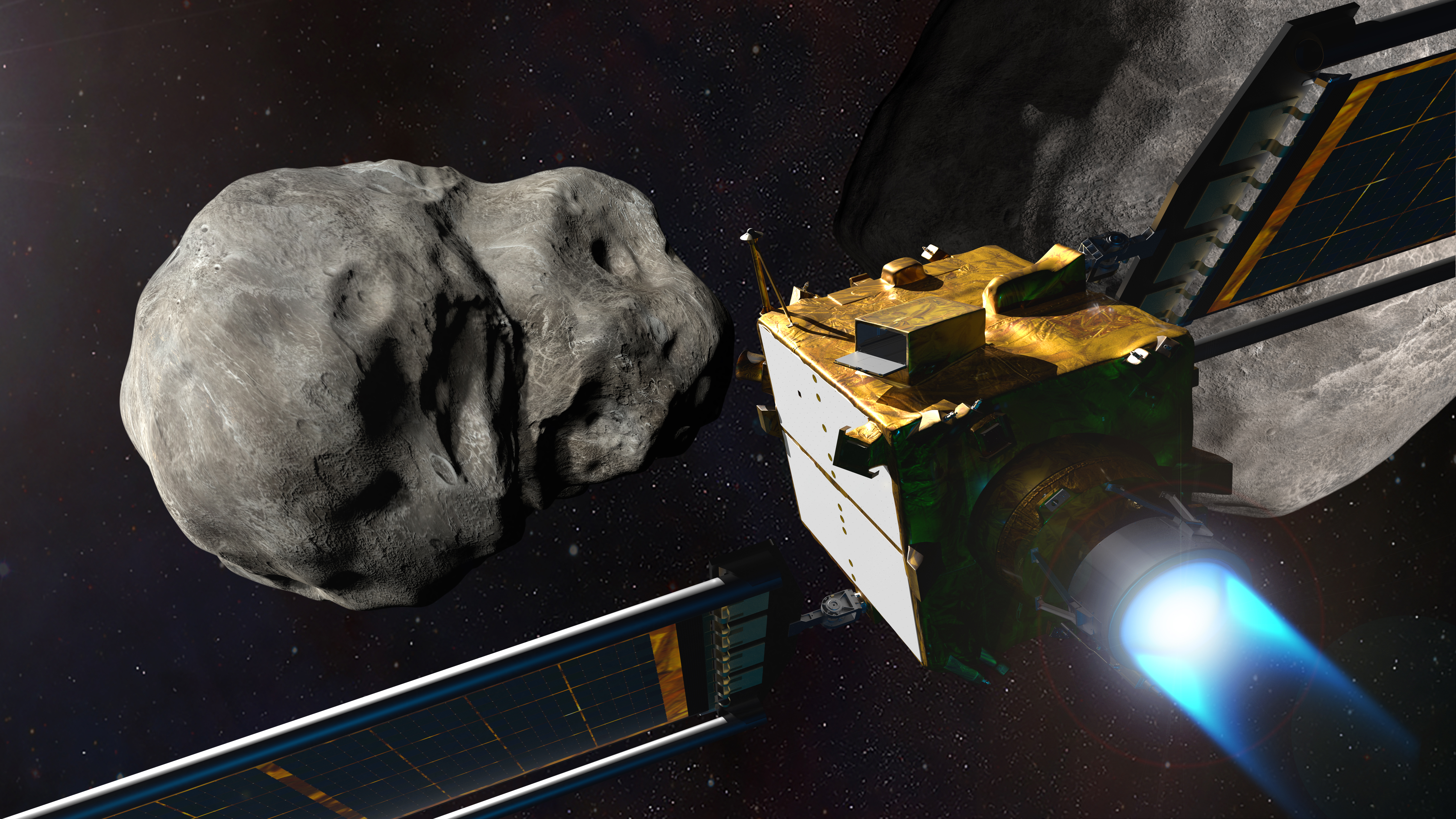
NASA’s DART, the Double Asteroid Redirection Test mission, struck the small asteroid Dimorphos, which is in orbit around the larger asteroid Didymos, in September 2022. DART was a ‘kinetic impactor’ – effectively a projectile that slammed into the asteroid with enough energy to nudge it into a new orbit, thereby proving that it is possible to deflect an asteroid that could be on a collision course with Earth.

A European Space Agency mission called Hera will follow-up on the DART impact when it reaches Didymos and Dimorphos in December 2026.

Where DART struck on Dimorphos was of relatively little concern, since the Didymos system is too massive to be deflected onto a collision course with Earth. However, for another hazardous asteroid orbiting the Sun, even a small variation in its orbit could send it through a gravitational keyhole.

The keyhole effect revolves around a small region of space where a planet’s gravity can modify a passing asteroid’s orbit such that it returns on a collision course with that planet at a later date. In this way, a gravitational keyhole unlocks more dangerous orbits.

Should a kinetic impactor mission similar to DART nudge a hazardous asteroid so that it passes through a gravitational keyhole, then it only postpones the danger.

“If an asteroid passed through one of these keyholes, its motion through the Solar System would steer it onto a path that causes it to hit Earth in the future,” said Makadia.

The trick, therefore, is to find the best spot on the surface of an asteroid to impact with a spacecraft so that the chances of pushing it through the keyhole are minimised.

Each point on the surface of an asteroid has a different probability of sending the asteroid through a gravitational keyhole after deflection by a kinetic impactor. Makadia’s team has therefore developed a technique for computing probability maps of an asteroid’s surface. Their method uses the results from DART as a guide, although each asteroid, with its own characteristics, will be subtly different.

The asteroid’s shape, surface topology (hills, craters etc), rotation and mass all must be determined first. Ideally this would be done with a space mission to rendezvous with the asteroid, producing high-resolution images and data. However, this might not be possible for all threatening asteroids, particularly if the time between discovery and impact on Earth is short.

“Fortunately, this entire analysis, at least at a preliminary level, is possible using ground-based observations alone, although a rendezvous mission is preferred,” said Makadia.

By computing the subsequent trajectory of the asteroid following a kinetic impact, and seeing which trajectories would be the most dangerous, scientists can calculate where the safest location to strike on the asteroid’s surface will be.

“With these probability maps, we can push asteroids away while preventing them from returning on an impact trajectory, protecting the Earth in the long run,” said Makadia.

Further information

EPSC-DPS2025-77 Keyhole-Based Site Selection for Kinetic Impact Deflection of Near-Earth Asteroids

Rahil Makadia, Steven Chesley, Davide Farnocchia and Siegfried Eggl, doi.org/10.5194/epsc-dps2025-77

The work was funded by a NASA Space Technology Graduate Research Opportunities (NSTGRO) award, NASA contract No. 80NSSC22K1173.

Information on DART can be found at https://dart.jhuapl.edu/. Details relating to Hera are available at https://www.esa.int/Space_Safety/Hera.

Images

An artwork of NASA’s DART mission, which was a kinetic impactor designed to test whether it is possible to deflect an asteroid. Image credit: NASA/Johns Hopkins APL.

https://dart.jhuapl.edu/Gallery/media/graphics/lg/DART_still-revisedA.jpg

One of the keyhole probability maps of the asteroid Bennu, The crosshair corresponds to the location on the surface that minimises the asteroid impact hazard after deflection. The maps assume a 25-metre targeting uncertainty for a kinetic impactor mission. As a result, deflection sites that could result in the kinetic impactor missing as a result of this uncertainty are not considered and form a grey boundary around the targetable region of the asteroid. Image credit: Rahil Makadia.

You can watch an animation of the keyhole probability map of Bennu here:

https://youtube.com/watch?v=XYPD-pKwqNs

Contacts

Rahil Makadia
University of Illinois, Urbana–Champaign
makadia2@illinois.edu

EPSC–DPS 2025 Press Office
press@europlanet.org

Notes for Editors

About the Joint Meeting of the Europlanet Science Congress and the Division of Planetary Sciences (EPSC-DPS) 

The Europlanet Science Congress (EPSC), established in 2006 as the European Planetary Science Congress, is the largest planetary science meeting in Europe. It covers the entire range of planetary sciences, with an extensive mix of talks, workshops and poster sessions, as well as providing a unique space for networking and exchanges of experiences.

EPSC joined forces for the first time with the American Astronomical Society’s Division for Planetary Sciences (DPS) for a joint meeting in Nantes, France, in 2011. This was followed by DPS-EPSC 2016 in Pasadena, EPSC-DPS 2019 in Geneva, and the return to the United States for the DPS-EPSC 2023 meeting in San Antonio. This year will mark the third iteration of a joint European-based meeting. The intent of the joint meetings is not only to connect the European and North American planetary science communities, but also to consolidate two major meetings and motivate planetary scientists from all over the globe to attend. With around 1800 participants expected to join in person and online, EPSC-DPS2025 will be the largest planetary science meeting held to date in Europe.

Follow on social media (BlueskyX and LinkedIn) with the hashtag #EPSC-DPS2025 for updates on the meeting.

About Europlanet

Europlanet (europlanet.org) is a non-profit association and membership organisation that provides the planetary science community with access to research infrastructure, services and training. The Europlanet Association Sans But Lucratif (AISBL), established in 2023, builds on the heritage of a series of projects funded by the European Commission between 2005 and 2024 (Grant Numbers 871149, 654208, 228319 and RICA-CT-2004-001637) to support the planetary science community in Europe and around the world. 

About the DPS

The Division for Planetary Sciences (DPS), founded in 1968, is the largest special-interest Division of the American Astronomical Society (AAS). Members of the DPS study the bodies of our own solar system, from planets and moons to comets and asteroids, and all other solar-system objects and processes. With the discovery that planets exist around other stars, the DPS has expanded its scope to include the study of extrasolar planetary systems as well. The American Astronomical Society (AAS), established in 1899, is the major organization of professional astronomers in North America. The mission of the AAS is to enhance and share humanity’s scientific understanding of the universe as a diverse and inclusive astronomical community, which it achieves through publishing, meeting organization, science advocacy, education and outreach, and training and professional development.

Reminder: Final Media Invitation for EPSC-DPS2025 and Details of Media Briefings on RAMSES and Juno Missions

Reminder: Final Media Invitation for EPSC-DPS2025 and Details of Media Briefings on RAMSES and Juno Missions

Joint Meeting of the Europlanet Science Congress and the American Astronomical Society’s Division for Planetary Science (EPSC-DPS2025), 7-12 September, Helsinki, Finland

The Europlanet Science Congress 2025 will be held jointly with the annual meeting of the American Astronomical Society’s Division of Planetary Science (EPSC-DPS2025) from 7–12 September 2025 at Finlandia Hall, Helsinki, Finland. With around 1800 participants expected to join in person and online, it will be the largest planetary science meeting held to date in Europe.

Press briefings will be livestreamed and press notices on presentations of interest to the media will be issued by the EPSC-DPS2025 Press Office during the meeting.

PRESS BRIEFINGS

Two press briefings will be held during the week: 

  • Monday, 08 September 2025. Topic: RAMSES mission to asteroid Apophis
  • Thursday, 11 September 2025. Topic: Recent Discoveries with the Juno Mission.

To attend press briefings in-person, please register as media for EPSC-DPS2025 by emailing press@europlanet.org. The press briefings will take place in the Press Conference Room, which can be accessed from the Press Entrance to the Congress Wing on the Mannerheimintie side of Finlandia Hall. To attend online, please follow the Zoom registration links below.

16:30-17:15 EEST (UTC+3), Monday, 08 September 2025

EPSC-DPS2025 Press Briefing: Update on the RAMSES mission to asteroid Apophis

ESA’s Space Safety programme has started preparatory work for its next planetary defence candidate mission – the Rapid Apophis Mission for Space Safety (RAMSES). Its main objective is the characterisation of the asteroid (99942) Apophis before, during and after its close encounter with Earth in April 2029. The findings will provide crucial knowledge on the properties and response of a small asteroid to external actions (here, Earth’s tidal forces), and therefore improve our ability to defend our planet from any similar object found to be on a collision course in the future. The briefing will give an update on the mission goals, payload, development and international participation. Europe’s space ministers will decide at ESA’s Ministerial Council in November 2025 whether to support RAMSES for launch.  

16:30 EEST: Welcome

Anita Heward, Press Officer, EPSC-DPS2025.

16:35 EEST: Speakers

  • Monica Lazzarin (University of Padova) and Patrick Michel (CNRS / Observatoire de la Côte d’Azur): RAMSES science and payloads.
  • Paolo Martino (RAMSES Project Manager, ESA): RAMSES project status.
  • Seiji Sugita (University of Tokyo and Science Management Board of RAMSES): Japanese participation in RAMSES.

To attend online, please follow this registration link and you will receive a confirmation email containing information about joining the live stream.

12:45-13:30 EEST (UTC+3): Thursday, 11 September 2025

EPSC-DPS2025 Press Briefing: Recent Discoveries with the Juno Mission

This press briefing will focus on several recent discoveries with the Juno Mission, including in-situ and remote observations of the ultraviolet footprint of the moon Callisto by the Juno spacecraft.

12:45 EEST: Welcome

Anita Heward, Press Officer, EPSC-DPS2025

12: 50 EEST: Speakers

  • Scott Bolton: Recent discoveries with Juno.
  • Vincent Hue: In-situ and remote observations of the ultraviolet footprint of the moon Callisto by the Juno spacecraft.

To attend online, please follow this registration link and you will receive a confirmation email containing information about joining the live stream.

FURTHER INFORMATION

Directions to Finlandia Hall can be found at: https://finlandiatalo.fi/en/finlandia-hall/location-transportation/

Details of all scientific sessions and presentation abstracts for EPSC-DPS2025 can be found at the official website: https://www.epsc-dps2025.eu

An overview of the programme can be found here: 

https://www.epsc-dps2025.eu/programme_overview.pdf

The meeting hashtag is #EPSC-DPSC2025

CONTACTS

Anita Heward
EPSC-DPS2025 Press Officer
+44 7756 034243

aheward@europlanet.org
press@europlanet.org

Keith Cooper
EPSC-DPS2025 Press Officer
press@europlanet.org

Thibaut Roger
EPSC-DPS2025 Press Officer
press@europlanet.org

NOTES FOR EDITORS

About the Joint Meeting of the Europlanet Science Congress and the Division of Planetary Sciences (EPSC-DPS) 

The Europlanet Science Congress (EPSC), established in 2006 as the European Planetary Science Congress, is the largest planetary science meeting in Europe. It covers the entire range of planetary sciences, with an extensive mix of talks, workshops and poster sessions, as well as providing a unique space for networking and exchanges of experiences.

EPSC joined forces for the first time with the American Astronomical Society’s Division for Planetary Sciences (DPS) for a joint meeting in Nantes, France, in 2011. This was followed by DPS-EPSC 2016 in Pasadena, EPSC-DPS 2019 in Geneva, and the return to the United States for the DPS-EPSC 2023 meeting in San Antonio. This year will mark the third iteration of a joint European-based meeting. The intent of the joint meetings is not only to connect the European and North American planetary science communities, but also to consolidate two major meetings and motivate planetary scientists from all over the globe to attend.

Follow on social media (BlueskyX and LinkedIn) with the hashtag #EPSC-DPS2025 for updates on the meeting.

Sharing Material at EPSC-DPS2025

Due to author copyright privileges, it is prohibited to retain or share any scientific material contained in any oral or poster presentation or supplementary material if a presenter has marked the material as “restricted” and/or used the “no-sharing” icon.

About Europlanet

Europlanet (www.europlanet.org) is a non-profit association and membership organisation that provides the planetary science community with access to research infrastructure, services and training. The Europlanet Association Sans But Lucratif (AISBL), established in 2023, builds on the heritage of a series of projects funded by the European Commission between 2005 and 2024 (Grant Numbers 871149, 654208, 228319 and RICA-CT-2004-001637) to support the planetary science community in Europe and around the world. 

About the DPS

The Division for Planetary Sciences (DPS), founded in 1968, is the largest special-interest Division of the American Astronomical Society (AAS). Members of the DPS study the bodies of our own solar system, from planets and moons to comets and asteroids, and all other solar-system objects and processes. With the discovery that planets exist around other stars, the DPS has expanded its scope to include the study of extrasolar planetary systems as well. The American Astronomical Society (AAS), established in 1899, is the major organization of professional astronomers in North America. The mission of the AAS is to enhance and share humanity’s scientific understanding of the universe as a diverse and inclusive astronomical community, which it achieves through publishing, meeting organization, science advocacy, education and outreach, and training and professional development.

About the European Space Agency

The European Space Agency (ESA) provides Europe’s gateway to space.  

ESA is an intergovernmental organisation, created in 1975, with the mission to shape the development of Europe’s space capability and ensure that investment in space delivers benefits to the citizens of Europe and the world.  

ESA has 23 Member States: Austria, Belgium, the Czech Republic, Denmark, Estonia, Finland, France, Germany, Greece, Hungary, Ireland, Italy, Luxembourg, the Netherlands, Norway, Poland, Portugal, Romania, Slovenia, Spain, Sweden, Switzerland and the United Kingdom. Latvia, Lithuania and Slovakia are Associate Members.  

ESA has established formal cooperation with four Member States of the EU. Canada takes part in some ESA programmes under a Cooperation Agreement.  

By coordinating the financial and intellectual resources of its members, ESA can undertake programmes and activities far beyond the scope of any single European country. It is working in particular with the EU on implementing the Galileo and Copernicus programmes as well as with Eumetsat for the development of meteorological missions.  

Learn more about ESA at www.esa.int

Tim Lichtenberg, Benoit Carry and Jean Schneider Honoured by New Europlanet Career Medals

Tim Lichtenberg, Benoit Carry and Jean Schneider Honoured by New Europlanet Career Medals

Joint Meeting of the Europlanet Science Congress and the American Astronomical Society’s Division for Planetary Science (EPSC-DPS2025) Press Release.

Europlanet has announced the winners of its inaugural Career Medals, which are designed to honour outstanding contributions from planetary scientists at three stages of their careers. 

Dr Tim Lichtenberg is awarded the Europlanet Early-Career Medal in recognition of an interdisciplinary approach that has led to significant advances in the understanding of planetary formation and exoplanet evolution. Lichtenberg’s work has shed light on the influence of radioactive elements on early planetary heating, the distribution of water and other volatile materials in planetary systems, and how planets evolve to become habitable. 

Dr Benoit Carry is awarded the Europlanet Mid-Career Medal for his work to characterise the internal structures and compositions of asteroids and planetary small bodies. Carry’s research has given critical insights into the evolution of the early Solar System, as well as making an important contribution to planetary defence efforts and to open science. 

Prof Jean Schneider is awarded the Europlanet Lifetime Achievement Medal for his role as one of the ‘architects’ of modern planetary sciences. In addition to pioneering key methodologies for detecting and characterising exoplanets, including transit photometry and transmission spectroscopy, Schneider founded the Encyclopaedia of Exoplanetary Systems, which for thirty years has been a cornerstone resource for the international community.

Noah Jäggi, Chair of the Medal Award Committee said, ‘With this first set of Europlanet Career Medals, we are delighted to be able to recognise the contributions of three individuals who have had such a profound impact, not just on planetary science, but on our whole community. The achievements of our inaugural medallists demonstrate that, at each stage of a career, scientists can make a substantial difference to the field in which they work and to the colleagues that work alongside them. We are proud to honour these truly deserving recipients.’

The awards will be presented next week at the Joint Meeting of the Europlanet Science Congress (EPSC) and the American Astronomical Society’s Division for Planetary Sciences (DPS) 2025, which will take place at Finlandia Hall, Helsinki, Finland, from 7-12 September.

Europlanet Early-Career Medal Winner, Tim Lichtenberg

Tim Lichtenberg.

Tim Lichtenberg works as Assistant Professor at the Kapteyn Astronomical Institute of the University of Groningen, where he leads the Forming Worlds Lab. His research bridges geochemistry, geophysics, climate science and exoplanet astronomy, and explores how factors like magma ocean longevity, the balance between oxidation and reduction processes, and core-mantle segregation can influence exoplanetary atmospheres and give insights into planetary evolution and habitability.

Lichtenberg proposed that the presence of aluminium-26 (26Al) during planet formation can heat and dry out embryonic planets. This theory could explain why planetary systems like our Solar System form largely dry terrestrial planets, contrasting with those in which Earth-mass exoplanets become water-rich ocean worlds. These theoretical insights have since been supported by observations of protoplanetary disks, analysis of stellar remnants that have been polluted by planetary debris, as well as evidence from meteorites formed very early in the Solar System’s history. These findings directly impact our understanding of the origin and distribution of long-lived atmospheres on terrestrial exoplanets.

Beyond his scientific achievements, Lichtenberg has shown leadership in community-building, promoting inclusive and team-spirited work environments and open science. He plays key roles in major international initiatives, including the Large Interferometer for Exoplanets (LIFE) project, several James Webb Space Telescope (JWST) programmes, and the interdisciplinary Rocky Worlds meeting series.

Europlanet Early-Career Medal citation: https://www.europlanet.org/europlanet-early-career-medal/

Forming Worlds Lab webpage: https://www.formingworlds.space

An interview with Tim Lichtenberg is included in Issue 8 of the Europlanet Magazine (Quickfire Questions with Tim Lichtenberg), with an extended version online (Exoplanets and Planetary Science: Two Different Worlds?).

Europlanet Mid-Career Medal Winner, Benoit Carry

Benoit Carry.

Benoit Carry, of the Lagrange laboratory of the Observatoire de la Côte d’Azur (OCA), uses observational and theoretical approaches for understanding the distribution and the compositional diversity of small bodies in planetary systems. His work in interpreting data from major space missions, such as Gaia and Euclid, has been pivotal in advancing our understanding of the formation of the asteroid belt and the evolution of the Solar System. 

Carry’s research has enabled more precise asteroid mass determinations, revealing key properties of asteroid interiors and substantially improving the accuracy of threat assessments for potentially hazardous asteroids. His collaborative work on compositional mapping of the asteroid belt has shaped current models of planetary migration and asteroid distribution. As co-chair of the ESA HERA mission’s Working Group on ground-based observations of Didymos, the target of the NASA DART and ESA HERA missions, he has taken a leading role in planning and interpreting asteroid deflection observations that will be vital for future planetary defence efforts. 

Alongside the scientific impact of his work, Carry is committed to open science and has developed critical infrastructure for the planetary science community, including tools that enable the real-time classification of astronomical alerts and services that provide comprehensive data on over a million asteroids and dwarf planets. 

The Europlanet Mid-Career Medal continues to honour the memory and legacy of the Italian scientist, Paolo Farinella (1953-2000), in whose name the Farinella Prize was awarded from 2011-2024.

Europlanet Mid-Career Medal citation: https://www.europlanet.org/europlanet-mid-career-medal/

Benoit Carry’s webpage: http://benoit.carry.free.fr

Europlanet Lifetime Achievement Winner, Jean Schnieder

Jean Schneider.

Jean Schneider is Emeritus Researcher at the Observatoire de Paris-Meudon. Nearly a decade before the first observation of an exoplanet, Schneider laid the theoretical groundwork for identifying exoplanets through transit photometry. Missions such as CoRoT, Kepler, and TESS have all built on these foundations, leading to the detection of thousands of new worlds, including CoRoT-7b, the first super-Earth with a measured radius.

In 1994, Schneider published the first work proposing transmission spectroscopy, a method of detecting the molecular fingerprints of gases on extrasolar planets by analysing light filtered through the atmospheres of planets passing in front of their host stars. This technique, used on JWST and Hubble data and underpinning the upcoming ESA Ariel mission, has characterised the atmospheres of around 100 exoplanets to date and may help ultimately to answer the question of whether planets other than Earth might harbour life. Schneider also pioneered methodologies for detecting planets around binary stars and exomoons, pushing the frontiers of what could potentially be observed.

Several months before the discovery of 51 Pegasi b in 1995, Schneider created the Encyclopaedia of Exoplanetary Systems, which today includes comprehensive information on over 7,600 planets orbiting other stars and is a unique resource for research, teaching and public outreach around the world. 

Throughout his career, Professor Schneider has shown a commitment to building the international collaborations and institutional frameworks required to support the advancement of planetary sciences, serving in many leadership roles for actions, working groups and steering committees at CNRS, ESO and the IAU. 

Europlanet Lifetime Achievement Medal citation: https://www.europlanet.org/europlanet-lifetime-achievement-medal/

Further information

The Europlanet Medals, launched in 2025, honour outstanding contributions to scientific excellence, community building, and outreach from individuals at three different stages of their scientific careers, covering the subjects addressed by the Europlanet Science Congress (EPSC):

  • Terrestrial Planets 
  • Outer Planet Systems 
  • Missions, Instrumentation, Techniques, Modelling 
  • Small Bodies (comets, KBOs, rings, asteroids, meteorites, dust) 
  • Exoplanets, Origins of Planetary Systems and Astrobiology  

The categories are based on the scientific age of a researcher at time of nomination, which is calculated from the year of the last degree in scientific education (MSc, PhD) without counting parental leave, health leave, or time working primarily outside science. Each of the inaugural Europlanet Medal winners receives a plaque and a registration waiver for the EPSC-DPS 2025 Joint Meeting in Helsinki, where they will give a medal lecture.

Images

Tim Lichtenberg. Credit: T Lichtenberg/U. Groningen.

https://www.europlanet.org/wp-content/uploads/2025/07/ECM_Lichtenberg.webp

Tim Lichtenberg. Credit: T Lichtenberg/U. Groningen.

https://www.europlanet.org/wp-content/uploads/2025/07/Award_page.webp

Benoit Carry. Credit: E Hernandez/Observatoire de la Cote d’Azur

https://www.europlanet.org/wp-content/uploads/2025/07/MCM25_Carry.webp

Benoit Carry. Credit: E Hernandez/Observatoire de la Cote d’Azur

https://www.europlanet.org/wp-content/uploads/2025/07/Award_page-1.webp

Jean Schneider. Credit: J Schneider.

Credit: https://www.europlanet.org/wp-content/uploads/2025/07/Main_page.webp

Contacts

EPSC-DPS2025 Press Office
press@europlanet.org
+44 7756 034243

Notes for Editors

About the Joint Meeting of the Europlanet Science Congress and the Division of Planetary Sciences (EPSC-DPS) 

The Europlanet Science Congress (EPSC), established in 2006 as the European Planetary Science Congress, is the largest planetary science meeting in Europe. It covers the entire range of planetary sciences, with an extensive mix of talks, workshops and poster sessions, as well as providing a unique space for networking and exchanges of experiences.

EPSC joined forces for the first time with the American Astronomical Society’s Division for Planetary Sciences (DPS) for a joint meeting in Nantes, France, in 2011. This was followed by DPS-EPSC 2016 in Pasadena, EPSC-DPS 2019 in Geneva, and the return to the United States for the DPS-EPSC 2023 meeting in San Antonio. This year will mark the third iteration of a joint European-based meeting. The intent of the joint meetings is not only to connect the European and North American planetary science communities, but also to consolidate two major meetings and motivate planetary scientists from all over the globe to attend.

Follow on social media (BlueskyX and LinkedIn) with the hashtag #EPSC-DPS2025 for updates on the meeting.

About Europlanet

Europlanet (europlanet.org) is a non-profit association and membership organisation that provides the planetary science community with access to research infrastructure, services and training. The Europlanet Association Sans But Lucratif (AISBL), established in 2023, builds on the heritage of a series of projects funded by the European Commission between 2005 and 2024 (Grant Numbers 871149, 654208, 228319 and RICA-CT-2004-001637) to support the planetary science community in Europe and around the world. 

About the DPS

The Division for Planetary Sciences (DPS), founded in 1968, is the largest special-interest Division of the American Astronomical Society (AAS). Members of the DPS study the bodies of our own solar system, from planets and moons to comets and asteroids, and all other solar-system objects and processes. With the discovery that planets exist around other stars, the DPS has expanded its scope to include the study of extrasolar planetary systems as well. The American Astronomical Society (AAS), established in 1899, is the major organization of professional astronomers in North America. The mission of the AAS is to enhance and share humanity’s scientific understanding of the universe as a diverse and inclusive astronomical community, which it achieves through publishing, meeting organization, science advocacy, education and outreach, and training and professional development.

1st Media Invitation: EPSC-DPS2025, 7-12 September 2025, Helsinki

1st Media Invitation: EPSC-DPS2025, 7 – 12 September 2025, Finlandia Hall, Helsinki, Finland

Joint Meeting of the Europlanet Science Congress and the American Astronomical Society’s Division of Planetary Science (EPSC-DPS2025)

The Europlanet Science Congress 2025 will be held jointly with the annual meeting of the American Astronomical Society’s Division of Planetary Science (EPSC-DPS2025) from 7–12 September 2025 at Finlandia Hall, Helsinki, Finland.

EPSC-DPS2025 covers the full spectrum of planetary research and technology across 74 scientific sessions, with topics including the latest results on Solar System, exoplanetary and interstellar bodies, current and upcoming missions, ground-based observations, the use of artificial intelligence and machine learning in planetary science, planetary defence, and the emergence of life in our Solar System and beyond. The programme is supplemented by keynotes, debates, community events and the Europlanet Space Innovation Night (E-SPIN). Around 1900 oral and poster presentations have been submitted and almost 2000 planetary scientists from Europe and around the world are expected to attend the conference.

EPSC-DPS2025 will take place as a fully hybrid meeting, with the possibility of live virtual participation in all standard scientific sessions. 

Press briefings will be livestreamed and press notices on presentations of interest to the media will be issued by the EPSC-DPS2025 Press Office during the meeting. Details of press briefings and livestream access will be circulated closer to the time.

Details of the scientific sessions and the presentation abstracts can be found at the official website: https://www.epsc-dps2025.eu

An overview of the programme can be found here: 

https://bit.ly/EPSC-DPS2025-SessionOverview

The meeting hashtag is #EPSC-DPS2025

Media Registration

Media representatives are cordially invited to attend the EPSC-DPS2025 meeting. Media registration is free. Any bona fide media delegates can register by e-mailing aheward@europlanet.org.

Contacts

EPSC-DPS2025 Press Office
+44 7756 034243
press@europlanet.org

Further Information 

About the Joint Meeting of the Europlanet Science Congress and the Division of Planetary Sciences (EPSC-DPS) 

The Europlanet Science Congress (EPSC), established in 2006 as the European Planetary Science Congress, is the largest planetary science meeting in Europe. It covers the entire range of planetary sciences, with an extensive mix of talks, workshops and poster sessions, as well as providing a unique space for networking and exchanges of experiences.

EPSC joined forces for the first time with the American Astronomical Society’s Division for Planetary Sciences (DPS) for a joint meeting in Nantes, France, in 2011. This was followed by DPS-EPSC 2016 in Pasadena, EPSC-DPS 2019 in Geneva, and the return to the United States for the DPS-EPSC 2023 meeting in San Antonio. This year will mark the third iteration of a joint European-based meeting. The intent of the joint meetings is not only to connect the European and North American planetary science communities, but also to consolidate two major meetings and motivate planetary scientists from all over the globe to attend.

Follow on social media (BlueskyX and LinkedIn) with the hashtag #EPSC-DPS2025 for updates on the meeting.

Sharing Material at EPSC-DPS2025

Due to author copyright privileges, it is prohibited to retain or share any scientific material contained in any oral or poster presentation or supplementary material if a presenter has marked the material as “restricted” and/or used the “no-sharing” icon.

Images

Finlandia Hall. Credit: Europlanet
Finlandia Hall, Helskinki, venue for the EPSC-DPS Joint Meeting 2025.
Finlandia Hall, Helskinki, venue for the EPSC-DPS Joint Meeting 2025. Credit: Daderot / CC0

About Europlanet

Europlanet (www.europlanet.org) is a non-profit association and membership organisation that provides the planetary science community with access to research infrastructure, services and training. The Europlanet Association Sans But Lucratif (AISBL), established in 2023, builds on the heritage of a series of projects funded by the European Commission between 2005 and 2024 (Grant Numbers 871149, 654208, 228319 and RICA-CT-2004-001637) to support the planetary science community in Europe and around the world. 

About the DPS

The Division for Planetary Sciences (DPS), founded in 1968, is the largest special-interest Division of the American Astronomical Society (AAS). Members of the DPS study the bodies of our own solar system, from planets and moons to comets and asteroids, and all other solar-system objects and processes. With the discovery that planets exist around other stars, the DPS has expanded its scope to include the study of extrasolar planetary systems as well. The American Astronomical Society (AAS), established in 1899, is the major organization of professional astronomers in North America. The mission of the AAS is to enhance and share humanity’s scientific understanding of the universe as a diverse and inclusive astronomical community, which it achieves through publishing, meeting organization, science advocacy, education and outreach, and training and professional development.

EPSC2024: Gravity Study Gives Insights into Hidden Features Beneath Lost Ocean of Mars and Rising Olympus Mons

Gravity Study Gives Insights into Hidden Features Beneath Lost Ocean of Mars and Rising Olympus Mons

Studies of gravity variations at Mars have revealed dense, large-scale structures hidden beneath the sediment layers of a lost ocean. The analysis, which combines models and data from multiple missions, also shows that active processes in the martian mantle may be giving a boost to the largest volcano in the Solar System, Olympus Mons. The findings have been presented this week at the Europlanet Science Congress (EPSC) in Berlin by Bart Root of Delft University of Technology (TU Delft).

Mars has many hidden structures, such as ice deposits, but the features discovered in the northern polar plains are a mystery because they are covered with a thick and smooth sediment layer believed to deposited on ancient seabed. 

“These dense structures could be volcanic in origin or could be compacted material due to ancient impacts. There are around 20 features of varying sizes that we have identified dotted around the area surrounding the north polar cap – one of which resembles the shape of a dog,” said Dr Root. “There seems to be no trace of them at the surface. However, through gravity data, we have a tantalising glimpse into the older history of the northern hemisphere of Mars.”

Dr Root and colleagues from TU Delft and Utrecht University used tiny deviations in the orbits of satellites to investigate the gravity field of Mars and find clues about the planet’s internal mass distribution. This data was fed into models that use new observations from NASA’s Insight mission on the thickness and flexibility of the martian crust, as well as the dynamics of the planet’s mantle and deep interior, to create a global density map of Mars.

The density map shows that the northern polar features are approximately 300-400 kg/m3 denser than their surroundings. However, the study also revealed new insights into the structures underlying the huge volcanic region of Tharsis Rise, which includes the colossal volcano, Olympus Mons. 

Although volcanoes are very dense, the Tharsis area is much higher than the average surface of Mars, and is ringed by a region of comparatively weak gravity. This gravity anomaly is hard to explain by looking at differences in the martian crust and upper mantle alone. The study by Dr Root and his team suggests that a light mass around 1750 kilometres across and at a depth of 1100 kilometres is giving the entire Tharsis region a boost upwards. This could be explained by huge plume of lava, deep within the martian interior, travelling up towards the surface.

“The NASA InSight mission has given us vital new information about the hard outer layer of Mars. This means we need to rethink how we understand the support for the Olympus Mons volcano and its surroundings,” said Dr Root. “It shows that Mars might still have active movements happening inside it, affecting and possibly making new volcanic features on the surface.”

Dr Root is part of the team proposing the Martian Quantum Gravity (MaQuls) mission,  which aims to use technology developed for missions like GRAIL and GRACE on the Moon and Earth respectively to map in detail the gravity field of Mars. 

“Observations with MaQuIs would enable us to better explore the subsurface of Mars. This would help us to find out more about these mysterious hidden features and study ongoing mantle convection, as well as understand dynamic surface processes like atmospheric seasonal changes and the detection of ground water reservoirs,” said Dr Lisa Wörner of DLR, who presented on the MaQuIs mission at EPSC2024 this week.

Images

Gravity map of Mars. The red circles show prominent volcanoes on Mars and the black circles show impact crates with a diameter larger than a few 100 km. A gravity high signal is located in the volcanic Tharsis Region (the red area in the centre right of the image), which is surrounded by a ring of negative gravity anomaly (shown in blue). Credit: Root et al.

Download high-resolution image.

Map highlighting the dense gravitational structures in the northern hemisphere. The regions denoted by the black lines are high mass anomalies that do not show any correlation with geology and topography. These hidden subsurface structures are covered by sediments from an old ocean. Their origin is still a mystery and a dedicated gravity mission, like MaQuIs, is needed to reveal their nature. Credit: Root et al.

Download high-resolution image.


Further information

Root, B., Alkahal, R., Qin, W., and Thieulot, C.: Exploration of high mass subsurface structures in the northern hemisphere with joint flexure and mantle convection modelling of the Martian gravity field , Europlanet Science Congress 2024, Berlin, Germany, 8–13 Sep 2024, EPSC2024-730, https://doi.org/10.5194/epsc2024-730.

Woerner, L.: Quantum Technologies for Planetary Geodesy, Europlanet Science Congress 2024, Berlin, Germany, 8–13 Sep 2024, EPSC2024-632, https://doi.org/10.5194/epsc2024-632.

Science contacts

Bart Root
Delft University of Technology
B.C.Root@tudelft.nl

Media Contacts

EPSC2024 Press Office
+44 7756 034243
epsc-press@europlanet-society.org

About the Europlanet Science Congress (EPSC) 

The Europlanet Science Congress (https://www.epsc2024.eu/), established in 2006 as the European Planetary Science Congress, is the largest planetary science meeting in Europe and regularly attracts around 1200 participants. It covers the entire range of planetary sciences with an extensive mix of talks, workshops and poster sessions, as well as providing a unique space for networking and exchanges of experiences.

Follow on X/Twitter via @europlanetmedia and using the hashtag #EPSC2024.

About Europlanet

Europlanet (www.europlanet-society.org) is a not-for-profit association that provides the planetary science community with access to research infrastructure and services. The Europlanet Association Sans But Lucratif (AISBL), established in 2023, builds on the heritage of a series of projects funded by the European Commission between 2005 and 2024 to support the planetary science community in Europe and around the world. Today, Europlanet is an independent membership organisation that provides mobility programmes, community services and training.

Europlanet received funding from the European Union’s Horizon 2020 research and innovation programme under grant agreement numbers 871149 (Europlanet 2024 Research Infrastructure) and 654208 (Europlanet 2020 RI), FP7 under grant agreement number 228319 (Europlanet RI) and FP6 under grant agreement number RICA-CT-2004-001637 (European Planetology Network).

EPSC2024: Movie of BepiColombo’s fourth Mercury Flyby Presented at EPSC2024

Movie of BepiColombo’s Fourth Mercury Flyby Presented at EPSC2024

Watch the closest flyby of a planet ever, as the ESA/JAXA BepiColombo spacecraft sped past Mercury during its latest encounter on 4 September 2024.

This flyby marked BepiColombo’s closest approach to Mercury yet, and for the first time, the spacecraft had a clear view of Mercury’s south pole.

This timelapse is made up of 128 different images captured by all three of BepiColombo’s monitoring cameras, M-CAM 1, 2 and 3. We see the planet move in and out of the fields of view of M-CAM 2 and 3, before M-CAM 1 sees the planet receding into the distance at the end of the video.

The first few images are taken in the days and weeks before the flyby. Mercury first appears in an image taken at 23:50 CEST (21:50 UTC) on 4 September, at a distance of 191 km. Closest approach was at 23:48 CEST at a distance of 165 km.

The sequence ends around 24 hours later, on 5 September 2024, when BepiColombo was about 243 000 km from Mercury.

During the flyby it was possible to identify various geological features that BepiColombo will study in more detail once in orbit around the planet. Four minutes after closest approach, a large ‘peak ring basin’ called Vivaldi came into view.

This crater was named after the famous Italian composer Antonio Vivaldi (1678–1741). The flyover of Vivaldi crater was the inspiration for using Antonio Vivaldi’s ‘Four Seasons’ as the soundtrack for this timelapse.

Peak ring basins are mysterious craters created by powerful asteroid or comet impacts, so-called because of the inner ring of peaks on an otherwise flattish floor.

A couple of minutes later, another peak ring basin came into view: newly named Stoddart. The name was recently assigned following a request from the M-CAM team, who realised that this crater would be visible in these images and decided it would be worth naming considering its potential interest for scientists in the future.

BepiColombo’s three monitoring cameras provided 1024 x 1024 pixel snapshots. Their main purpose is to monitor the spacecraft’s various booms and antennas, hence why we see parts of the spacecraft in the foreground. The photos that they capture of Mercury during the flybys are a bonus.

The imaages and movie were presented today at the Europlanet Science Congress (EPSC) 2024 in Berlin.

The 4 September gravity assist flyby was the fourth at Mercury and the seventh of nine planetary flybys overall. During its eight-year cruise to the smallest and innermost planet of the Solar System, BepiColombo makes one flyby at Earth, two at Venus and six at Mercury, to help steer itself on course for entering orbit around Mercury in 2026.

BepiColombo is an international collaboration between ESA and JAXA.

  • Image and video credit
    ESA/BepiColombo/MTM
  • LICENCE
    CC BY-SA 3.0 IGO or ESA Standard Licence 
    (content can be used under either licence)
  • Video acknowledgement
  • Image processing and video production by Mark McCaughrean

EPSC2024: JunoCam Spots New Volcano on Active Io

EPSC2024: JunoCam Spots New Volcano on Active Io

A new volcano has been spotted on Jupiter’s moon Io, the most geologically active place in the Solar System. Analysis of the first close-up images of Io in over 25 years, captured by the JunoCam instrument on NASA’s Juno mission, reveal the emergence of a fresh volcano with multiple lava flows and volcanic deposits covering an area about 180 kilometres by 180 kilometres. The findings have been presented at the Europlanet Science Congress (EPSC) in Berlin this week.

The new volcano is located just south of Io’s equator. Although Io is covered with active volcanoes, images taken during NASA’s Galileo mission in 1997 did not see a volcano is in this particular region – just a featureless surface. 

“Our recent JunoCam images show many changes on Io, including this large, complicated volcanic feature that appears to have formed from nothing since 1997,” said Michael Ravine, Advanced Projects Manager at Malin Space Science Systems, Inc, which designed, developed and operates JunoCam for the NASA Juno Project.  

The eastern side of the volcano is stained a diffuse red from sulphur that has been vented by the volcano into space and fallen back onto Io’s surface. On the western side, two dark streams of lava have erupted, each running for about a hundred kilometres. At the farthest point of the flows, where the lava has pooled, the heat has caused the frozen material on the surface to vaporise, generating two overlapping grey circular deposits. 

The best JunoCam image of this feature, east of an existing volcano called Kanehekili, was taken on 3 February 2024 from a distance of 2,530 kilometres and at a scale of 1.7 kilometres per pixel. The images were captured the nightside of Io with the illumination coming only from Jupiter. 

This encounter was one of three recent flybys of Io in 2023 and 2024, during which JunoCam acquired around 20 close-up visible colour images. JunoCam observed a total of nine plumes associated with active volcanic features on the moon, as well as other changes, such as new lava flows and other surface deposits.

The JunoCam data are posted on the mission’s website (missionjuno.swri.edu) soon after being received on Earth to enable the public to create images of Jupiter and its moons.  

“JunoCam images are created by people from all walks of life, providing a way for anyone to join our science team and share in the excitement of space exploration,” said Scott Bolton, the Principal Investigator of NASA’s Juno mission at Southwest Research Institute.  

Further Information

This work was funded by the National Aeronautics and Space Administration through the Juno Project. Junocam images are available at https://www.missionjuno.swri.edu and are archived with NASA’s Planetary Data System (PDS).  

EPSC2024-731 – Results from recent close-up imaging of Io by JunoCam (perijoves 57, 58 and 60)

Michael Ravine, Candice Hansen, Michael Caplinger, Paul Schenk, Leslie Lipkaman Vittling, Daniel Krysak, Jason Perry, David Williams,Jani Radebaugh, Madeline Pettine, James Keane, Alexander Hayes, Julie Rathbun, and Scott Bolton. https://doi.org/10.5194/epsc2024-731

Images

The western hemisphere of Io is against a black sky. Io's pale yellow surface is blotched with red deposits and black volcanic features. The new volcanic feature, just below the equator, is ringed in red. Above, an insert shows the same area imaged by the Galileo mission in 1997. The same area, ringed in red, is featureless.
A comparison of JunoCam data from February 2024 with Galileo spacecraft imagery of the same area in November 1997 (greyscale insert) reveals a new volcanic feature on the surface of Jupiter’s moon, Io. Credit: NASA/JPL-Caltech/SwRI/MSSS/Europlanet.

Illustration indicating the size of the lava flows relative to Berlin, the host city for the Europlanet Science Congress (EPSC) 2024. Credit: NASA/JPL-Caltech/SwRI/MSSS/Europlanet/Google Maps.

JunoCam’s 3 February 2024 Io encounter sequence of images (the first two images show Io illuminated by Jupiter-shine).  The new volcano discussed above was captured in the second image in the sequence.  Credit: NASA/JPL-Caltech/SwRI/MSSS.

A side-by-side comparison of Galileo spacecraft imagery in November 1997 (left) with JunoCam data of the same area from February 2024 (right), reveals a new volcanic feature on the surface of Jupiter’s moon, Io. Credit: NASA/JPL-Caltech/SwRI/MSSS.

Contacts

Michael Ravine
Malin Space Science Systems Inc.
San Diego, USA
ravine@msss.com

Media Contacts

EPSC2024 Press Office
+44 7756 034243
epsc-press@europlanet-society.org

Further information

About the Europlanet Science Congress (EPSC) 

The Europlanet Science Congress (https://www.epsc2024.eu/), established in 2006 as the European Planetary Science Congress, is the largest planetary science meeting in Europe and regularly attracts around 1200 participants. It covers the entire range of planetary sciences with an extensive mix of talks, workshops and poster sessions, as well as providing a unique space for networking and exchanges of experiences.

Follow on X/Twitter via @europlanetmedia and using the hashtag #EPSC2024.

About Europlanet

Europlanet (www.europlanet-society.org) is a not-for-profit association that provides the planetary science community with access to research infrastructure and services. The Europlanet Association Sans But Lucratif (AISBL), established in 2023, builds on the heritage of a series of projects funded by the European Commission between 2005 and 2024 to support the planetary science community in Europe and around the world. Today, Europlanet is an independent membership organisation that provides mobility programmes, community services and training.

Europlanet received funding from the European Union’s Horizon 2020 research and innovation programme under grant agreement numbers 871149 (Europlanet 2024 Research Infrastructure) and 654208 (Europlanet 2020 RI), FP7 under grant agreement number 228319 (Europlanet RI) and FP6 under grant agreement number RICA-CT-2004-001637 (European Planetology Network).

Cloud Atlas of Mars Showcases Array of Atmospheric Phenomena

Cloud Atlas of Mars Showcases Array of Atmospheric Phenomena

Cloud enthusiasts have a new tool to investigate striking formations in the skies above the Red Planet. A browsable database of 20-years-worth of images of clouds and storms, created by the German Aerospace Centre (DLR) in Berlin, is helping scientists better understand how and where features arise in the martian atmosphere and what they can tell us about the climate of Mars and other planets. The Mars ‘Cloud Atlas’, which is available to the public, has been presented this week at the Europlanet Science Congress (EPSC) 2024 in Berlin by Daniela Tirsch of DLR.

The images in the Cloud Atlas have been captured by the High Resolution Stereo Camera (HRSC) instrument, which has been in orbit on board the European Space Agency (ESA) Mars Express spacecraft since 2003. Although Mars has a very thin atmosphere, numerous cloud formations and dust storm phenomena can develop from water and carbon dioxide ice crystals as well as dust particles. 

“Clouds on Mars are just as diverse and fascinating as those we see in our skies on Earth, with some features unique to the Red Planet. One of my favourite phenomena are the beautiful ‘cloud streets’ – linear rows of fleecy clouds that develop around the huge volcanic Tharsis rise and the northern lowlands in northern spring and summer. While they resemble cumulus clouds on Earth, they are formed under different atmospheric conditions,” said Dr Tirsch. “We also see impressive dust clouds that can spread hundreds of kilometres – a phenomena we luckily don’t experience on Earth.”

Dust plays a major role in the atmosphere and climate of Mars. Rare upwelling events can leave beige, dust-laden blobs hanging in the atmosphere. Large differences in temperature and air pressure at certain seasons can result in stronger-than-usual winds that lift large amounts of dust from the Martian surface. Dust clouds spreading from the tops of giant volcanoes take on the appearance of eruption clouds, although they are no longer active. 

Large spiral dust storms and cyclone systems can also be observed each year near the Martian north pole. Studying these phenomena is crucial to scientists in understanding the atmosphere and air mass circulation on Mars. 

Rippling ‘gravity clouds’ are one of the most common formations on both Mars and the Earth. Seen at mid-latitudes in winter for both hemispheres, as well as over the Tharsis volcanic plateau in southern winter. Lee waves, a special type of gravity clouds, can build up on the downwind side of ridges, mountains and other obstacles to create repeating ridge formations. 

Some types of clouds studied are specific to locations and seasons; others like ‘twilight clouds’ can appear in the early morning at any place or time of year.

The HRSC Cloud Atlas will provide valuable insights into the physical nature and appearance of clouds and storms, the time of their occurrence and their location. This knowledge will help better understand the atmospheric dynamics and the climate cycles on Mars, as well as providing input for studies of the climate on other planets such as Earth and Venus. The DLR team has already used the database to create global maps showing the occurrence of various types of cloud as a function of season and location.

“As Mars Express has been extended by ESA until at least 2026, this will enable us keep filling this database and refine even further our understand of Mars atmosphere,” said Dr Tirsch.

Papers on the database and scientific applications are currently in preparation.

FURTHER INFORMATION 

Images

Mars is viewed from orbit, with the limb of the planet against a black sky. In the centre of the image is the circular feature of Arsia Mons. A ribbon of cloud streams from it to the far left of the picture.
Arsia Mons Elongated Cloud (AMEC): This elongated cloud has formed as a result of wind encountering the Arsia Mons mountains. It forms almost every day during a specific season, from early morning until noon. Credit: ESA/DLR/FU Berlin/A. Cowart.
A crater on Mars is on the left hand side of the image, under clear skies. The plain to the right is covered in a thickening rows of fleecy clouds.
Cloud Streets at Vastitas Borealis: An example of cloud streets over Vastitas Borealis, a large area near the North Pole mostly devoid of craters. © ESA/DLR/FU Berlin/A. Cowart.

https://www.europlanet.org/wp-content/uploads/2024/09/Arsia_cloud_flickr_Cowart.jpghttps://www.europlanet.org/wp-content/uploads/2024/09/Clous.at_.Vastitas_18063_A.Cowart.jpg

Dust lifting event. This image displays two atmospheric phenomena: the white curved lines are gravity wave clouds, while the brown areas are dust lifted from the ground by wind. The colour shift visible in the dust lifting event might be indicative of very fast winds, a phenomenon currently under investigation by other members of the team. Credit: ESA/DLR/FU Berlin.

Mars is viewed from orbit. The limb of the planet against the black sky is in the bottom right hand corner. The atmosphere is bluish and there are white rippling clouds. The dust clouds are beige and oval.
Dust lifting event. This image displays two atmospheric phenomena: the white curved lines are gravity wave clouds, while the brown areas are dust lifted from the ground by wind. The colour shift visible in the dust lifting event might be indicative of very fast winds, a phenomenon currently under investigation by other members of the team. Credit: ESA/DLR/FU Berlin.

https://www.europlanet.org/wp-content/uploads/2024/09/Mars_Dust_Lifting_Event_Credit_ESA_DLR_FU-Berlin.jpg

Lee waves 

In the middle of the image, running north to south, is a ridge across the surface of Mars with a crater. Lee wave clouds build up to the left, with a few spilling over to the right.
Lee waves: Lee waves are a special type of cloud created by the wind encountering obstacles and build up on the ‘leeward‘ or downwind side. The geometries of the lee waves depend on the shape of the obstacles. Credit: ESA/DLR/FU Berlin.

https://www.europlanet.org/wp-content/uploads/2024/09/Lee.waves_23498_Credit_ESA_DLR_FU-Berlin.jpg

There are clear skies at the bottom right of the image. Lee clouds build up to the top left.
Lee waves: Lee waves are a special type of cloud created by the wind encountering obstacles and build up on the ‘leeward‘ or downwind side. The geometries of the lee waves depend on the shape of the obstacles. Credit: ESA/DLR/FU Berlin.

https://www.europlanet.org/wp-content/uploads/2024/09/Lee.waves_19362_Credit_ESA_DLR_FU-Berlin.jpg

Media Contacts

EPSC2024 Press Office
+44 7756 034243
epsc-press@europlanet-society.org

About the Europlanet Science Congress (EPSC) 

The Europlanet Science Congress (https://www.epsc2024.eu/), established in 2006 as the European Planetary Science Congress, is the largest planetary science meeting in Europe and regularly attracts around 1200 participants. It covers the entire range of planetary sciences with an extensive mix of talks, workshops and poster sessions, as well as providing a unique space for networking and exchanges of experiences.

Follow on X/Twitter via @europlanetmedia and using the hashtag #EPSC2024.

About Europlanet

Europlanet (www.europlanet-society.org) is a not-for-profit association that provides the planetary science community with access to research infrastructure and services. The Europlanet Association Sans But Lucratif (AISBL), established in 2023, builds on the heritage of a series of projects funded by the European Commission between 2005 and 2024 to support the planetary science community in Europe and around the world. Today, Europlanet is an independent membership organisation that provides mobility programmes, community services and training.

Europlanet received funding from the European Union’s Horizon 2020 research and innovation programme under grant agreement numbers 871149 (Europlanet 2024 Research Infrastructure) and 654208 (Europlanet 2020 RI), FP7 under grant agreement number 228319 (Europlanet RI) and FP6 under grant agreement number RICA-CT-2004-001637 (European Planetology Network).

EPSC2024: Farinella Prize 2024 Awarded to Ravit Helled

Farinella Prize 2024 Awarded to Ravit Helled

EPSC2024 Press Release 

Prof Ravit Helled, of the University of Zurich in Switzerland, has been awarded the 2024 Paolo Farinella Prize for her outstanding contributions to research into ‘the internal structure of planetary bodies: clues on formation processes of the Solar System’. The award ceremony took place today during the Europlanet Science Congress (EPSC) 2024 in Berlin and was followed by a prize lecture by Prof Helled.

The annual prize was established in 2010 to honour the memory of the Italian scientist Paolo Farinella (1953-2000). Each year, the prize acknowledges an outstanding researcher not older than 47 years (the age of Prof Farinella when he passed away) who has achieved important results in one of Prof Farinella’s fields of work. Each edition of the prize focuses on a different research area and, in 2024, the topic covered theoretical, modelling, experimental and observational work on the internal structure of Solar System bodies, including planets, moons and small bodies. The award is supported by the Europlanet Society.

Prof Helled’s research deals with the formation of gaseous-rich planets inside and outside the Solar System. Her research on planetary interiors aims to determine the composition and internal structures of planets. She proposed that the cores of giant planets, which are enriched with heavy elements, might not be distinct from the rest of the deep interior region. This idea that cores are dilute or fuzzy, with some hydrogen and helium contained in the core and a gradual heavy-element structure extending into the deep interior, has since been confirmed by mission data. 

Adriano Campo Bagatin, of the University of Alicante in Spain, said on behalf of the Paolo Farinella Prize Committee: “Ravit Helled has made first-order contributions to our understanding of giant planet formation, structure and evolution. She introduced the idea of dilute cores that was subsequently confirmed by Juno and Cassini measurements of Jupiter and Saturn. She has investigated different possible structures for gas giants and ice giants, both in this Solar System and elsewhere, and has shown how these structures are related to accretion processes. She has a strongly international perspective with involvement in both ESA and NASA spacecraft missions.”

Prof Helled obtained her Bachelor’s degree and PhD from the University of Tel Aviv. She joined the Department of Astrophysics at the University of Zurich in 2016 as Assistant Professor and has been Full Professor since 2023. She is a Co-Investigator on NASA’s Juno and ESA’s Juice missions, a Science Team Member of ESA’s Plato mission and the Interior Working Group Leader and a Consortium Member of ESA’s Ariel mission.

Prof Helled said on receiving the award: “I am very honored to receive the Farinella Prize. I am proud to be part of the planetary science community and thankful for doing research on a daily basis. I also thank my collaborators, students and postdocs who make the science journey so exciting and enjoyable.“

About the Paolo Farinella Prize

The Paolo Farinella Prize (https://www.europlanet.org/paolo-farinella-prize/) was established to honour the memory and the outstanding figure of Paolo Farinella (1953-2000), an extraordinary scientist and person. The prize is awarded in recognition of significant contributions given in the fields of interest of Farinella, which span from planetary sciences to space geodesy, fundamental physics, science popularization, and security in space, weapons control and disarmament. The winner of the prize is selected each year on the basis of their overall research results in a chosen field. Candidates must participate in international and interdisciplinary collaborations, and be not older than 47 years, the age of Farinella when he passed away, at the date of 25 March 2000. The prize was first proposed during the ‘International Workshop on Paolo Farinella the scientist and the man’, held in Pisa in 2010 and supported by the University of Pisa, ISTI/CNR and by IAPS-INAF (Rome), and first awarded in 2011.

The 2024 Paolo Farinella Prize Committee:

  • Francis Nimmo (Chair. UC Santa Cruz, USA)
  • Erik Asphaug (Univ. of  Arizona, USA)
  • Ricardo Hueso (Univ. del País Vasco, Spain)
  • Hauke Hussmann (DLR, Germany)
  • Catherine Johnson (UBC, Canada)
  • Adriano Campo Bagatin (Univ. Alicante, Spain)

Paolo Farinella Prize winners:

  • 2011: William Bottke (Physics and dynamics of small Solar System bodies)
  • 2012: John Chambers (Formation and early evolution of the Solar System)
  • 2013: Patrick Michel (Collisional processes in the Solar System)
  • 2014: David Vokrouhlicky (Understanding of the dynamics and physics of Solar System, including how pressure from solar radiation affects the orbits of both asteroids and artificial satellites)
  • 2015: Nicolas Biver (Molecular and isotopic composition of cometary volatiles by means of submillimetre and millimetre ground and space observations)
  • 2016: Kleomenis Tsiganis (Studies of the applications of celestial mechanics to the dynamics of planetary systems, including the development of the Nice model)
  • 2017: Simone Marchi (Understanding the complex problems related to the impact history and physical evolution of the inner Solar System, including the Moon)
  • 2018: Francis Nimmo (Understanding of the internal structure and evolution of icy bodies in the Solar System and the resulting influence on their surface processes)
  • 2019: Scott Sheppard and Chad Trujillo (Observational characterisation of the Kuiper belt and the Neptune-trojan population)
  • 2020: Jonathan Fortney and Heather Knutson (Understanding of the structure, evolution and atmospheric dynamics of giant planets)
  • 2021: Diana Valencia and Lena Noack (Understanding of the interior structure and dynamics of terrestrial and super-Earth exoplanets)
  • 2022: Julie Castillo-Rogez and Martin Jutzi (Asteroids: Physics, Dynamics, Modelling and Observations)
  • 2023: Federica Spoto and Diego Turrini (From superbolides to meteorites: physics and dynamics of small planetary impactors).

Images

Prof Ravit Helled, winner of the Farinella Prize 2024, is looking directly at the camera.
Prof Ravit Helled. Credit: Jos Schmid.

Science Contacts

Prof Ravit Helled
Department of Astrophysics
University of Zurich
Switzerland
http://www.ics.uzh.ch/~rhelled/Site/Home.html
ravit.helled@uzh.ch

Media Contact
Anita Heward
Press Officer
EPSC2024
Phone: +44 7756 034243
a.heward@europlanet-society.org

About the Europlanet Science Congress (EPSC) 

The Europlanet Science Congress (https://www.epsc2024.eu/), established in 2006 as the European Planetary Science Congress, is the largest planetary science meeting in Europe and regularly attracts around 1200 participants. It covers the entire range of planetary sciences with an extensive mix of talks, workshops and poster sessions, as well as providing a unique space for networking and exchanges of experiences.

Follow on X/Twitter via @europlanetmedia and using the hashtag #EPSC2024.

About Europlanet

Europlanet (www.europlanet-society.org) is a not-for-profit association and membership organisation that provides the planetary science community with access to research infrastructure, services and training. The Europlanet Internationale Association Sans But Lucratif (AISBL), established in 2023, builds on the heritage of a series of projects funded by the European Commission between 2005 and 2024 to support the planetary science community in Europe and around the world. 

Europlanet received funding from the European Union’s Horizon 2020 research and innovation programme under grant agreement numbers 871149 (Europlanet 2024 Research Infrastructure) and 654208 (Europlanet 2020 RI), FP7 under grant agreement number 228319 (Europlanet RI) and FP6 under grant agreement number RICA-CT-2004-001637 (European Planetology Network).

EPSC2024: Final Media Invitation and Details of Media Briefings

EPSC2024: Final Media Invitation and Details of Media Briefings

ESA Hera Mission – One Month Before Launch; Updates on the ESA/JAXA BepiColombo Mission to Mercury: The Closest Flyby of a Planet Ever

The 2024 Europlanet Science Congress (EPSC2024) is taking place this week in hybrid format at the Henry Ford Building of the Freie Universität Berlin, Germany, and online.

EPSC2024 covers the full spectrum of planetary research and technology across more than 60 scientific sessions. More than 1200 oral and poster presentations have been submitted and around 1200 planetary scientists from Europe and around the world are attending the conference. Media representatives are cordially invited to attend EPSC2024. Media registration is free. Any bona fide media delegates can register by e-mailing aheward@europlanet-society.org.

Press Briefing, Friday, 13 September 2024

A press briefing will be held on Friday, 13 September at the Henry Ford Building of the Freie Universität Berlin and online. The briefing will cover two topics, with the following programme:

12:00 CEST: Welcome
Anita Heward, Press Officer, EPSC2024

12:05 CEST: ESA Hera Mission: One Month Before Launch 
In just under one month, ESA’s Hera mission will set off to make a detailed post-impact survey of the asteroid moonlet Dimorphos, which was impacted by NASA’s DART mission on 26 September 2022. Representatives of the Hera team will discuss expectations, current status and future plans for the mission, and summarise results from data extracted from DART to date.

Speakers:

  • Michael Küppers, ESA Hera Project Scientist, European Space Astronomy Centre (ESAC), Spain
  • Patrick Michel, Hera Mission Principal Investigator, DART Investigation Team, Director of Research at CNRS, Observatoire de la Côte d’Azur, France.

12:30 CEST: Updates on the ESA/JAXA BepiColombo Mission to Mercury: The Closest Flyby of a Planet Ever
Following the successful flyby of Mercury by the joint ESA/JAXA BepiColombo mission on 4 September 2024, members of the mission and science team will present an update on the latest rendezvous, plans for the remainder of the mission, as well as results from previous flybys.

Speakers:

  • Johannes Benkhoff and Geraint Jones, ESA BepiColombo Project Scientists, ESA-ESTEC, Netherlands
  • Ignacio Clérigo, BepiColombo Spacecraft Operations Manager, ESA-ESOC, Germany
  • Prof Yasumasa Kasaba, Tohoku University, Japan and PI of PWI instrument on the JAXA spacecraft Mio
  • Note: Additional speakers may join.

To attend press briefings in-person, please make sure that you have received a TAN code waiver and registered as media for EPSC2024 by emailing aheward@europlanet-society.org. To attend online, please follow the Zoom registration links below and you will receive a confirmation email containing information about joining the live stream.

https://us02web.zoom.us/webinar/register/WN__aVMtry8SPmI67ee7ALnMQ

Details of the scientific sessions and the presentation abstracts can be found at the official website: https://www.epsc2024.eu/

An overview of the programme can be found here:
https://www.epsc2024.eu/epsc2024-session-overview.pdf
The meeting hashtag is #EPSC2024

Contacts

Anita Heward
EPSC2024 Press Officer
+44 7756 034243
aheward@europlanet-society.org
epsc-press@europlanet-society.org

Thibaut Roger
EPSC2024 Press Officer
epsc-press@europlanet-society.org

FURTHER INFORMATION 

About the Europlanet Science Congress (EPSC) 

The Europlanet Science Congress (https://www.epsc2024.eu/), established in 2006 as the European Planetary Science Congress, is the largest planetary science meeting in Europe and regularly attracts around 1200 participants. It covers the entire range of planetary sciences with an extensive mix of talks, workshops and poster sessions, as well as providing a unique space for networking and exchanges of experiences.

Follow on Twitter via @europlanetmedia and using the hashtag #EPSC2024.

About Europlanet

Europlanet (www.europlanet-society.org) is a not-for-profit association and membership organisation that provides the planetary science community with access to research infrastructure, services and training. The Europlanet Association Sans But Lucratif (AISBL), established in 2023, builds on the heritage of a series of projects funded by the European Commission between 2005 and 2024 to support the planetary science community in Europe and around the world. 

Europlanet received funding from the European Union’s Horizon 2020 research and innovation programme under grant agreement numbers 871149 (Europlanet 2024 Research Infrastructure) and 654208 (Europlanet 2020 RI), FP7 under grant agreement number 228319 (Europlanet RI) and FP6 under grant agreement number RICA-CT-2004-001637 (European Planetology Network).

EPSC2024: Media Invitation to the Europlanet Science Congress (EPSC) 2024

EPSC2024: Media Invitation to the Europlanet Science Congress (EPSC) 2024, 8-13 September 2024

The 2024 Europlanet Science Congress (EPSC2024) will take place at the Henry Ford Building of the Freie Universität Berlin, Germany, from 8–13 September 2024.

EPSC2024 covers the full spectrum of planetary research and technology across more than 60 scientific sessions, with topics including current and upcoming missions, the use of drones, AI and Machine Learning in planetary science, planetary defence and sample return. The programme is supplemented by keynotes, debates and community events. More than 1200 oral and poster presentations have been submitted and around 1200 planetary scientists from Europe and around the world are expected to attend the conference.

EPSC2024 will take place as a fully hybrid meeting, with the possibility of live virtual participation in all standard scientific sessions. 

Press briefings will be livestreamed and press notices on presentations of interest to the media will be issued by the EPSC2024 Press Office during the meeting. Details of press briefings and livestream access will be circulated closer to the time.

Details of the scientific sessions and the presentation abstracts can be found at the official website: https://www.epsc2024.eu/

An overview of the programme can be found here: 

https://www.epsc2024.eu/epsc2024-session-overview.pdf

The meeting hashtag is #EPSC2024

Media Registration

Media representatives are cordially invited to attend the EPSC2024 meeting. Media registration is free. Any bona fide media delegates can register by e-mailing aheward@europlanet-society.org.

Contacts

Anita Heward
EPSC2024 Press Officer
+44 7756 034243
aheward@europlanet-society.org
epsc-press@europlanet-society.org

Thibaut Roger
EPSC2024 Press Officer
epsc-press@europlanet-society.org

https://www.epsc2024.eu/information/press-media.html

Further Information

About the Europlanet Science Congress (EPSC) 

The Europlanet Science Congress (https://www.epsc2024.eu/), established in 2006 as the European Planetary Science Congress, is the largest planetary science meeting in Europe and regularly attracts around 1200 participants. It covers the entire range of planetary sciences with an extensive mix of talks, workshops and poster sessions, as well as providing a unique space for networking and exchanges of experiences.

Follow on X/Twitter via @europlanetmedia and using the hashtag #EPSC2024.

About Europlanet

Europlanet (www.europlanet-society.org) is a not-for-profit association that provides the planetary science community with access to research infrastructure and services. The Europlanet Association Sans But Lucratif (AISBL), established in 2023, builds on the heritage of a series of projects funded by the European Commission between 2005 and 2024 to support the planetary science community in Europe and around the world. Today, Europlanet is an independent membership organisation that provides mobility programmes, community services and training.

Europlanet received funding from the European Union’s Horizon 2020 research and innovation programme under grant agreement numbers 871149 (Europlanet 2024 Research Infrastructure) and 654208 (Europlanet 2020 RI), FP7 under grant agreement number 228319 (Europlanet RI) and FP6 under grant agreement number RICA-CT-2004-001637 (European Planetology Network).

BepiColombo Spies Escaping Oxygen and Carbon in Unexplored Region of Venus’s Magnetosphere

BepiColombo Spies Escaping Oxygen and Carbon in Unexplored Region of Venus’s Magnetosphere

A fleeting visit of the ESA/JAXA BepiColombo mission to Venus has revealed surprising insights into how gases are stripped away from the upper layers of the planet’s atmosphere. 

Detections in a previously unexplored region of Venus’s magnetic environment show that carbon and oxygen are being accelerated to speeds where they can escape the planet’s gravitational pull.  The results have been published today in the journal Nature Astronomy.

Lina Hadid, CNRS researcher at the Plasma Physics Laboratory (LPP) and lead author of the study said: “This is the first time that positively charged carbon ions have been observed escaping from Venus’s atmosphere. These are heavy ions that are usually slow moving, so we are still trying to understand the mechanisms that are at play. It may be that an electrostatic ‘wind’ is lifting them away from the planet, or they could be accelerated through centrifugal processes.”

Unlike Earth, Venus does not generate an intrinsic magnetic field in its core. Nonetheless, a weak, comet-shaped ‘induced magnetosphere’ is created around the planet by the interaction of charged particles emitted by Sun (the solar wind) with electrically charged particles in Venus’s upper atmosphere. Draped around the magnetosphere is a region called the ‘magnetosheath’ where the solar wind is slowed and heated.

On 10 August 2021, BepiColombo passed by Venus to slow down and adjust course towards its final destination of Mercury. The spacecraft swooped up the long tail of Venus’s magnetosheath and emerged through the nose of the magnetic regions closest to the Sun. Over a 90-minute period of observations, BepiColombo’s instruments measured the number and mass of charged particles it encountered, capturing information about the chemical and physical processes driving atmospheric escape in the flank of the magnetosheath.

Early in its history, Venus had many similarities to Earth, including significant amounts of liquid water. Interactions with the solar wind have stripped away the water, leaving an atmosphere composed mainly of carbon dioxide and smaller amounts of nitrogen and other trace species. Previous missions, including NASA’s Pioneer Venus Orbiter and ESA’s Venus Express have made detailed studies of the type and quantity of molecules and charged particles that are lost into space. However, the missions’ orbital paths left some areas around Venus unexplored and many questions still unanswered.

Data for the study were obtained by BepiColombo’s Mass Spectrum Analyzer (MSA) and the Mercury Ion Analyzer (MIA) during the spacecraft’s second Venus flyby. The two sensors are part of the Mercury Plasma Particle Experiment (MPPE) instrument package, which is carried by Mio, the JAXA-led Mercury Magnetospheric Orbiter.

“Characterising the loss of heavy ions and understanding the escape mechanisms at Venus is crucial to understand how the planet’s atmosphere has evolved and how it has lost all its water,” said Dominique Delcourt, researcher at LPP and the Principal Investigator of the MSA instrument. 

Europlanet’s SPIDER space weather modelling tools enabled the researchers to track how the particles propagated through the Venusian magnetosheath.

“This result shows the unique results that can come out of measurements made during planetary flybys, where the spacecraft may move through regions generally unreachable by orbiting spacecraft,” said Nicolas André, of the Institut de Recherche en Astrophysique et Planétologie (IRAP) and lead of the SPIDER service.

A fleet of spacecraft will investigate Venus over the next decade, including ESA’s Envision mission, NASA’s VERITAS orbiter and DAVINCI probe, and India’s Shukrayaan orbiter. Collectively, these spacecraft will provide a comprehensive picture of the Venusian environment, from the magnetosheath, down through the atmosphere to the surface and interior.

“Recent results suggest that the atmospheric escape from Venus cannot fully explain the loss of its historical water content. This study is an important step to uncover the truth about the historical evolution of the Venusian atmosphere, and upcoming missions will help fill in many gaps,” added co-author, Moa Persson of the Swedish Institute of Space Physics.

Publication details:

Hadid et al. BepiColombo observations of oxygen and carbon ions in the flank of Venus induced magnetosphere. Nature Astronomy, 12 April 2024.

https://www.nature.com/articles/s41550-024-02247-2

DOI: 10.1038/s41550-024-02247-2

Images

Schematic view of planetary material escaping through Venus magnetosheath flank. The red line and arrow show the region and direction of observations by BepiColombo when the escaping ions (C+, O+, H+) were observed.
Schematic view of planetary material escaping through Venus magnetosheath flank. The red line and arrow show the region and direction of observations by BepiColombo when the escaping ions (C+, O+, H+) were observed. Credit: Thibaut Roger/Europlanet 2024 RI/Hadid et al.

Download image file as: JPG | PNG | PDF

Science Contacts

Dr Lina Hadid
Laboratoire de Physique des Plasmas (LPP)
Palaiseau
France
lina.hadid@lpp.polytechnique.fr

Dr Dominique Delcourt
Laboratoire de Physique des Plasmas (LPP)
Palaiseau
France
dominique.delcourt@lpp.polytechnique.fr

Dr Moa Persson
Institutet för Rymdfysik (IRF)
Swedish Institute of Space Physics
Uppsala
Sweden
moa.persson@irf.se

Dr Nicolas André
Institut de Recherche en Astrophysique et Planétologie (IRAP)
Toulouse
France
Nicolas.andre@irap.omp.eu

Media Contacts

Anita Heward
Press Officer
Europlanet 2024 Research Infrastructure (RI)
+44 7756 034243
aheward@europlanet-society.org

Thibaut Roger
Press Officer
Europlanet 2024 Research Infrastructure (RI)
thibaut.roger@science-elegance.com

Further Information

About ISAS/JAXA

In October 2003, the Japan Aerospace Exploration Agency (JAXA) was established as an independent administrative institution, integrating the Institute of Space and Astronautical Science (ISAS), the National Space Development Agency of Japan (NASDA) and the National Aerospace Laboratory of Japan (NAL). ISAS became one of four principal sections within the newly established organization. Its mission is to advance space science – scientific research conducted in outer space – in Japan, mainly by collaboration with universities. It also actively contributes to JAXA’s and Japan’s entire space development. 

ISAS’s new efforts and results in space science are published in Japan and shared with the international community, thus promoting JAXA’s status and enhancing Japan’s intellectual reputation in the world.

Web: https://www.isas.jaxa.jp/en/

Twitter: @ISAS_JAXA_EN

About Europlanet

Since 2005, Europlanet has provided Europe’s planetary science community with a platform to exchange ideas and personnel, share research tools, data and facilities, define key science goals for the future, and engage stakeholders, policy makers and European citizens with planetary science.

The Europlanet 2024 Research Infrastructure (RI) has received funding from the European Union’s Horizon 2020 research and innovation programme under grant agreement No 871149 to provide access to state-of-the-art research facilities and a mechanism to coordinate Europe’s planetary science community. The project builds on a €2 million Framework 6 Coordination Action (EuroPlaNet), a €6 million Framework 7 Research Infrastructure (Europlanet RI) and a €10 million Horizon 2020 Research Infrastructure (Europlanet 2020 RI) funded by the European Commission. 

The Europlanet Society promotes the advancement of European planetary science and related fields for the benefit of the community and is open to individual and organisational members. The Society’s aims are:

  • To expand and support a diverse and inclusive planetary community across Europe through the activities of its 10 Regional Hubs
  • To build the profile of the sector through outreach, education and policy activities
  • To underpin the key role Europe plays in planetary science through developing links at a national and international level. 

Europlanet 2024 RI project website: www.europlanet-2024-ri.eu

Europlanet Society website: www.europlanet-society.org   

Follow on Twitter via @europlanetmedia

Create your own sky map, find the weirdest stars and explore the surface of the Moon with the EXPLORE astronomy toolkit

Create your own sky map, find the weirdest stars and explore the surface of the Moon with the EXPLORE astronomy toolkit

EXPLORE Project Press Release

A new set of tools for astronomers and planetary explorers use interactive visual analytics and machine learning to reveal and contrast properties of objects in our galaxy. From identifying the ‘weirdest’ outliers in a population of stars to creating maps of the dusty Milky Way, or combining datasets for an immersive exploration of the lunar surface, the open-source tools are designed to help astronomers investigate, annotate and work together on interesting results in a collaborative online environment.

The EXPLORE toolkit, which has been developed with funding from the European Commission’s Horizon 2020 programme, was presented last month at the Astronomical Data Analysis Software & Systems (ADASS) XXXIII conference and during a technology workshop at the Italian Space Agency’s headquarters.

EXPLORE’s lunar tools allow users to navigate a 3D model of the Moon and upload, display and compare multiple datasets from lunar missions. Zooming in on a location, users can overlay basemaps with contours, visualisations at different wavelengths and spectral information on the mineralogy of the surface.  Pre-trained deep learning models help identify craters and map features. A ‘pedestrian view’ enables users to visualise themselves standing and moving around the lunar surface through digital elevation models.

Tools for stellar research are designed to investigate the properties of stars in the Milky Way observed by theEuropean Space Agency’s Gaia mission and in other large databases. Assigning a weirdness score to spectral data can help astronomers find unusual stars, or groupings that have similar characteristics, within a population of a million stars.  Comparisons of the brightness of stars at different wavelengths can reveal information on the temperature, age, size and amount of energy stars produce. When applied to a census of all the stars in the Milky Way, these collective results can help unravel the overall composition of our galaxy, and how it was built up.

Galactic tools enable users to look at dusty objects and the distribution of dust in the Milky Way in one, two or three dimensions. Slicing through the galaxy in any orientation can reveal where dust is densely clumped and where there are windows that offer potential sightlines to objects of interest. Interactive sky maps show how the dust band at the core of the Milky Way passes overhead through the day and night at any given location on Earth.

Nick Cox, the coordinator of EXPLORE, said: “These EXPLORE science applications are demonstrators for astronomers working in a broad range of fields, including stellar spectroscopy, galactic archaeology and lunar exploration. Both the EXPLORE tools and the platform they are deployed on are very flexible and can be adapted to other areas of astronomy and planetary science.”

Manuela Rauch, of the Know Center, who led the development of the visualisation tools and user interface, said: “Our goal for EXPLORE is to supply methodologies, tools and inspiration for others to create their own web apps and services!”

Giacomo Nodjoumi, of Constructor University, who developed the lunar exploration tools, said: “These new tools for the scientific community are completely open source, modular, expandable and scalable, with no installation required.”

Animations

Sky map animation showing the concentration of dust in the Milky Way above the skies of Brussels through the day and night. Credit EXPLORE consortium. The star catalogue used for the constellations is copyright 2005-2020, Marc van der Sluys, hemel.waarnemen.com and used under (CC BY 4.0) licence.

Full tutorial on using the G-TOMO tool to investigate dust in the Milky Way: 

Full tutorial on L-HEX and L-EXPLO tools to explore the surface of the Moon:

Full tutorial on using the S-PHOT tool to investigate properties of stars in the Milky Way: 

Full tutorial on using the S-DISCO tool to discover unusual stars in the Milky Way.

Images

The EXPLORE lunar tools include a ‘pedestrian view’ for visualising the exploration of the lunar surface.
The EXPLORE lunar tools include a ‘pedestrian view’ for visualising the exploration of the lunar surface. Credit: EXPLORE Consortium/TerriaJS/Smithsonian/NASA/GSFC/ASU/LROC Team/USGS.
Using the EXPLORE lunar tools, basemaps of visible imagery of the lunar surface can be overlaid by spectral data that indicate the mineralogy rocks present.
Using the EXPLORE lunar tools, basemaps of visible imagery of the lunar surface can be overlaid by spectral data that indicate the mineralogy rocks present. Credit: EXPLORE Consortium/TerriaJS/ISRO/NASA/JPL/GSFC/ASU/LROC Team/USGS.
Using the EXPLORE lunar tools, basemaps of visible imagery of the lunar surface can be overlaid by observations in other wavelengths. Clicking on points can reveal the spectral profile and chemical make-up of the rocks present.
Using the EXPLORE lunar tools, basemaps of visible imagery of the lunar surface can be overlaid by observations in other wavelengths. Clicking on points can reveal the spectral profile and chemical make-up of the rocks present. Credit: EXPLORE Consortium/TerriaJS/ISRO/NASA/JPL/GSFC/ASU/LROC Team/USGS.
Basemaps of visible imagery of the lunar surface can be overlaid by observations in other wavelengths. Clicking on points can reveal the spectral profile and chemical make-up of the rocks present.
Using the EXPLORE lunar tools, basemaps of visible imagery of the lunar surface can be overlaid by observations in other wavelengths. Clicking on points can reveal the spectral profile and chemical make-up of the rocks present. Credit: EXPLORE Consortium/TerriaJS/ISRO/NASA/JPL/GSFC/ASU/LROC Team/USGS.
With the EXPLORE lunar tools, pre-trained deep learning models help identify craters and map features.
With the EXPLORE lunar tools, pre-trained deep learning models help identify craters and map features. Credit: EXPLORE Consortium/TerriaJS/NASA/GSFC/ASU/LROC Team/USGS.
Screenshot of interface to create your own sky map showing the concentration of dust in the Milky Way overhead at your chosen location and time of day or night.
Screenshot of interface to create your own sky map showing the concentration of dust in the Milky Way overhead at your chosen location and time of day or night. Credit: EXPLORE consortium; the star catalogue used for the constellations is copyright 2005-2020, Marc van der Sluys, hemel.waarnemen.com and used under (CC BY 4.0) licence.
Taking a slice through regions of the Milky Way shows where there are dense clumps of dust and potential sightlines to interesing objects.
Taking a slice through regions of the Milky Way shows where there are dense clumps of dust and potential sightlines to interesting objects. Credit: EXPLORE Consortium.
The stellar tools reveal information on the temperature, age, size and amount of energy stars produce for a population of a million stars in the Milky Way.
The stellar tools reveal information on the temperature, age, size and amount of energy stars produce for a population of a million stars in the Milky Way. Credit: EXPLORE Consortium.

Science Contacts

Nick Cox
Coordinator, EXPLORE Project
ACRI-ST
nick.cox@acri-st.fr

Manuela Rauch
Know Center GmbH, Graz, Austria
mrauch@know-center.at

Giacomo Nodjoumi
Constructor University
gnodjoumi@constructor.university

Media Contact

Anita Heward
EXPLORE Communications Manager
Europlanet Media Centre
aheward@europlanet-society.org

About EXPLORE

Innovative Scientific Data Exploration and Exploitation Applications for Space Sciences (EXPLORE) has received funding from the European Union’s Horizon 2020 research and innovation programme under grant agreement No 101004214.  https://explore-platform.eu

The six scientific data applications developed by EXPLORE are: 

Galactic:

  • G-Arch: Galactic Archaeology
  • G-Tomo: Interstellar 3D tomography of dust and gas in the Galaxy

Stellar:

  • S-Phot: Stars and their blue infrared colour excess: signs of activity and circumstellar material 
  • S-Disco: Spectral discovery of stars 

Lunar:

  • L-Explo: Global multi-scale compositional higher-level products for the lunar surface
  • L-Hex: Human lunar exploration landing site characterisation and support 

EXPLORE is a consortium of seven beneficiaries:

Input has also been provided by Tel Aviv University (Israel). Dissemination for EXPLORE is supported by the Europlanet Media Centre: https://www.europlanet.org/media-centre/

Follow the hashtag #ExplorePlatform

YouTube channel @ExplorePlatform

Europlanet Prize for Public Engagement 2023 awarded to Daniela de Paulis and El Mehdi Essaidi

Europlanet Prize for Public Engagement 2023 awarded to Daniela de Paulis and El Mehdi Essaidi

Europlanet Press Release

The 2023 Europlanet Prize for Public Engagement has been awarded jointly to the artist, Daniela de Paulis, for her interdisciplinary programmes to bring space and planetary science to international audiences, and the science communicator, El Mehdi Essaidi, for his community-centric work in southern Morocco to share the wonders of our Solar System and the Universe.

Federica Duras, chair of the Europlanet Outreach Jury, said: “It is a great source of honour for Europlanet to recognise the achievements of these two inspiring professionals with such different projects, resources, outcomes. Above all, it shows us that bringing people closer to planetary science, and more generally to the wonder of the Universe, can be done in many ways, and it’s great to see how it’s being done in different parts of the world.”

Daniela de Paulis is an interdisciplinary artist, whose installations and performances have a strong public engagement component. She has collaborated with astronomers and space scientists for many years and is currently a SETI  Institute Artist-in-Residence (SETI AIR). Her latest project, “A Sign in Space”, invited people around the world to help decode a simulated message from an alien civilisation. The message was transmitted from Mars orbit on 24 May 2023 by the European Space Agency (ESA) mission, ExoMars Trace Gas Orbiter, and was received by three radio telescopes on Earth. The project reached people in 174 countries and over 85,000 people have viewed a livestream of the event. Almost 5,000 people registered on the online platform Discord, where the message was extracted from the raw signal data within less than 10 days; however the process is ongoing as people on Discord are now trying to decode and interpret the message. The design of the project required coordination with ESA, the Italian National Institute for Astrophysics (INAF), the US-based Green Bank Observatory and the SETI Institute, as well as teams of radio astronomers, planetary scientists, engineers, communicators, artists, poets, philosophers, anthropologists and computer scientists, collaborating over different time zones for more than two years.

Claudia Mignone of INAF, who proposed Daniela de Paulis for the prize said: “The visionary idea of Daniela de Paulis brought together a wide audience from over a hundred countries, who have been sharing their thoughts and discussing themes related to space exploration and the quest for life in the Universe, but also what it means to be human at this particular time in history and what we are capable to do when we harness our collective knowledge.”

El Mehdi Essaidi, from the Asif n Ait Bounouh Association for Culture and Awareness in Ait Bounouh / Tafraoute, works to empower students and enhance science literacy in isolated and underserved communities in southern regions of Morocco. Through programmes that are tailored to the specific cultural contexts and local dialects, including astronomy workshops, hands-on experiments, story-telling, stargazing events, mentorship opportunities and observational research projects, El Mehdi Essaidi has motivated young individuals to pursue their dreams in the field of astronomy. By engaging both children and adults, he aims to create a ripple effect that spreads scientific curiosity throughout the community, and provide a relatable role model who shares their language and cultural background. With his latest project, “Asif Stars”, he has enabled communities in Morocco to conduct observational research using the Las Cumbres Observatory telescope network. 

Dr Youssef Oukhallou, President of the Youth Policy Center in Morocco, said: “El Mehdi Essaidi’s contributions to education and public engagement, particularly in the field of astronomy, have had a transformative impact on the lives of numerous individuals and communities, particularly in rural and marginalised areas.”

The winners are invited to give prize lectures at the Europlanet Science Congress 2024 in Berlin from 8-13 September 2024.

IMAGES

Daniela de Paulis, winner of the Europlanet Prize for Public Engagement 2023
Daniela de Paulis, winner of the Europlanet Prize for Public Engagement 2023. Credit: Bas Czerwinski. Download full resolution version
Daniela de Paulis at the Green Bank Observatory. Credit: Paul Vosteen/Green Bank Observatory

Download full resolution version

Decoded Image: The message/binary code as extracted from the raw data received by the radio telescopes for “A Sign in Space” on 24 May 2023 in the form of an image. This is now being used by people trying to decode and interpret the message. Credit: A Sign in Space.

Download full resolution version

“The Family Portrait” (2015) which was moonbounced as part of Daniela De Paulis’s project OPTICKS, using the Visual Moonbounce technology that the artist helped to develop. Credit: NASA/Charles Duke.

Download full resolution version

"Still artfilm", a still image from Daniela de Paulis’s project "Mare Incognito" (2022).
“Still artfilm”, a still image from Daniela de Paulis’s project “Mare Incognito” (2022). Credit: Mirjam Somers/Bas Czerwinski, copyright: Daniela de Paulis.

Download full resolution version

https://www.europlanet.org/wp-content/uploads/2023/10/Prize_2023_ElMehdi1.jpg

https://www.europlanet.org/wp-content/uploads/2023/10/Prize_2023_ElMehdi2.jpg

https://www.europlanet.org/wp-content/uploads/2023/10/Prize_2023_ElMehdi3.jpg

El Mehdi Essaidi, winner of the Europlanet Prize for Public Engagement 2023.
El Mehdi Essaidi, winner of the Europlanet Prize for Public Engagement 2023. Credit: Asif Astronomy Club.

Download full resolution version

El Mehdi Essaidi leading an observing session. Credit: Asif Astronomy Club.

El Mehdi Essaidi leading an observing session. Credit: Asif Astronomy Club.

Download full resolution version

El Mehdi Essaidi leading an observing session. Credit: Asif Astronomy Club.

Download full resolution version

El Mehdi Essaidi leading a Robotic Telescope Workshop. Credit: Asif Astronomy Club.

Download full resolution version

CONTACTS

Daniela de Paulis
Rotterdam, Netherlands
selavyrose@gmail.com
X (formerly Twitter): @danieladepaulis

El Mehdi Essaidi
Asif n Ait Bounouh Association for Culture and Awareness
Casablanca, Morocco
elmehdiessaidi@gmail.com

Federica Duras
Chair, Europlanet Outreach Jury
INAF
federica.duras@inaf.it

MEDIA CONTACT

Anita Heward
Europlanet Press Officer
+44 7756 034243
aheward@europlanet-society.org

FURTHER INFORMATION 

About Europlanet

Since 2005, Europlanet (www.europlanet-society.org) has provided Europe’s planetary science community with a platform to exchange ideas and personnel, share research tools, data and facilities, define key science goals for the future, and engage stakeholders, policy makers and European citizens with planetary science.  

The Europlanet Society promotes the advancement of European planetary science and related fields for the benefit of the community and is open to individual and organisational members. The Europlanet Society is the parent organisation of the Europlanet Science Congress (EPSC).

2023 Farinella Prize Awarded to Federica Spoto and Diego Turrini

2023 Farinella Prize Awarded to Federica Spoto and Diego Turrini

Europlanet Society Press Release

Dr Federica Spoto, of the Minor Planet Centre in Cambridge, Massachusetts, USA, and Dr Diego Turrini, of the National Institute for Astrophysics – Turin Astrophysical Observatory (INAF-OATo) in Italy, have been awarded jointly the 2023 Paolo Farinella Prize for their outstanding contributions to the field “From superbolides to meteorites: physics and dynamics of small planetary impactors”. The award ceremony will take place during the 55th Annual Division for Planetary Sciences (DPS) meeting joint with the Europlanet Science Congress (EPSC) in San Antonio, Texas, and online and will be followed by prize lectures by each of the winners.

The annual prize was established in 2010 to honour the memory of the Italian scientist Paolo Farinella (1953-2000). Each year, the prize acknowledges an outstanding researcher not older than 47 years (the age of Prof Farinella when he passed away) who has achieved important results in one of Prof Farinella’s fields of work. Each edition of the prize focuses on a different research area and, in 2023, the topic was chosen to highlight recent advances in knowledge about small-size Near-Earth Object (NEO) populations. The award is supported by the Europlanet Society.

Ettore Perozzi, Senior Scientist at the Science Directorate of the Italian Space Agency (ASI) and Chair of the 2023 Paolo Farinella Committee, said on behalf of the Prize Committee: “The work of Diego Turrini has provided deep insights into the collisional processes occurring early in the history of planetary systems, while Federica Spoto has paved the way to quickly identify and reliably compute the orbit of imminent impactors of the Earth. That is the beginning and the end of the long journey of meteorites.”

Dr Spoto’s research focuses on advanced methods to determine the orbits of asteroids and
the age of asteroid families. She led an international team of experts responsible for the validation of the Gaia Solar System objects, a necessary step to ensure the quality of the data in every release. Throughout her career, Dr Spoto has tackled the challenge of efficiently determining the orbits of ‘imminent impactors’ – newly discovered objects approaching our planet that, depending on their size and composition, could result in meteorites reaching the ground and potentially causing significant damage.

“Federica’s outstanding contribution has been twofold: addressing from a theoretical point of view a highly complex chaotic orbit determination problem, and translating the results into practical algorithms for responding to the needs of the operational systems for planetary defence,” said Dr Perozzi.

Through theoretical work, modelling and observations, Dr Turrini has investigated the dynamical and collisional evolution of Solar System bodies, in particular during the early phases of planetary formation. His work highlights the role small planetary impactors play in shaping planetary bodies and their surfaces through collisional erosion and contaminating their chemical composition. He led the development of the ‘Jovian Early Bombardment’ scenario, which describes how the formation and migration of Jupiter triggered a primordial bombardment in the asteroid belt, and the search for its signatures in protoplanetary disks hosting newly formed giant planets. As a scientific team member of the visible and infrared imaging spectrometer (VIR) instrument on the Dawn mission, Dr Turrini combined impact contamination models with in-situ measurements of Vesta and meteoritic data to explain the abundance of dark, carbon-rich material, as well as the unexpected presence of water and olivine deposits, on the surface of Vesta, the second biggest asteroid in the Solar System. These methods developed to study the contamination of asteroids are now providing the basis for investigating how small impactors shape the atmospheric composition of giant exoplanets.

“Diego’s impressive list of participation in high-level committees, such as the ESA Solar System and Exploration Working Group (SSEWG), and his involvement in past, present and future space missions, including Dawn, Juno, Ariel, JUICE and BepiColombo, witness the appreciation of his work by the international astronomical and space science communities,” said Dr Perozzi.

Dr Spoto obtained her academic degrees in celestial mechanics at the Department of Mathematics of the University of Pisa, Italy. She then moved to France to take up post-doctoral positions at Observatoire de la Côte d’Azur and at the Institut de Mécanique Céleste et de Calcul des Éphémérides (IMCCE) in Paris. In February 2020, she joined the IAU Minor Planet Centre where she now holds the role of project scientist.

Dr Turrini obtained a Master’s degree in physics at the University of Milano Bicocca and a PhD in space science and technology at the Center of Studies and Activities for Space (CISAS) “Giuseppe Colombo” at the University of Padova, Italy. He then moved to INAF for his post-doctoral studies and is currently a researcher at INAF-OATo, on transfer from the INAF – Institute for Space Astrophysics and Planetology (INAF-IAPS) in Rome.

About the Paolo Farinella Prize

The Paolo Farinella Prize (https://www.europlanet.org/paolo-farinella-prize/) was established to honour the memory and the outstanding figure of Paolo Farinella (1953-2000), an extraordinary scientist and person. The prize is awarded in recognition of significant contributions given in the fields of interest of Farinella, which span from planetary sciences to space geodesy, fundamental physics, science popularization, and security in space, weapons control and disarmament. The winner of the prize is selected each year on the basis of their overall research results in a chosen field. Candidates must participate in international and interdisciplinary collaborations, and be not older than 47 years, the age of Farinella when he passed away, at the date of 25 March 2000. The prize was first proposed during the ‘International Workshop on Paolo Farinella the scientist and the man’, held in Pisa in 2010 and supported by the University of Pisa, ISTI/CNR and by IAPS-INAF (Rome), and first awarded in 2011.

The 2023 Paolo Farinella Prize Committee:

Ettore Perozzi (ASI, Italy), Chair
Alceste Bonanos (National Observatory of Athens, Greece)
Daniele Gardiol (INAF – Istituto Nazionale di Astrofisica, Italy)
Maria Hajdukova (Astronomical Institute of the Slovak Academy of Sciences)
Robert Jedicke (University of Hawaii, USA)
Peter Jenniskens (SETI Institute, USA)

Paolo Farinella Prize winners:

2011: William Bottke (Physics and dynamics of small Solar System bodies)
2012: John Chambers (Formation and early evolution of the Solar System)
2013: Patrick Michel (Collisional processes in the Solar System)
2014: David Vokrouhlicky (Understanding of the dynamics and physics of Solar System, including how pressure from solar radiation affects the orbits of both asteroids and artificial satellites)
2015: Nicolas Biver (Molecular and isotopic composition of cometary volatiles by means of submillimetre and millimetre ground and space observations)
2016: Kleomenis Tsiganis (Studies of the applications of celestial mechanics to the dynamics of planetary systems, including the development of the Nice model)
2017: Simone Marchi (Understanding the complex problems related to the impact history and physical evolution of the inner Solar System, including the Moon)
2018: Francis Nimmo (Understanding of the internal structure and evolution of icy bodies in the Solar System and the resulting influence on their surface processes)
2019: Scott Sheppard and Chad Trujillo (Observational characterisation of the Kuiper belt and the Neptune-trojan population)
2020: Jonathan Fortney and Heather Knutson (Understanding of the structure, evolution and atmospheric dynamics of giant planets)
2021: Diana Valencia and Lena Noack (Understanding of the interior structure and dynamics of terrestrial and super-Earth exoplanets)
2022: Julie Castillo-Rogez and Martin Jutzi (Asteroids: Physics, Dynamics, Modelling and Observations)

Images

Farinella Prize winner 2023: Federica Spoto.
Dr Federica Spoto, joint winner of the Farinella Prize 2023. Credit: Jonathan Sullivan.

Download the full resolution image:
https://www.europlanet.org/wp-content/uploads/2023/10/Federica_Spoto_Farinella_2023.jpg

Farinella Prize winner 2023: Diego Turrini.
Dr Diego Turrini, joint winner of the Farinella Prize 2023. Credit: Danae Polychroni

Download the full resolution image:
https://www.europlanet.org/wp-content/uploads/2023/09/Diego_Turrini_Farinella_2023.jpg

Science Contacts

Dr Federica Spoto
Minor Planet Center
Center for Astrophysics | Harvard & Smithsonian
Cambridge (MA)
USA
Phone: +1 (617) 495-7170
federica.spoto@cfa.harvard.edu

Dr Diego Turrini
National Institute for Astrophysics
Turin Astrophysical Observatory (INAF-OATo)
Italy
Phone: +39 011 8101933
diego.turrini@inaf.it

Media Contact

Anita Heward
Press Officer
Europlanet Society
Phone: +44 7756 034243
a.heward@europlanet-society.org

About Europlanet

Since 2005, Europlanet has provided Europe’s planetary science community with a platform to exchange ideas and personnel, share research tools, data and facilities, define key science goals for the future, and engage stakeholders, policy makers and European citizens with planetary science.

The Europlanet Society (www.europlanet-society.org) promotes the advancement of European planetary science and related fields for the benefit of the community and is open to individual and organisational members. The Society’s aims are:
• To expand and support a diverse and inclusive planetary community across Europe through the activities of its 10 Regional Hubs.
• To build the profile of the sector through outreach, education and policy activities
• To underpin the key role Europe plays in planetary science through developing links at a national and international level.

Virtual Press Conferences at 2023 Meeting of Division for Planetary Sciences and Europlanet Science Congress

Virtual Press Conferences at 2023 Meeting of Division for Planetary Sciences and Europlanet Science Congress

The 55th annual meeting of the American Astronomical Society (AAS) Division for Planetary Sciences (DPS), joint with the Europlanet Science Congress (EPSC), is being held in San Antonio, Texas, and virtually Sunday, 1 October, through Friday, 6 October 2023. The AAS/DPS offers complimentary press registration to bona fide working journalists and public information officers (PIOs); see details below. We will hold press conferences via Zoom on Monday, 2 October, and Wednesday, 4 October, to showcase some of the most exciting discoveries being presented at the meeting. 

In addition to the briefings, the meeting features a rich science program, including plenary sessions with live panel discussions, oral presentations, a virtual poster session, and Q&A/discussions with presenters and fellow attendees via Slack. 

Nearly 900 planetary scientists, journalists, and others are already registered for the conference. The meeting hashtag is #DPSEPSC2023; you may also wish to follow @DPSMeeting and @AAS_Press on Twitter.

DPS-EPSC 2023 Meeting Links:

• Meeting Website

• Block Schedule

• Press Information

Press Registration 

To request complimentary press registration, first check our eligibility criteria, then send an email message to DPS Press Officer Teddy Kareta (tkareta@lowell.edu) with your name and media affiliation (or “freelance” if applicable). Upon confirming your eligibility, he’ll email you a special promotional code that you can use to register for the meeting the same way regular attendees do, i.e., via the DPS-EPSC 2023 registration page. For step-by-step instructions on what to do next, see the DPS 55 press information page

Please register as soon as possible. Note that if you are attempting to register after the meeting is under way, we may not be able to process your registration in time for you to attend that day’s events.

Press Conference Schedule, Topics & Speakers 

Press conferences will be conducted via Zoom for press registrants and any other meeting registrants wishing to attend. They’ll also be live-streamed on the AAS Press Office YouTube channel for other interested people who have not registered for the meeting. You will not be able to ask questions via YouTube — to do that, you need to register for the meeting and join the briefings via Zoom. The briefings will be archived on the AAS Press Office YouTube channel afterward. 

Following is the press-conference program, which remains subject to change. Corresponding abstract numbers are shown in [square brackets]. Briefings are scheduled as follows (all times are CDT = UTC – 5 hours); each briefing will last approximately 1 hour, including time for Q&A: 

  • Monday, 2 October, 12:15 pm CDT 
  • Wednesday, 4 October, 12:15 pm CDT 

All findings are embargoed until the time of presentation at the meeting. “Time of presentation” means the start time of the session in which the paper will be given, or the start time of the corresponding press conference (if any), whichever comes first. See the complete AAS/DPS embargo policy for more information. 

Note: All new discoveries are subject to confirmation by independent teams of scientists. Inclusion here does not imply endorsement by the American Astronomical Society or the Division for Planetary Sciences. The AAS and DPS do not endorse individual scientific results. 

Small Bodies and Small Moons

Monday, 2 October, 12:15 pm CDT Evidence of (16) Psyche’s Metallic Nature Found with SOFIA
Anicia Arredondo (Southwest Research Institute)
[107.07] 
Photometric Properties of Phobos from Mars Express’s High Resolution Stereo Camera
Sonia Fornasier (LESIA-Université Paris Cité)
[217.08] 
Does Strength Help Pluto Capture Charon?
C. Adeene Denton (University of Arizona)[308.09]Exoplanets and Large MoonsWednesday, 4 October, 12:15 pm CDTCold Ocean Planets: Super-Earths or Super-Europas?
Lynnae Quick (NASA Goddard Space Flight Center)
[108.04]
Unraveling Planet Formation and Dynamics across the Vast Galactic Landscape
Jon Zink (Caltech)
[403.01] 
Ménec Fossae and Thrace Macula on Europa: Hints for Shallow Water Pockets and Identification of the Youngest Terrains
Pietro Matteoni (Freie Universität Berlin)
[210.02D] 
Ariel Data Challenge: What Can We Learn From Outsourcing Our Problems to the AI Community
Gordon Kai Hou Yip (University College London)[109.02]

Contacts: 

Dr. Theodore Kareta 

DPS Press Officer 

+1 617-671-5906
tkareta@lowell.edu

Dr. Susanna Kohler 

AAS Communications Manager & Press Officer 

+1 202-328-2010 x127 

susanna.kohler@aas.org 

The Division for Planetary Sciences (DPS), founded in 1968, is the largest special-interest Division of the American Astronomical Society. Members of the DPS study the bodies of our own solar system, from planets and moons to comets and asteroids, and all other solar-system objects and processes. With the discovery that planets exist around other stars, the DPS has expanded its scope to include the study of extrasolar planetary systems as well. 

The American Astronomical Society (AAS), established in 1899, is a major international organization of professional astronomers, astronomy educators, and amateur astronomers. Its membership of approximately 8,000 also includes physicists, geologists, engineers, and others whose interests lie within the broad spectrum of subjects now comprising the astronomical sciences. The mission of the AAS is to enhance and share humanity’s scientific understanding of the universe as a diverse and inclusive astronomical community, which it achieves through publishing, meetings, science advocacy, education and outreach, and training and professional development.

The Europlanet Society was formed in 2018 to promote the advancement of European planetary science and related fields for the benefit of the community and is open to individual and organizational members.

Ariel Mission Passes Major Milestone

Ariel Mission Completes its Preliminary Design Review

Ariel, the European Space Agency’s next-generation mission to observe the chemical make-up of distant extrasolar planets, has passed a major milestone after successfully completing its Payload Preliminary Design Review (PDR). The successful completion of the Payload PDR marks a crucial step forward for Ariel, demonstrating that the mission’s payload design meets all the required technical and scientific specifications, and no showstoppers were found for the foreseen launch in 2029.

The Ariel consortium payload team prepared 179 technical documents and addressed 364 questions (RIDs) for a panel of ESA experts, who evaluated the feasibility, performance, and robustness of the payload design. The review scrutinised every aspect of the proposed payload, to ensure that the designed systems meet the technical, scientific, and operational requirements of the mission. In May 2023 the ESA review board accepted that all the objectives had been completed, and confirmed the successful closure of the Ariel Payload PDR.  

As a result of this major achievement, Ariel’s payload critical technology is now considered at Technical Readiness Level 6, indicating that the mission can now proceed to payload CDR (Critical Design Review) and begin to manufacture its first prototype models.

Read the full press release on the Ariel Consortium website.

First BepiColombo Flyby of Mercury Finds Electron Rain Triggers X-Ray Auroras

First BepiColombo Flyby of Mercury Finds Electron Rain Triggers X-Ray Auroras

Europlanet 2024 Research Infrastructure (RI) Press Release

BepiColombo, the joint European Space Agency (ESA) and Japanese Aerospace Exploration Agency (JAXA) mission, has revealed how electrons raining down onto the surface of Mercury can trigger high-energy auroras. 

The mission, which has been enroute to the Solar System’s innermost planet since 2018, successfully carried out its first Mercury flyby on 1 October 2021. An international team of researchers analysed data from three of BepiColombo’s instruments during the encounter. The outcomes of this study have been published today in the scientific journal, Nature Communications.

Terrestrial auroras are generated by interactions between the solar wind, a stream of charged particles emitted by the Sun, and an electrically charged upper layer of Earth’s atmosphere, called the ionosphere. As Mercury only has a very thin atmosphere, called an exosphere, its auroras are generated by the solar wind interacting directly with the planet’s surface.

The BepiColombo mission consists of two spacecraft, the Mercury Planetary Orbiter (MPO) led by ESA, and the Mercury Magnetospheric Orbiter (MMO, named Mio after launch) led by JAXA, which are currently in a docked configuration for the seven-year cruise to the final orbit. During its first Mercury flyby, Bepicolombo swooped just 200 kilometres above the planet’s surface. The observations by plasma instruments onboard Mio enabled the first simultaneous observations of different kinds of charged particles from the solar wind in the vicinity of Mercury. 

Lead author, Sae Aizawa, of the Institut de Recherche en Astrophysique et Planétologie (IRAP), now at JAXA’s Institute of Space and Astronautical Science (ISAS) and University of Pisa, Italy, said: “For the first time, we have witnessed how electrons are accelerated in Mercury’s magnetosphere and precipitated onto the planet’s surface. While Mercury’s magnetosphere is much smaller than Earth’s and has a different structure and dynamics, we have confirmation that the mechanism that generates aurorae is the same throughout the Solar System.”

During the flyby, BepiColombo approached Mercury from the night side of the northern hemisphere and made its closest approach near the morning side of the southern hemisphere. It observed the magnetosphere on the daytime side of the southern hemisphere, and then passed out of the magnetosphere back into the solar wind. Its instruments successfully observed the structure and the boundaries of the magnetosphere, including the magnetopause and bow shock. The data also showed that the magnetosphere was in an unusually compressed state, most likely due to high pressure conditions in the solar wind. 

The acceleration of electrons appears to occur due to plasma processes in the dawn side of Mercury’s magnetosphere. The high energy electrons are transported from the tail region towards the planet, where they eventually rain down on the Mercury’s surface. Unimpeded by an atmosphere, they interact with material on the surface and cause X-rays to be emitted, resulting in an auroral glow. Although auroras had been observed before at Mercury by the NASA MESSENGER mission, the processes triggering the X-ray fluorescence by the surface had not been well understood and witnessed directly to date.

The study was carried out by a research team composed of the French Institut de Recherche en Astrophysique et Planétologie (IRAP), Kyoto University, ISAS, the Laboratoire de Physique des Plasmas (France), the Max Planck Institute for Solar System Research (Germany), the Swedish Institute of Space Physics, Osaka University, Kanazawa University, and Tokai University. The work was partially supported through Europlanet 2024 Research Infrastructure funding from the European Commission under grant agreement No 871149.

Publication Details

Aizawa et al. Direct evidence of substorm-related impulsive injections of electrons at Mercury. Nature Communications, 18 July, 2023.

DOI: 10.1038/s41467-023-39565-4

Link: https://www.nature.com/articles/s41467-023-39565-4

Image 

Artist’s representation of ESA/JAXA’s BepiColombo mission flying through precipitating electrons that can trigger X-rays auroras on the surface of Mercury.

Artist’s representation of the ESA/JAXA BepiColombo mission flying through precipitating electrons that can trigger X-ray auroras on the surface of Mercury. Credit: Creative Commons Attribution-ShareAlike 4.0 International (CC BY-SA 4.0) Thibaut Roger/Europlanet.

Science Contacts

Dr Sae Aizawa
Institut de Recherche en Astrophysique et Planétologie (IRAP), CNRS-UPS-CNES
Toulouse
France
also at ISAS, Japan and University of Pisa, Italy
sae.aizawa@irap.omp.eu

Dr Yuki Harada
Department of Geophysics, Graduate School of Science, Kyoto University
Kyoto
Japan
haraday@kugi.kyoto-u.ac.jp

Dr Moa Persson
Institut de Recherche en Astrophysique et Planétologie (IRAP), CNRS-UPS-CNES
Toulouse
France
also at University of Tokyo, Japan
moa.persson@irap.omp.eu

Dr Nicolas André
Institut de Recherche en Astrophysique et Planétologie (IRAP), CNRS-UPS-CNES
Toulouse
France
Nicolas.andre@irap.omp.eu

Dr Go Murakami
Institute of Space and Astronautical Science (ISAS)
Japan Aerospace Exploration Agency (JAXA)
Sagamihara
Japan
go@stp.isas.jaxa.jp

Media Contacts

Anita Heward
Press Officer
Europlanet 2024 Research Infrastructure (RI)
+44 7756 034243
aheward@europlanet-society.org

Further Information

The study used data mainly from Mio’s Mercury Electron Analyzer, MEA, complemented by data from the Mercury Ion Analyzer (MIA), and Energetic Neutral Atom (ENA) instruments, which are part of the Mercury Plasma Particle Experiment (MPPE). The MPPE consortium is led by the Principal Investigator, Yoshifumi Saito, from ISAS in Tokyo, Japan. https://mio.isas.jaxa.jp/en/mission/#mission_01

About ISAS/JAXA

In October 2003, the Japan Aerospace Exploration Agency (JAXA) was established as an independent administrative institution, integrating the Institute of Space and Astronautical Science (ISAS), the National Space Development Agency of Japan (NASDA) and the National Aerospace Laboratory of Japan (NAL). ISAS became one of four principal sections within the newly established organization. Its mission is to advance space science – scientific research conducted in outer space – in Japan, mainly by collaboration with universities. It also actively contributes to JAXA’s and Japan’s entire space development. 

ISAS’s new efforts and results in space science are published in Japan and shared with the international community, thus promoting JAXA’s status and enhancing Japan’s intellectual reputation in the world.

Web: https://www.isas.jaxa.jp/en/

Twitter: @ISAS_JAXA_EN

About Europlanet

Since 2005, Europlanet has provided Europe’s planetary science community with a platform to exchange ideas and personnel, share research tools, data and facilities, define key science goals for the future, and engage stakeholders, policy makers and European citizens with planetary science.

The Europlanet 2024 Research Infrastructure (RI) has received funding from the European Union’s Horizon 2020 research and innovation programme under grant agreement No 871149 to provide access to state-of-the-art research facilities and a mechanism to coordinate Europe’s planetary science community. The project builds on a €2 million Framework 6 Coordination Action (EuroPlaNet), a €6 million Framework 7 Research Infrastructure (Europlanet RI) and a €10 million Horizon 2020 Research Infrastructure (Europlanet 2020 RI) funded by the European Commission. 

The Europlanet Society promotes the advancement of European planetary science and related fields for the benefit of the community and is open to individual and organisational members. The Society’s aims are:

  • To expand and support a diverse and inclusive planetary community across Europe through the activities of its 10 Regional Hubs
  • To build the profile of the sector through outreach, education and policy activities
  • To underpin the key role Europe plays in planetary science through developing links at a national and international level. 

Europlanet 2024 RI project website: www.europlanet-2024-ri.eu

Europlanet Society website: www.europlanet-society.org   

Follow on Twitter via @europlanetmedia

Join the hunt for exoplanets – Ariel Data Challenge 2023

Calling AI experts! Join the hunt for exoplanets – Ariel Data Challenge 2023

Artificial Intelligence (AI) experts have been challenged to help a new space mission to investigate Earth’s place in the universe.

The Ariel Data Challenge 2023, which launches on 14 April, is inviting AI and machine learning experts from industry and academia to help astronomers understand planets outside our solar system, known as exoplanets. 

Dr Ingo Waldmann, Associate Professor in Astrophysics, UCL (University College London) and Ariel Data Challenge lead said: 

“AI has revolutionised many fields of science and industry in the past years. The field of exoplanets has fully arrived in the era of big-data and cutting edge AI is needed to break some of our biggest bottlenecks holding us back.” 

Understanding our place in the universe

For centuries, astronomers could only glimpse the planets in our solar system but in recent years, thanks to telescopes in space, they have discovered more than 5000 planets orbiting other stars in our galaxy. 

The European Space Agency’s Ariel telescope will complete one of the largest-ever surveys of these planets by observing the atmospheres of around one-fifth of the known exoplanets.  

Due to the large number of planets in this survey, and the expected complexity of the captured observations, Ariel mission scientists are calling for the help of the AI and machine learning community to help interpret the data.

Ariel Data Challenge

Ariel will study the light from each exoplanet’s host star after it has travelled through the planet’s atmosphere in what is known as a spectrum. The information from these spectra can help scientists investigate the chemical makeup of the planet’s atmosphere and discover more about these planets and how they formed. 

Scientists involved in the Ariel mission need a new method to interpret these data. Advanced machine learning techniques could help them to understand the impact of different atmospheric phenomena on the observed spectrum.

The Ariel Data Challenge calls on the AI community to investigate solutions. The competition is open from 14 April to 18 June 2023.

Participants are free to use any model, algorithm, data pre-processing technique or other tools to provide a solution. They may submit as many solutions as they like and collaborations between teams are welcomed.

This year, the competition also offers participants access to High Powered Computing resources through DiRAC, part of the UK’s Science and Technology Facilities Council’s computing facilities.

Kai Hou (Gordon) Yip, Postdoctoral Research Fellow at UCL and Ariel Data Challenge Lead said:

“With the arrival of next-generation instrumentation, astronomers are struggling to keep up with the complexity and volume of incoming exo-planetary data. The ECML-PKDD data challenge 2023 provides an excellent platform to facilitate cross-disciplinary solutions with AI experts.” 

The competition

Winners will be invited to present their solutions at the prestigious ECML conference. The top three winning teams will be receive sponsored tickets to ECML-PKDD in Turing or the cash equivalent. 

Winners will also be invited to present their solutions to the Ariel consortium.

The UK Space Agency, Centre National d’Etudes Spatiales (CNES), European Research Council, UKRI Science and Technology Funding Council (STFC), European Space Agency and Europlanet Society support the competition.

For the first time, DiRAC is providing free access to GPU computing resources to selected participants. The application is open for all.

Previous competition

This is the fourth Ariel Machine Learning Data challenge following successful competitions in 2019, 2021 and 2022. The 2022 challenge welcomed 230 participating teams from across the world, including entrants from leading academic institutes and AI companies. 

This challenge and its predecessor have taken a bite-sized aspect of a larger problem to help make exoplanet research more accessible to the machine-learning community. These challenges are not designed to solve the data analysis issues faced by the mission outright but provide a forum for new ideas, discussions and to encourage future collaborations.

More details about the competition and how to take part can be found on the Ariel Data Challenge website. Follow @ArielTelescope for more updates. 

Videos: 

Note: Please get in touch with press contact for mp4 files. 

Ariel animations: https://www.youtube.com/playlist?list=PL7nlYuIpjicaxp36LxZwkXOH72Otf-rgY  

Welcome to Ariel: https://youtu.be/28afJ_5TTGc

Contacts: 

Rebecca Leigh Coates

Ariel Space Mission and UCL Centre for Space Exochemistry Data Communications (CSED) Media Officer

Mob: +44 (0) 7890162840

Email: r.l.coates@ucl.ac.uk

Notes to editors: 

Ariel (Atmospheric Remote-sensing Infrared Exoplanet Large-survey) 

Ariel, a mission to answer fundamental questions about how planetary systems form and evolve, is a European Space Agency (ESA) medium-class science mission due for launch in 2028. During a 4-year mission, Ariel will observe 1000 planets orbiting distant stars in visible and infrared wavelengths to study how they formed and how they evolve. It is the first mission dedicated to measuring the chemistry and thermal structures exoplanet atmospheres, enabling planetary science far beyond the boundaries of the Solar System. 

The Ariel mission has been developed by a consortium of more than 50 institutes from 16ESA member state countries, including the UK, France, Italy, Poland, Belgium, Spain, the Netherlands, Austria, Denmark, Ireland, Czech Republic, Hungary, Portugal, Norway, Sweden, Estonia –plus USA contribution from NASA. 

Twitter: @ArielTelescope | YouTube: Ariel Space Mission | www.arielmission.space

Ariel Machine Learning Data Challenge

https://www.ariel-datachallenge.space/

Ariel consortium 

The Ariel mission payload is developed by a consortium of more than 50 institutes from 17 ESA countries – which include the UK, France, Italy, Poland, Belgium, Spain, the Netherlands, Austria, Denmark, Ireland, Czech Republic, Hungary, Portugal, Norway, Sweden, Germany, Estonia – plus a NASA contribution. 

The Europlanet Society is collaborating with the Ariel Consortium on media and communications.

About UCL – London’s Global University

UCL is a diverse global community of world-class academics, students, industry links, external partners, and alumni. Our powerful collective of individuals and institutions work together to explore new possibilities.

Since 1826, we have championed independent thought by attracting and nurturing the world’s best minds. Our community of more than 43,800 students from 150 countries and over 14,300 staff pursues academic excellence, breaks boundaries and makes a positive impact on real world problems.

We are consistently ranked among the top 10 universities in the world and are one of only a handful of institutions rated as having the strongest academic reputation and the broadest research impact. 

We have a progressive and integrated approach to our teaching and research – championing innovation, creativity and cross-disciplinary working. We teach our students how to think, not what to think, and see them as partners, collaborators and contributors.  

For almost 200 years, we are proud to have opened higher education to students from a wide range of backgrounds and to change the way we create and share knowledge. 

We were the first in England to welcome women to university education and that courageous attitude and disruptive spirit is still alive today. We are UCL.

www.ucl.ac.uk | Follow @uclnews on Twitter | Read news at www.ucl.ac.uk/news/ | Listen to UCL podcasts on SoundCloud | Find out what’s on at UCL Minds

BepiColombo and Solar Orbiter compare notes at Venus

BepiColombo and Solar Orbiter compare notes at Venus 

Europlanet 2024 RI/ISAS/JAXA Press Release
Thursday, 26 January 2023

The convergence of two spacecraft at Venus in August 2021 has given a unique insight into how the planet is able to retain its thick atmosphere without the protection of a global magnetic field. 

The ESA/JAXA BepiColombo mission, enroute to study Mercury, and the ESA/NASA Solar Orbiter, which is observing the Sun from different perspectives, are both using a number of gravity-assists from Venus to change their trajectories and guide them on their way.  On 9-10 August 2021, the missions flew past Venus within a day of each other, sending back observations synergistically captured from eight sensors and two vantage points in space. The results have been published in Nature Communications.

Unlike Earth, Venus does not generate an intrinsic magnetic field in its core. Nonetheless, a weak, comet-shaped ‘induced magnetosphere’ is created around the planet by the interaction of the solar wind – a stream of charged particles emitted by the Sun – with electrically charged particles in Venus’s upper atmosphere. Around this magnetic bubble, the solar wind is slowed, heated and deflected like the wake of a boat in a region called ‘magnetosheath’.

During the flyby, BepiColombo swooped along the long tail of the magnetosheath and emerged through the blunt nose of the magnetic regions closest to the Sun. Meanwhile, Solar Orbiter captured a peaceful solar wind from its location upfront of Venus.

“These dual sets of observations are particularly valuable because the solar wind conditions experienced by Solar Orbiter were very stable. This meant that BepiColombo had a perfect view of the different regions within the magnetosheath and magnetosphere, undisturbed by fluctuations from solar activity,” said lead-author Moa Persson of the University of Tokyo in Kashiwa, Japan, who was funded to carry out the study by the European Commission through the Europlanet 2024 Research Infrastructure (RI) project.

BepiColombo’s flyby was a rare opportunity to investigate the ‘stagnation region’, an area at the nose of the magnetosphere where some of the largest effects of the interaction between Venus and the solar wind are observed. The data gathered gave the first experimental evidence that charged particles in this region are slowed significantly by the interactions between the solar wind and Venus, and that the zone extends to an unexpectedly large distance of 1,900 kilometres above the planet’s surface.

The observations also showed that the induced magnetosphere provides a stable barrier that protects the atmosphere of Venus from being eroded by the solar wind. This protection remains robust even during solar minimum, when lower ultraviolet emissions from the Sun reduce the strength of the currents that generate the induced magnetosphere. The finding, which is contrary to previous predictions, sheds new light on the connection between magnetic fields and atmospheric loss due to the solar wind.

‘The effectiveness of an induced magnetosphere in helping a planet retain its atmosphere has implications for understanding the habitability of exoplanets without internally-generated magnetic fields,” said co-author Sae Aizawa of JAXA’s Institute of Space and Astronautical Science (ISAS).

BepiColombo comprises a pair of spacecraft, Mio, the JAXA-led Mercury Magnetospheric Orbiter, and MPO, the ESA-led Mercury Planetary Orbiter, which have been stacked together for the journey to Mercury. The study combined data from Mio’s four particle sensors, the magnetometer and another particle instrument on MPO, and the magnetometer and solar wind analyser on Solar Orbiter. Europlanet’s SPIDER space weather modelling tools enabled the researchers to track in detail how features in the solar wind observed by Solar Orbiter were affected as they propagated towards BepiColombo through the venusian magnetosheath.

“The important results of this study demonstrate how turning sensors on during planetary flybys and cruise phases can lead to unique science,” said co-author Nicolas Andre, the coordinator of the Europlanet SPIDER service at the Institut de Recherche en Astrophysique et Planétologie (IRAP) in Toulouse, France.

Publication details:

Persson et al. BepiColombo mission confirms stagnation region of Venus and reveals its large extent. Nature Communications vol 13, 7743 (2022). https://doi.org/10.1038/s41467-022-35061-3 

Further information

Science and Housekeeping data for the study were obtained from eight sensors on three spacecraft:

  • Mio
    • Mercury Electron Analyzer (MEA)
    • Mercury Ion Analyzer (MIA)
    • Mass Spectrum Analyzer (MSA) 
    • Energetic Neutral Atom (ENA)
  • MPO 
    • Magnetometer (MAG)
    • Miniature Ion Precipitation Analyzer (MIPA) 
  • Solar Orbiter 
    • Magnetometer (MAG)
    • Proton Alpha Spectrometer (PAS)

Image

The convergence of BepiColombo and Solar Orbiter spacecraft at Venus in August 2021 was a rare opportunity to investigate the ‘stagnation region’, an area of the venusian magnetosphere where some of the largest effects of the interaction between Venus and the solar wind are observed. Credit: CC BY-Nc-SA 4.0 – Thibaut Roger/Europlanet 2024 RI

The convergence of BepiColombo and Solar Orbiter spacecraft at Venus in August 2021 was a rare opportunity to investigate the ‘stagnation region’, an area of the venusian magnetosphere where some of the largest effects of the interaction between Venus and the solar wind are observed.

Download full resolution image as JPG, PNG or PDF.

Video

Dr Moa Persson describes the observations by BepiColombo and Solar Orbiter of Venus’s induced magnetosphere and magnetosheath.

Dr Sae Aizawa explains how the solar wind interacts with magnetic fields and atmospheres at different planets in our Solar System.

Science Contacts

Dr Moa Persson
The University of Tokyo
Kashiwa
Japan
moa.persson@irap.omp.eu

Dr Sae Aizawa
Institute of Space and Astronautical Science (ISAS)
Japan Aerospace Exploration Agency (JAXA)
Sagamihara
Japan
sae.aizawa@irap.omp.eu

Dr Go Murakami
Institute of Space and Astronautical Science (ISAS)
Japan Aerospace Exploration Agency (JAXA)
Sagamihara
Japan
go@stp.isas.jaxa.jp

Dr Nicolas André
Institut de Recherche en Astrophysique et Planétologie (IRAP)
Toulouse
France
Nicolas.andre@irap.omp.eu

Media Contacts

Anita Heward
Press Officer
Europlanet 2024 Research Infrastructure (RI)
+44 7756 034243
aheward@europlanet-society.org

Further Information

About ISAS/JAXA

In October 2003, the Japan Aerospace Exploration Agency (JAXA) was established as an independent administrative institution, integrating the Institute of Space and Astronautical Science (ISAS), the National Space Development Agency of Japan (NASDA) and the National Aerospace Laboratory of Japan (NAL). ISAS became one of four principal sections within the newly established organization. Its mission is to advance space science – scientific research conducted in outer space – in Japan, mainly by collaboration with universities. It also actively contributes to JAXA’s and Japan’s entire space development. 

ISAS’s new efforts and results in space science are published in Japan and shared with the international community, thus promoting JAXA’s status and enhancing Japan’s intellectual reputation in the world.

Web: https://www.isas.jaxa.jp/en/

Twitter: @ISAS_JAXA_EN

About Europlanet

Since 2005, Europlanet has provided Europe’s planetary science community with a platform to exchange ideas and personnel, share research tools, data and facilities, define key science goals for the future, and engage stakeholders, policy makers and European citizens with planetary science.

The Europlanet 2024 Research Infrastructure (RI) has received funding from the European Union’s Horizon 2020 research and innovation programme under grant agreement No 871149 to provide access to state-of-the-art research facilities and a mechanism to coordinate Europe’s planetary science community. The project builds on a €2 million Framework 6 Coordination Action (EuroPlaNet), a €6 million Framework 7 Research Infrastructure (Europlanet RI) and a €10 million Horizon 2020 Research Infrastructure (Europlanet 2020 RI) funded by the European Commission. 

The Europlanet Society promotes the advancement of European planetary science and related fields for the benefit of the community and is open to individual and organisational members. The Society’s aims are:

  • To expand and support a diverse and inclusive planetary community across Europe through the activities of its 10 Regional Hubs
  • To build the profile of the sector through outreach, education and policy activities
  • To underpin the key role Europe plays in planetary science through developing links at a national and international level. 

Europlanet 2024 RI project website: www.europlanet-2024-ri.eu

Europlanet Society website: www.europlanet-society.org   

Follow on Twitter via @europlanetmedia