Look Out for the Keyhole: How to Find the Safest Spots to Deflect a Hazardous Asteroid
Joint Meeting of the Europlanet Science Congress and the American Astronomical Society’s Division for Planetary Science (EPSC-DPS2025) Press Release
Selecting the right spot to smash a spacecraft into the surface of a hazardous asteroid to deflect it must be done with great care, according to new research presented at the EPSC-DPS2025 Joint Meeting this week in Helsinki. Slamming into its surface indiscriminately runs the risk of knocking the asteroid through a ‘gravitational keyhole’ that sends it back around to hit Earth at a later date.
“Even if we intentionally push an asteroid away from Earth with a space mission, we must make sure it doesn’t drift into one of these keyholes afterwards. Otherwise, we’d be facing the same impact threat again down the line,” said Rahil Makadia, a NASA Space Technology Graduate Research Opportunity Fellow at the University of Illinois at Urbana-Champaign, who is presenting the findings at the EPSC-DPS2025 meeting.
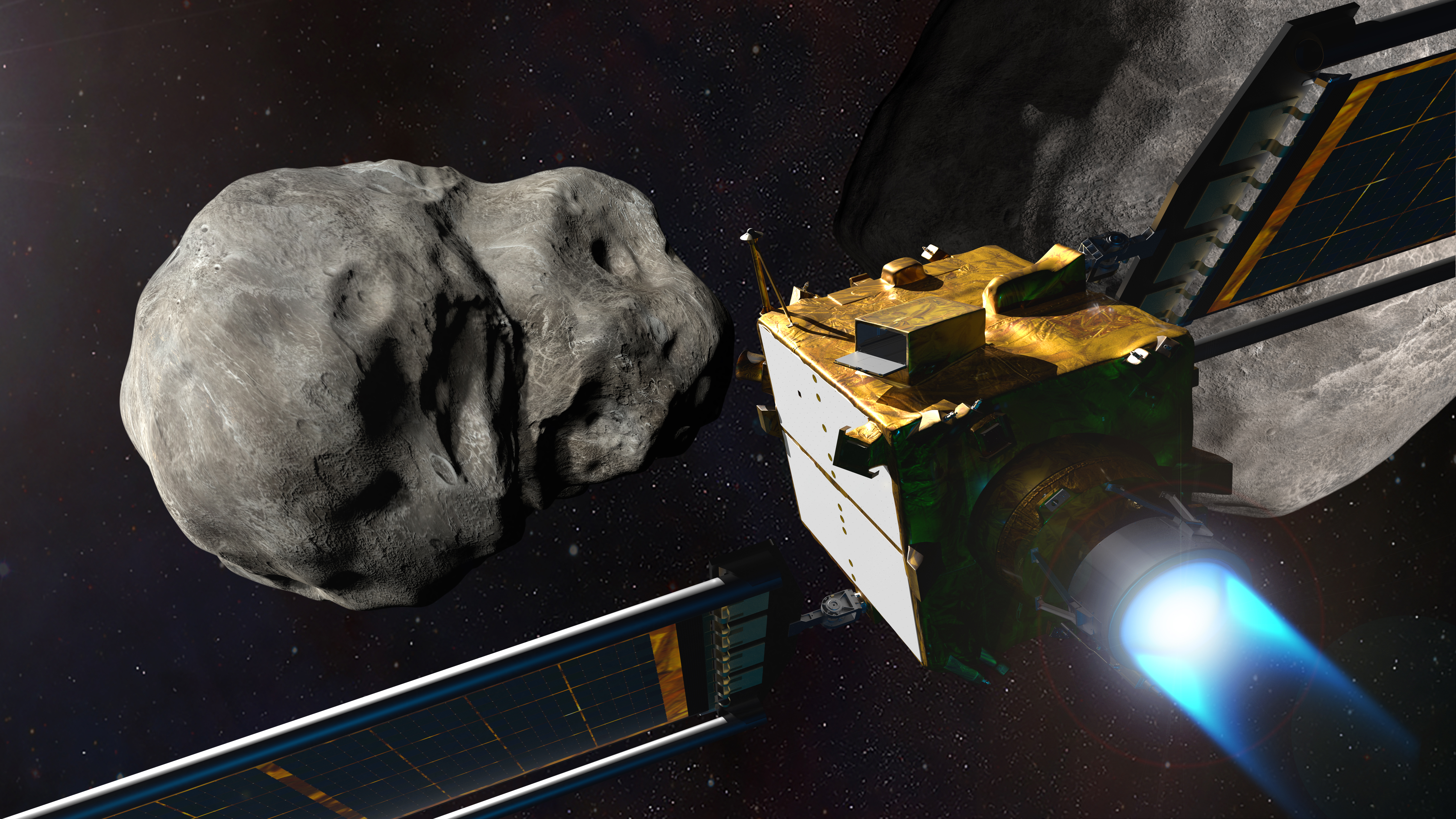
NASA’s DART, the Double Asteroid Redirection Test mission, struck the small asteroid Dimorphos, which is in orbit around the larger asteroid Didymos, in September 2022. DART was a ‘kinetic impactor’ – effectively a projectile that slammed into the asteroid with enough energy to nudge it into a new orbit, thereby proving that it is possible to deflect an asteroid that could be on a collision course with Earth.
A European Space Agency mission called Hera will follow-up on the DART impact when it reaches Didymos and Dimorphos in December 2026.
Where DART struck on Dimorphos was of relatively little concern, since the Didymos system is too massive to be deflected onto a collision course with Earth. However, for another hazardous asteroid orbiting the Sun, even a small variation in its orbit could send it through a gravitational keyhole.
The keyhole effect revolves around a small region of space where a planet’s gravity can modify a passing asteroid’s orbit such that it returns on a collision course with that planet at a later date. In this way, a gravitational keyhole unlocks more dangerous orbits.
Should a kinetic impactor mission similar to DART nudge a hazardous asteroid so that it passes through a gravitational keyhole, then it only postpones the danger.
“If an asteroid passed through one of these keyholes, its motion through the Solar System would steer it onto a path that causes it to hit Earth in the future,” said Makadia.
The trick, therefore, is to find the best spot on the surface of an asteroid to impact with a spacecraft so that the chances of pushing it through the keyhole are minimised.
Each point on the surface of an asteroid has a different probability of sending the asteroid through a gravitational keyhole after deflection by a kinetic impactor. Makadia’s team has therefore developed a technique for computing probability maps of an asteroid’s surface. Their method uses the results from DART as a guide, although each asteroid, with its own characteristics, will be subtly different.
The asteroid’s shape, surface topology (hills, craters etc), rotation and mass all must be determined first. Ideally this would be done with a space mission to rendezvous with the asteroid, producing high-resolution images and data. However, this might not be possible for all threatening asteroids, particularly if the time between discovery and impact on Earth is short.
“Fortunately, this entire analysis, at least at a preliminary level, is possible using ground-based observations alone, although a rendezvous mission is preferred,” said Makadia.
By computing the subsequent trajectory of the asteroid following a kinetic impact, and seeing which trajectories would be the most dangerous, scientists can calculate where the safest location to strike on the asteroid’s surface will be.
“With these probability maps, we can push asteroids away while preventing them from returning on an impact trajectory, protecting the Earth in the long run,” said Makadia.
Further information
EPSC-DPS2025-77 Keyhole-Based Site Selection for Kinetic Impact Deflection of Near-Earth Asteroids
Rahil Makadia, Steven Chesley, Davide Farnocchia and Siegfried Eggl, doi.org/10.5194/epsc-dps2025-77
The work was funded by a NASA Space Technology Graduate Research Opportunities (NSTGRO) award, NASA contract No. 80NSSC22K1173.
Information on DART can be found at https://dart.jhuapl.edu/. Details relating to Hera are available at https://www.esa.int/Space_Safety/Hera.
Images
An artwork of NASA’s DART mission, which was a kinetic impactor designed to test whether it is possible to deflect an asteroid. Image credit: NASA/Johns Hopkins APL.

https://dart.jhuapl.edu/Gallery/media/graphics/lg/DART_still-revisedA.jpg
One of the keyhole probability maps of the asteroid Bennu, The crosshair corresponds to the location on the surface that minimises the asteroid impact hazard after deflection. The maps assume a 25-metre targeting uncertainty for a kinetic impactor mission. As a result, deflection sites that could result in the kinetic impactor missing as a result of this uncertainty are not considered and form a grey boundary around the targetable region of the asteroid. Image credit: Rahil Makadia.

You can watch an animation of the keyhole probability map of Bennu here:
https://youtube.com/watch?v=XYPD-pKwqNs
Contacts
Rahil Makadia
University of Illinois, Urbana–Champaign
makadia2@illinois.edu
EPSC–DPS 2025 Press Office
press@europlanet.org
Notes for Editors
About the Joint Meeting of the Europlanet Science Congress and the Division of Planetary Sciences (EPSC-DPS)
The Europlanet Science Congress (EPSC), established in 2006 as the European Planetary Science Congress, is the largest planetary science meeting in Europe. It covers the entire range of planetary sciences, with an extensive mix of talks, workshops and poster sessions, as well as providing a unique space for networking and exchanges of experiences.
EPSC joined forces for the first time with the American Astronomical Society’s Division for Planetary Sciences (DPS) for a joint meeting in Nantes, France, in 2011. This was followed by DPS-EPSC 2016 in Pasadena, EPSC-DPS 2019 in Geneva, and the return to the United States for the DPS-EPSC 2023 meeting in San Antonio. This year will mark the third iteration of a joint European-based meeting. The intent of the joint meetings is not only to connect the European and North American planetary science communities, but also to consolidate two major meetings and motivate planetary scientists from all over the globe to attend. With around 1800 participants expected to join in person and online, EPSC-DPS2025 will be the largest planetary science meeting held to date in Europe.
Follow on social media (Bluesky, X and LinkedIn) with the hashtag #EPSC-DPS2025 for updates on the meeting.
About Europlanet
Europlanet (europlanet.org) is a non-profit association and membership organisation that provides the planetary science community with access to research infrastructure, services and training. The Europlanet Association Sans But Lucratif (AISBL), established in 2023, builds on the heritage of a series of projects funded by the European Commission between 2005 and 2024 (Grant Numbers 871149, 654208, 228319 and RICA-CT-2004-001637) to support the planetary science community in Europe and around the world.
About the DPS
The Division for Planetary Sciences (DPS), founded in 1968, is the largest special-interest Division of the American Astronomical Society (AAS). Members of the DPS study the bodies of our own solar system, from planets and moons to comets and asteroids, and all other solar-system objects and processes. With the discovery that planets exist around other stars, the DPS has expanded its scope to include the study of extrasolar planetary systems as well. The American Astronomical Society (AAS), established in 1899, is the major organization of professional astronomers in North America. The mission of the AAS is to enhance and share humanity’s scientific understanding of the universe as a diverse and inclusive astronomical community, which it achieves through publishing, meeting organization, science advocacy, education and outreach, and training and professional development.