1st Media Invitation: EPSC-DPS2025, 7 – 12 September 2025, Finlandia Hall, Helsinki, Finland
Joint Meeting of the Europlanet Science Congress and the American Astronomical Society’s Division of Planetary Science (EPSC-DPS2025)
The Europlanet Science Congress 2025 will be held jointly with the annual meeting of the American Astronomical Society’s Division of Planetary Science (EPSC-DPS2025) from 7–12 September 2025 at Finlandia Hall, Helsinki, Finland.
EPSC-DPS2025 covers the full spectrum of planetary research and technology across 74 scientific sessions, with topics including the latest results on Solar System, exoplanetary and interstellar bodies, current and upcoming missions, ground-based observations, the use of artificial intelligence and machine learning in planetary science, planetary defence, and the emergence of life in our Solar System and beyond. The programme is supplemented by keynotes, debates, community events and the Europlanet Space Innovation Night (E-SPIN). Around 1900 oral and poster presentations have been submitted and almost 2000 planetary scientists from Europe and around the world are expected to attend the conference.
EPSC-DPS2025 will take place as a fully hybrid meeting, with the possibility of live virtual participation in all standard scientific sessions.
Press briefings will be livestreamed and press notices on presentations of interest to the media will be issued by the EPSC-DPS2025 Press Office during the meeting. Details of press briefings and livestream access will be circulated closer to the time.
Details of the scientific sessions and the presentation abstracts can be found at the official website: https://www.epsc-dps2025.eu
Media representatives are cordially invited to attend the EPSC-DPS2025 meeting. Media registration is free. Any bona fide media delegates can register by e-mailing aheward@europlanet.org.
About the Joint Meeting of the Europlanet Science Congress and the Division of Planetary Sciences (EPSC-DPS)
The Europlanet Science Congress (EPSC), established in 2006 as the European Planetary Science Congress, is the largest planetary science meeting in Europe. It covers the entire range of planetary sciences, with an extensive mix of talks, workshops and poster sessions, as well as providing a unique space for networking and exchanges of experiences.
EPSC joined forces for the first time with the American Astronomical Society’s Division for Planetary Sciences (DPS) for a joint meeting in Nantes, France, in 2011. This was followed by DPS-EPSC 2016 in Pasadena, EPSC-DPS 2019 in Geneva, and the return to the United States for the DPS-EPSC 2023 meeting in San Antonio. This year will mark the third iteration of a joint European-based meeting. The intent of the joint meetings is not only to connect the European and North American planetary science communities, but also to consolidate two major meetings and motivate planetary scientists from all over the globe to attend.
Follow on social media (Bluesky, X and LinkedIn) with the hashtag #EPSC-DPS2025 for updates on the meeting.
Sharing Material at EPSC-DPS2025
Due to author copyright privileges, it is prohibited to retain or share any scientific material contained in any oral or poster presentation or supplementary material if a presenter has marked the material as “restricted” and/or used the “no-sharing” icon.
Images
Finlandia Hall. Credit: EuroplanetFinlandia Hall, Helskinki, venue for the EPSC-DPS Joint Meeting 2025. Credit: Daderot / CC0
About Europlanet
Europlanet (www.europlanet.org) is a non-profit association and membership organisation that provides the planetary science community with access to research infrastructure, services and training. The Europlanet Association Sans But Lucratif (AISBL), established in 2023, builds on the heritage of a series of projects funded by the European Commission between 2005 and 2024 (Grant Numbers 871149, 654208, 228319 and RICA-CT-2004-001637) to support the planetary science community in Europe and around the world.
About the DPS
The Division for Planetary Sciences (DPS), founded in 1968, is the largest special-interest Division of the American Astronomical Society (AAS). Members of the DPS study the bodies of our own solar system, from planets and moons to comets and asteroids, and all other solar-system objects and processes. With the discovery that planets exist around other stars, the DPS has expanded its scope to include the study of extrasolar planetary systems as well. The American Astronomical Society (AAS), established in 1899, is the major organization of professional astronomers in North America. The mission of the AAS is to enhance and share humanity’s scientific understanding of the universe as a diverse and inclusive astronomical community, which it achieves through publishing, meeting organization, science advocacy, education and outreach, and training and professional development.
The Co-Chairs of the EPSC SOC, are responsible for ensuring that the SOC carries out its duties to oversee the scientific programme of EPSC, including:
To maintain and develop EPSC as the major annual meeting in Europe on planetary science and related fields
To ensure that EPSC covers the full spectrum of scientific topics related to planetary science
To promote discussion on scientific topics and interactive opportunities within the meeting
To promote, encourage and support the Europlanet’s commitment to diversity and ensure that all scientific activities within EPSC are representative of the diverse community, balancing gender, career age and nationality.
Responsibilities include:
Chairing the SOC, including convening meetings and oversight of the Session Conveners and Session Chairs in carrying out their duties to define the scientific programme.
Serving as a member of the EPSC Committee and giving reports on SOC activities.
Overseeing logistical requirements for oral and poster sessions (room and poster capacities, etc.)
Disseminating information on EPSC scientific programme.
Please note that a current Europlanet membership is required in order to be eligible for these positions.
The EPSC Committee Incoming Chair is responsible for:
Serving as a member of the EPSC Committee.
Supporting the EPSC Committee Chair in the commission of their duties.
Standing in for the Chair as required.
The EPSC Committee Incoming Chair is responsible for:
Together with the EPSC Committee Chair, Copernicus and the wider EPSC Committee, maintaining oversight of the budget for EPSC and ensuring that the conference does not operate at a loss.
Together with the EPSC Committee Chair
Convening monthly EPSC Committee meetings and ensuring that appropriate records and actions are maintained and circulated.
Leading the EPSC Committee in supporting the Scientific Organising Committee (SOC), Virtual Organising Committee (VOC), Local Organising Committee (LOC) and Copernicus in the practical delivery of EPSC meetings.
Extending invitations to high-level speakers and guests at EPSC.
Updating the Code of Conduct and guidelines for EPSC.
Disseminating information from the EPSC Committee to the community.
Ensuring that EPSC overall upholds Europlanet’s commitment to diversity.
Overseeing incident reporting procedures.
Preparing reports for the Europlanet Executive Board on EPSC (including collated summaries of activities by the SOC, VOC and LOC) and overseeing evaluation of feedback from EPSC participants.
Working with the EPSC Committee, Copernicus and Executive Office in preparing calls for proposals of venues for future EPSC meetings and overseeing selection process.
Liaising with the American Astronomical Society’s Division of Planetary Sciences in preparation of join EPSC/DPS meetings.
Liaising with other Europlanet bodies in preparation for Europlanet community events around EPSC.
Organising calls for bursary schemes in collaboration with Europlanet’s Executive Board and Executive Office.
The EPSC committee, the DPS Committee, the Scientific Organizing Committee and Copernicus Meetings invite the world-wide community of planetary scientists to submit an abstract for presentation of their recent work at the EPSC-DPS2025 meeting, which will take place at the Finlandia Hall Helsinki, Finland, 7–12 September 2025. EPSC-DPS2025 will be organised as a fully hybrid meeting and will allow virtual access to all oral and poster sessions.
We are looking forward to meeting everyone in person this year in Helsinki. The ethos for EPSC-DPS2025 is to create a simple, flexible, and inclusive meeting that provides multiple opportunities for interaction, scientific discussion, and networking. The programme of the congress will contain oral and poster sessions, as well as workshops and panel discussions.
The current list of sessions is organised around the following Programme Groups:
Small Bodies (comets, KBOs, rings, asteroids, meteorites, dust) (SB)
Exoplanets, Origins of Planetary Systems and Astrobiology (EXOA)
Outreach, Diversity, Amateur Astronomy (ODAA)
Submit your abstract now by accessing the scientific programme and the abstract submission tool:
Please browse the list of sessions and identify the session that most closely matches your area of interest; your abstract can be submitted directly to that session.
For future deadlines including (early) registration, refer to the deadlines & milestones of the conference.
Information on registration and social events, as well as a separate online form for requesting splinter meetings & workshops will also be available soon on the meeting website.
We look forward to seeing you in Helsinki!
Lena Noack & Noah Jäggi on behalf of the EPSC committee
Athena Coustenis & Scott Murchie on behalf of the DPS committee
Stavro Ivanovski, Ákos Kereszturi, Connor Nixon, and James Roberts on behalf of the Scientific Organizing Committee
Europlanet Announces Career Medals – Call Now Open
Deadline for nominations: 15 April 2025
Europlanet has launched a new annual set of awards. The Europlanet Career Medals are an opportunity to honour outstanding contributions from individuals of three different scientific career stages to the scientific fields covered by the Europlanet Science Congress (EPSC).
One Europlanet Medal each will be awarded in the categories Early-Career, Mid-Career and Lifetime Achievement. The categories are based on the scientific age of a researcher at time of submission. The Europlanet Mid-Career Medal will honour the memory and the outstanding figure of Paolo Farinella (1953-2000), an extraordinary scientist and person, in whose name the Paolo Farinella Prize (2011-2024) was previously awarded.
The EPSC Outstanding Poster Contest (OPC) is an opportunity for early career researchers to have their work recognised at EPSC.
Posters entered for the EPSC2024 OPC were judged based on 1) the relevance of the study, 2) the scientific accuracy, as well as 3) the clarity of presentation. Participation was open to all BSc or MSc students, PhD candidates, as well as scientists that obtained their last degree after 1 January in 2024.
Gravity Study Gives Insights into Hidden Features Beneath Lost Ocean of Mars and Rising Olympus Mons
Studies of gravity variations at Mars have revealed dense, large-scale structures hidden beneath the sediment layers of a lost ocean. The analysis, which combines models and data from multiple missions, also shows that active processes in the martian mantle may be giving a boost to the largest volcano in the Solar System, Olympus Mons. The findings have been presented this week at the Europlanet Science Congress (EPSC) in Berlin by Bart Root of Delft University of Technology (TU Delft).
Mars has many hidden structures, such as ice deposits, but the features discovered in the northern polar plains are a mystery because they are covered with a thick and smooth sediment layer believed to deposited on ancient seabed.
“These dense structures could be volcanic in origin or could be compacted material due to ancient impacts. There are around 20 features of varying sizes that we have identified dotted around the area surrounding the north polar cap – one of which resembles the shape of a dog,” said Dr Root. “There seems to be no trace of them at the surface. However, through gravity data, we have a tantalising glimpse into the older history of the northern hemisphere of Mars.”
Dr Root and colleagues from TU Delft and Utrecht University used tiny deviations in the orbits of satellites to investigate the gravity field of Mars and find clues about the planet’s internal mass distribution. This data was fed into models that use new observations from NASA’s Insight mission on the thickness and flexibility of the martian crust, as well as the dynamics of the planet’s mantle and deep interior, to create a global density map of Mars.
The density map shows that the northern polar features are approximately 300-400 kg/m3 denser than their surroundings. However, the study also revealed new insights into the structures underlying the huge volcanic region of Tharsis Rise, which includes the colossal volcano, Olympus Mons.
Although volcanoes are very dense, the Tharsis area is much higher than the average surface of Mars, and is ringed by a region of comparatively weak gravity. This gravity anomaly is hard to explain by looking at differences in the martian crust and upper mantle alone. The study by Dr Root and his team suggests that a light mass around 1750 kilometres across and at a depth of 1100 kilometres is giving the entire Tharsis region a boost upwards. This could be explained by huge plume of lava, deep within the martian interior, travelling up towards the surface.
“The NASA InSight mission has given us vital new information about the hard outer layer of Mars. This means we need to rethink how we understand the support for the Olympus Mons volcano and its surroundings,” said Dr Root. “It shows that Mars might still have active movements happening inside it, affecting and possibly making new volcanic features on the surface.”
Dr Root is part of the team proposing the Martian Quantum Gravity (MaQuls) mission, which aims to use technology developed for missions like GRAIL and GRACE on the Moon and Earth respectively to map in detail the gravity field of Mars.
“Observations with MaQuIs would enable us to better explore the subsurface of Mars. This would help us to find out more about these mysterious hidden features and study ongoing mantle convection, as well as understand dynamic surface processes like atmospheric seasonal changes and the detection of ground water reservoirs,” said Dr Lisa Wörner of DLR, who presented on the MaQuIs mission at EPSC2024 this week.
Images
Gravity map of Mars. The red circles show prominent volcanoes on Mars and the black circles show impact crates with a diameter larger than a few 100 km. A gravity high signal is located in the volcanic Tharsis Region (the red area in the centre right of the image), which is surrounded by a ring of negative gravity anomaly (shown in blue). Credit: Root et al.
Map highlighting the dense gravitational structures in the northern hemisphere. The regions denoted by the black lines are high mass anomalies that do not show any correlation with geology and topography. These hidden subsurface structures are covered by sediments from an old ocean. Their origin is still a mystery and a dedicated gravity mission, like MaQuIs, is needed to reveal their nature. Credit: Root et al.
Root, B., Alkahal, R., Qin, W., and Thieulot, C.: Exploration of high mass subsurface structures in the northern hemisphere with joint flexure and mantle convection modelling of the Martian gravity field , Europlanet Science Congress 2024, Berlin, Germany, 8–13 Sep 2024, EPSC2024-730, https://doi.org/10.5194/epsc2024-730.
Woerner, L.: Quantum Technologies for Planetary Geodesy, Europlanet Science Congress 2024, Berlin, Germany, 8–13 Sep 2024, EPSC2024-632, https://doi.org/10.5194/epsc2024-632.
Science contacts
Bart Root Delft University of Technology B.C.Root@tudelft.nl
The Europlanet Science Congress (https://www.epsc2024.eu/), established in 2006 as the European Planetary Science Congress, is the largest planetary science meeting in Europe and regularly attracts around 1200 participants. It covers the entire range of planetary sciences with an extensive mix of talks, workshops and poster sessions, as well as providing a unique space for networking and exchanges of experiences.
Follow on X/Twitter via @europlanetmedia and using the hashtag #EPSC2024.
About Europlanet
Europlanet (www.europlanet-society.org) is a not-for-profit association that provides the planetary science community with access to research infrastructure and services. The Europlanet Association Sans But Lucratif (AISBL), established in 2023, builds on the heritage of a series of projects funded by the European Commission between 2005 and 2024 to support the planetary science community in Europe and around the world. Today, Europlanet is an independent membership organisation that provides mobility programmes, community services and training.
Europlanet received funding from the European Union’s Horizon 2020 research and innovation programme under grant agreement numbers 871149 (Europlanet 2024 Research Infrastructure) and 654208 (Europlanet 2020 RI), FP7 under grant agreement number 228319 (Europlanet RI) and FP6 under grant agreement number RICA-CT-2004-001637 (European Planetology Network).
Movie of BepiColombo’s Fourth Mercury Flyby Presented at EPSC2024
Watch the closest flyby of a planet ever, as the ESA/JAXA BepiColombo spacecraft sped past Mercury during its latest encounter on 4 September 2024.
This flyby marked BepiColombo’s closest approach to Mercury yet, and for the first time, the spacecraft had a clear view of Mercury’s south pole.
This timelapse is made up of 128 different images captured by all three of BepiColombo’s monitoring cameras, M-CAM 1, 2 and 3. We see the planet move in and out of the fields of view of M-CAM 2 and 3, before M-CAM 1 sees the planet receding into the distance at the end of the video.
The first few images are taken in the days and weeks before the flyby. Mercury first appears in an image taken at 23:50 CEST (21:50 UTC) on 4 September, at a distance of 191 km. Closest approach was at 23:48 CEST at a distance of 165 km.
The sequence ends around 24 hours later, on 5 September 2024, when BepiColombo was about 243 000 km from Mercury.
During the flyby it was possible to identify various geological features that BepiColombo will study in more detail once in orbit around the planet. Four minutes after closest approach, a large ‘peak ring basin’ called Vivaldi came into view.
This crater was named after the famous Italian composer Antonio Vivaldi (1678–1741). The flyover of Vivaldi crater was the inspiration for using Antonio Vivaldi’s ‘Four Seasons’ as the soundtrack for this timelapse.
Peak ring basins are mysterious craters created by powerful asteroid or comet impacts, so-called because of the inner ring of peaks on an otherwise flattish floor.
A couple of minutes later, another peak ring basin came into view: newly named Stoddart. The name was recently assigned following a request from the M-CAM team, who realised that this crater would be visible in these images and decided it would be worth naming considering its potential interest for scientists in the future.
BepiColombo’s three monitoring cameras provided 1024 x 1024 pixel snapshots. Their main purpose is to monitor the spacecraft’s various booms and antennas, hence why we see parts of the spacecraft in the foreground. The photos that they capture of Mercury during the flybys are a bonus.
The imaages and movie were presented today at the Europlanet Science Congress (EPSC) 2024 in Berlin.
The 4 September gravity assist flyby was the fourth at Mercury and the seventh of nine planetary flybys overall. During its eight-year cruise to the smallest and innermost planet of the Solar System, BepiColombo makes one flyby at Earth, two at Venus and six at Mercury, to help steer itself on course for entering orbit around Mercury in 2026.
BepiColombo is an international collaboration between ESA and JAXA.
A new volcano has been spotted on Jupiter’s moon Io, the most geologically active place in the Solar System. Analysis of the first close-up images of Io in over 25 years, captured by the JunoCam instrument on NASA’s Juno mission, reveal the emergence of a fresh volcano with multiple lava flows and volcanic deposits covering an area about 180 kilometres by 180 kilometres. The findings have been presented at the Europlanet Science Congress (EPSC) in Berlin this week.
The new volcano is located just south of Io’s equator. Although Io is covered with active volcanoes, images taken during NASA’s Galileo mission in 1997 did not see a volcano is in this particular region – just a featureless surface.
“Our recent JunoCam images show many changes on Io, including this large, complicated volcanic feature that appears to have formed from nothing since 1997,” said Michael Ravine, Advanced Projects Manager at Malin Space Science Systems, Inc, which designed, developed and operates JunoCam for the NASA Juno Project.
The eastern side of the volcano is stained a diffuse red from sulphur that has been vented by the volcano into space and fallen back onto Io’s surface. On the western side, two dark streams of lava have erupted, each running for about a hundred kilometres. At the farthest point of the flows, where the lava has pooled, the heat has caused the frozen material on the surface to vaporise, generating two overlapping grey circular deposits.
The best JunoCam image of this feature, east of an existing volcano called Kanehekili, was taken on 3 February 2024 from a distance of 2,530 kilometres and at a scale of 1.7 kilometres per pixel. The images were captured the nightside of Io with the illumination coming only from Jupiter.
This encounter was one of three recent flybys of Io in 2023 and 2024, during which JunoCam acquired around 20 close-up visible colour images. JunoCam observed a total of nine plumes associated with active volcanic features on the moon, as well as other changes, such as new lava flows and other surface deposits.
The JunoCam data are posted on the mission’s website (missionjuno.swri.edu) soon after being received on Earth to enable the public to create images of Jupiter and its moons.
“JunoCam images are created by people from all walks of life, providing a way for anyone to join our science team and share in the excitement of space exploration,” said Scott Bolton, the Principal Investigator of NASA’s Juno mission at Southwest Research Institute.
Further Information
This work was funded by the National Aeronautics and Space Administration through the Juno Project. Junocam images are available at https://www.missionjuno.swri.edu and are archived with NASA’s Planetary Data System (PDS).
EPSC2024-731 – Results from recent close-up imaging of Io by JunoCam (perijoves 57, 58 and 60)
Michael Ravine, Candice Hansen, Michael Caplinger, Paul Schenk, Leslie Lipkaman Vittling, Daniel Krysak, Jason Perry, David Williams,Jani Radebaugh, Madeline Pettine, James Keane, Alexander Hayes, Julie Rathbun, and Scott Bolton. https://doi.org/10.5194/epsc2024-731
Images
A comparison of JunoCam data from February 2024 with Galileo spacecraft imagery of the same area in November 1997 (greyscale insert) reveals a new volcanic feature on the surface of Jupiter’s moon, Io. Credit: NASA/JPL-Caltech/SwRI/MSSS/Europlanet.
Illustration indicating the size of the lava flows relative to Berlin, the host city for the Europlanet Science Congress (EPSC) 2024. Credit: NASA/JPL-Caltech/SwRI/MSSS/Europlanet/Google Maps.
JunoCam’s 3 February 2024 Io encounter sequence of images (the first two images show Io illuminated by Jupiter-shine). The new volcano discussed above was captured in the second image in the sequence. Credit: NASA/JPL-Caltech/SwRI/MSSS.
A side-by-side comparison of Galileo spacecraft imagery in November 1997 (left) with JunoCam data of the same area from February 2024 (right), reveals a new volcanic feature on the surface of Jupiter’s moon, Io. Credit: NASA/JPL-Caltech/SwRI/MSSS.
Contacts
Michael Ravine Malin Space Science Systems Inc. San Diego, USA ravine@msss.com
The Europlanet Science Congress (https://www.epsc2024.eu/), established in 2006 as the European Planetary Science Congress, is the largest planetary science meeting in Europe and regularly attracts around 1200 participants. It covers the entire range of planetary sciences with an extensive mix of talks, workshops and poster sessions, as well as providing a unique space for networking and exchanges of experiences.
Follow on X/Twitter via @europlanetmedia and using the hashtag #EPSC2024.
About Europlanet
Europlanet (www.europlanet-society.org) is a not-for-profit association that provides the planetary science community with access to research infrastructure and services. The Europlanet Association Sans But Lucratif (AISBL), established in 2023, builds on the heritage of a series of projects funded by the European Commission between 2005 and 2024 to support the planetary science community in Europe and around the world. Today, Europlanet is an independent membership organisation that provides mobility programmes, community services and training.
Europlanet received funding from the European Union’s Horizon 2020 research and innovation programme under grant agreement numbers 871149 (Europlanet 2024 Research Infrastructure) and 654208 (Europlanet 2020 RI), FP7 under grant agreement number 228319 (Europlanet RI) and FP6 under grant agreement number RICA-CT-2004-001637 (European Planetology Network).
The Europlanet Science Congress (EPSC) Executive Committee is delighted to announce that EPSC2026 will be hosted at the Amare venue in The Hague, Netherlands from 6-11 September 2026. The Co-chairs of the Local Organising Committee will be Dr Sebastiaan de Vet (TU Delft) and Prof Inge Loes ten Kate (Utrecht University).
EPSC2027 will be hosted at the Pierre Baudis Congress Centre in Toulouse, France from 19-24 September 2027. The Local Organising Committee will be chaired by Nicolas André (IRAP).
Congratulations to both hosts. We look forward to seeing everyone there!
Cloud Atlas of Mars Showcases Array of Atmospheric Phenomena
Cloud enthusiasts have a new tool to investigate striking formations in the skies above the Red Planet. A browsable database of 20-years-worth of images of clouds and storms, created by the German Aerospace Centre (DLR) in Berlin, is helping scientists better understand how and where features arise in the martian atmosphere and what they can tell us about the climate of Mars and other planets. The Mars ‘Cloud Atlas’, which is available to the public, has been presented this week at the Europlanet Science Congress (EPSC) 2024 in Berlin by Daniela Tirsch of DLR.
The images in the Cloud Atlas have been captured by the High Resolution Stereo Camera (HRSC) instrument, which has been in orbit on board the European Space Agency (ESA) Mars Express spacecraft since 2003. Although Mars has a very thin atmosphere, numerous cloud formations and dust storm phenomena can develop from water and carbon dioxide ice crystals as well as dust particles.
“Clouds on Mars are just as diverse and fascinating as those we see in our skies on Earth, with some features unique to the Red Planet. One of my favourite phenomena are the beautiful ‘cloud streets’ – linear rows of fleecy clouds that develop around the huge volcanic Tharsis rise and the northern lowlands in northern spring and summer. While they resemble cumulus clouds on Earth, they are formed under different atmospheric conditions,” said Dr Tirsch. “We also see impressive dust clouds that can spread hundreds of kilometres – a phenomena we luckily don’t experience on Earth.”
Dust plays a major role in the atmosphere and climate of Mars. Rare upwelling events can leave beige, dust-laden blobs hanging in the atmosphere. Large differences in temperature and air pressure at certain seasons can result in stronger-than-usual winds that lift large amounts of dust from the Martian surface. Dust clouds spreading from the tops of giant volcanoes take on the appearance of eruption clouds, although they are no longer active.
Large spiral dust storms and cyclone systems can also be observed each year near the Martian north pole. Studying these phenomena is crucial to scientists in understanding the atmosphere and air mass circulation on Mars.
Rippling ‘gravity clouds’ are one of the most common formations on both Mars and the Earth. Seen at mid-latitudes in winter for both hemispheres, as well as over the Tharsis volcanic plateau in southern winter. Lee waves, a special type of gravity clouds, can build up on the downwind side of ridges, mountains and other obstacles to create repeating ridge formations.
Some types of clouds studied are specific to locations and seasons; others like ‘twilight clouds’ can appear in the early morning at any place or time of year.
The HRSC Cloud Atlas will provide valuable insights into the physical nature and appearance of clouds and storms, the time of their occurrence and their location. This knowledge will help better understand the atmospheric dynamics and the climate cycles on Mars, as well as providing input for studies of the climate on other planets such as Earth and Venus. The DLR team has already used the database to create global maps showing the occurrence of various types of cloud as a function of season and location.
“As Mars Express has been extended by ESA until at least 2026, this will enable us keep filling this database and refine even further our understand of Mars atmosphere,” said Dr Tirsch.
Papers on the database and scientific applications are currently in preparation.
Dust lifting event. This image displays two atmospheric phenomena: the white curved lines are gravity wave clouds, while the brown areas are dust lifted from the ground by wind. The colour shift visible in the dust lifting event might be indicative of very fast winds, a phenomenon currently under investigation by other members of the team. Credit: ESA/DLR/FU Berlin.
Dust lifting event. This image displays two atmospheric phenomena: the white curved lines are gravity wave clouds, while the brown areas are dust lifted from the ground by wind. The colour shift visible in the dust lifting event might be indicative of very fast winds, a phenomenon currently under investigation by other members of the team. Credit: ESA/DLR/FU Berlin.
Lee waves: Lee waves are a special type of cloud created by the wind encountering obstacles and build up on the ‘leeward‘ or downwind side. The geometries of the lee waves depend on the shape of the obstacles. Credit: ESA/DLR/FU Berlin.
Lee waves: Lee waves are a special type of cloud created by the wind encountering obstacles and build up on the ‘leeward‘ or downwind side. The geometries of the lee waves depend on the shape of the obstacles. Credit: ESA/DLR/FU Berlin.
The Europlanet Science Congress (https://www.epsc2024.eu/), established in 2006 as the European Planetary Science Congress, is the largest planetary science meeting in Europe and regularly attracts around 1200 participants. It covers the entire range of planetary sciences with an extensive mix of talks, workshops and poster sessions, as well as providing a unique space for networking and exchanges of experiences.
Follow on X/Twitter via @europlanetmedia and using the hashtag #EPSC2024.
About Europlanet
Europlanet (www.europlanet-society.org) is a not-for-profit association that provides the planetary science community with access to research infrastructure and services. The Europlanet Association Sans But Lucratif (AISBL), established in 2023, builds on the heritage of a series of projects funded by the European Commission between 2005 and 2024 to support the planetary science community in Europe and around the world. Today, Europlanet is an independent membership organisation that provides mobility programmes, community services and training.
Europlanet received funding from the European Union’s Horizon 2020 research and innovation programme under grant agreement numbers 871149 (Europlanet 2024 Research Infrastructure) and 654208 (Europlanet 2020 RI), FP7 under grant agreement number 228319 (Europlanet RI) and FP6 under grant agreement number RICA-CT-2004-001637 (European Planetology Network).
Prof Ravit Helled, of the University of Zurich in Switzerland, has been awarded the 2024 Paolo Farinella Prize for her outstanding contributions to research into ‘the internal structure of planetary bodies: clues on formation processes of the Solar System’. The award ceremony took place today during the Europlanet Science Congress (EPSC) 2024 in Berlin and was followed by a prize lecture by Prof Helled.
The annual prize was established in 2010 to honour the memory of the Italian scientist Paolo Farinella (1953-2000). Each year, the prize acknowledges an outstanding researcher not older than 47 years (the age of Prof Farinella when he passed away) who has achieved important results in one of Prof Farinella’s fields of work. Each edition of the prize focuses on a different research area and, in 2024, the topic covered theoretical, modelling, experimental and observational work on the internal structure of Solar System bodies, including planets, moons and small bodies. The award is supported by the Europlanet Society.
Prof Helled’s research deals with the formation of gaseous-rich planets inside and outside the Solar System. Her research on planetary interiors aims to determine the composition and internal structures of planets. She proposed that the cores of giant planets, which are enriched with heavy elements, might not be distinct from the rest of the deep interior region. This idea that cores are dilute or fuzzy, with some hydrogen and helium contained in the core and a gradual heavy-element structure extending into the deep interior, has since been confirmed by mission data.
Adriano Campo Bagatin, of the University of Alicante in Spain, said on behalf of the Paolo Farinella Prize Committee: “Ravit Helledhas made first-order contributions to our understanding of giant planet formation, structure and evolution. She introduced the idea of dilute cores that was subsequently confirmed by Juno and Cassini measurements of Jupiter and Saturn. She has investigated different possible structures for gas giants and ice giants, both in this Solar System and elsewhere, and has shown how these structures are related to accretion processes. She has a strongly international perspective with involvement in both ESA and NASA spacecraft missions.”
Prof Helled obtained her Bachelor’s degree and PhD from the University of Tel Aviv. She joined the Department of Astrophysics at the University of Zurich in 2016 as Assistant Professor and has been Full Professor since 2023. She is a Co-Investigator on NASA’s Juno and ESA’s Juice missions, a Science Team Member of ESA’s Plato mission and the Interior Working Group Leader and a Consortium Member of ESA’s Ariel mission.
Prof Helled said on receiving the award: “I am very honored to receive the Farinella Prize. I am proud to be part of the planetary science community and thankful for doing research on a daily basis. I also thank my collaborators, students and postdocs who make the science journey so exciting and enjoyable.“
About the Paolo Farinella Prize
The Paolo Farinella Prize (https://www.europlanet.org/paolo-farinella-prize/) was established to honour the memory and the outstanding figure of Paolo Farinella (1953-2000), an extraordinary scientist and person. The prize is awarded in recognition of significant contributions given in the fields of interest of Farinella, which span from planetary sciences to space geodesy, fundamental physics, science popularization, and security in space, weapons control and disarmament. The winner of the prize is selected each year on the basis of their overall research results in a chosen field. Candidates must participate in international and interdisciplinary collaborations, and be not older than 47 years, the age of Farinella when he passed away, at the date of 25 March 2000. The prize was first proposed during the ‘International Workshop on Paolo Farinella the scientist and the man’, held in Pisa in 2010 and supported by the University of Pisa, ISTI/CNR and by IAPS-INAF (Rome), and first awarded in 2011.
The 2024 Paolo Farinella Prize Committee:
Francis Nimmo (Chair. UC Santa Cruz, USA)
Erik Asphaug (Univ. of Arizona, USA)
Ricardo Hueso (Univ. del País Vasco, Spain)
Hauke Hussmann (DLR, Germany)
Catherine Johnson (UBC, Canada)
Adriano Campo Bagatin (Univ. Alicante, Spain)
Paolo Farinella Prize winners:
2011: William Bottke (Physics and dynamics of small Solar System bodies)
2012: John Chambers (Formation and early evolution of the Solar System)
2013: Patrick Michel (Collisional processes in the Solar System)
2014: David Vokrouhlicky (Understanding of the dynamics and physics of Solar System, including how pressure from solar radiation affects the orbits of both asteroids and artificial satellites)
2015: Nicolas Biver (Molecular and isotopic composition of cometary volatiles by means of submillimetre and millimetre ground and space observations)
2016: Kleomenis Tsiganis (Studies of the applications of celestial mechanics to the dynamics of planetary systems, including the development of the Nice model)
2017: Simone Marchi (Understanding the complex problems related to the impact history and physical evolution of the inner Solar System, including the Moon)
2018: Francis Nimmo (Understanding of the internal structure and evolution of icy bodies in the Solar System and the resulting influence on their surface processes)
2019: Scott Sheppard and Chad Trujillo (Observational characterisation of the Kuiper belt and the Neptune-trojan population)
2020: Jonathan Fortney and Heather Knutson (Understanding of the structure, evolution and atmospheric dynamics of giant planets)
2021: Diana Valencia and Lena Noack (Understanding of the interior structure and dynamics of terrestrial and super-Earth exoplanets)
2022: Julie Castillo-Rogez and Martin Jutzi (Asteroids: Physics, Dynamics, Modelling and Observations)
2023: Federica Spoto and Diego Turrini (From superbolides to meteorites: physics and dynamics of small planetary impactors).
The Europlanet Science Congress (https://www.epsc2024.eu/), established in 2006 as the European Planetary Science Congress, is the largest planetary science meeting in Europe and regularly attracts around 1200 participants. It covers the entire range of planetary sciences with an extensive mix of talks, workshops and poster sessions, as well as providing a unique space for networking and exchanges of experiences.
Follow on X/Twitter via @europlanetmedia and using the hashtag #EPSC2024.
About Europlanet
Europlanet (www.europlanet-society.org) is a not-for-profit association and membership organisation that provides the planetary science community with access to research infrastructure, services and training. The Europlanet Internationale Association Sans But Lucratif (AISBL), established in 2023, builds on the heritage of a series of projects funded by the European Commission between 2005 and 2024 to support the planetary science community in Europe and around the world.
Europlanet received funding from the European Union’s Horizon 2020 research and innovation programme under grant agreement numbers 871149 (Europlanet 2024 Research Infrastructure) and 654208 (Europlanet 2020 RI), FP7 under grant agreement number 228319 (Europlanet RI) and FP6 under grant agreement number RICA-CT-2004-001637 (European Planetology Network).
EPSC2024: Final Media Invitation and Details of Media Briefings
ESA Hera Mission – One Month Before Launch; Updates on the ESA/JAXA BepiColombo Mission to Mercury: The Closest Flyby of a Planet Ever
The 2024 Europlanet Science Congress (EPSC2024) is taking place this week in hybrid format at the Henry Ford Building of the Freie Universität Berlin, Germany, and online.
EPSC2024 covers the full spectrum of planetary research and technology across more than 60 scientific sessions. More than 1200 oral and poster presentations have been submitted and around 1200 planetary scientists from Europe and around the world are attending the conference. Media representatives are cordially invited to attend EPSC2024. Media registration is free. Any bona fide media delegates can register by e-mailing aheward@europlanet-society.org.
Press Briefing, Friday, 13 September 2024
A press briefing will be held on Friday, 13 September at the Henry Ford Building of the Freie Universität Berlin and online. The briefing will cover two topics, with the following programme:
12:05 CEST: ESA Hera Mission: One Month Before Launch In just under one month, ESA’s Hera mission will set off to make a detailed post-impact survey of the asteroid moonlet Dimorphos, which was impacted by NASA’s DART mission on 26 September 2022. Representatives of the Hera team will discuss expectations, current status and future plans for the mission, and summarise results from data extracted from DART to date.
Speakers:
Michael Küppers, ESA Hera Project Scientist, European Space Astronomy Centre (ESAC), Spain
Patrick Michel, Hera Mission Principal Investigator, DART Investigation Team, Director of Research at CNRS, Observatoire de la Côte d’Azur, France.
12:30 CEST: Updates on the ESA/JAXA BepiColombo Mission to Mercury: The Closest Flyby of a Planet Ever Following the successful flyby of Mercury by the joint ESA/JAXA BepiColombo mission on 4 September 2024, members of the mission and science team will present an update on the latest rendezvous, plans for the remainder of the mission, as well as results from previous flybys.
Speakers:
Johannes Benkhoff and Geraint Jones, ESA BepiColombo Project Scientists, ESA-ESTEC, Netherlands
Prof Yasumasa Kasaba, Tohoku University, Japan and PI of PWI instrument on the JAXA spacecraft Mio
Note: Additional speakers may join.
To attend press briefings in-person, please make sure that you have received a TAN code waiver and registered as media for EPSC2024 by emailing aheward@europlanet-society.org. To attend online, please follow the Zoom registration links below and you will receive a confirmation email containing information about joining the live stream.
The Europlanet Science Congress (https://www.epsc2024.eu/), established in 2006 as the European Planetary Science Congress, is the largest planetary science meeting in Europe and regularly attracts around 1200 participants. It covers the entire range of planetary sciences with an extensive mix of talks, workshops and poster sessions, as well as providing a unique space for networking and exchanges of experiences.
Follow on Twitter via @europlanetmedia and using the hashtag #EPSC2024.
About Europlanet
Europlanet (www.europlanet-society.org) is a not-for-profit association and membership organisation that provides the planetary science community with access to research infrastructure, services and training. The Europlanet Association Sans But Lucratif (AISBL), established in 2023, builds on the heritage of a series of projects funded by the European Commission between 2005 and 2024 to support the planetary science community in Europe and around the world.
Europlanet received funding from the European Union’s Horizon 2020 research and innovation programme under grant agreement numbers 871149 (Europlanet 2024 Research Infrastructure) and 654208 (Europlanet 2020 RI), FP7 under grant agreement number 228319 (Europlanet RI) and FP6 under grant agreement number RICA-CT-2004-001637 (European Planetology Network).
On behalf of Europlanet, welcomes to Berlin for the Europlanet Science Congress (EPSC) 2024! With 1075 in-person participants and 66 virtual registrations so far – we are looking forward to probably our largest stand-alone meeting to date.
We start proceedings at 16:30 this afternoon with the Icebreaker Reception, followed by the Diversity Keynote. Tomorrow, scientific sessions begin at 08:30 and the Opening Ceremony at 16:15.
Many thanks to all the Local Organising Committee, the Scientific Organising Committee, the Conveners, the EPSC Committee, the EPEC Early Career Network, the Europlanet Society Board, Committees and Working Groups and, especially, the team at Copernicus, who have put such an exciting week together.
If you want to find out more about Europlanet, the organisation behind EPSC, come by our stand in the exhibition.
Get creative with Europlanet’s #InspiredByOtherWorlds arts contest 2024
**Deadline Extended**
(Update from original post on 11 March 2024)
The Europlanet Science Congress (EPSC) 2024 is inviting schools and space enthusiasts of all ages to get creative and share their artworks and performances inspired by other worlds in a contest called#InspiredByOtherWorlds.
The theme this year is ‘Returning to Earth’.
About the contest
With missions like OSIRIS-REx and Hayabusa2 in the headlines, this year’s contest looks at ideas around returning to Earth samples and clues on the origin of our Solar system and life!
Art is meant to inspire. Art is meant to be shared. Art allows us to go beyond our limits. Planetary science takes us beyond the limits of our world. What happens when a passion for art and a passion for exploring planets and other worlds meet? Let your imagination take us on a voyage through our Solar System and back to Earth! Show us how you have been inspired to create drawings, storytelling, pictures, videos, stop-motion animations, models, craft works or art installations at home.
The deadline for the competition has been extended to 30 September 2024.
Entries for #InspiredByOtherWorldswill be showcased during EPSC2024 in Berlin.
All artworks submitted will be judged by a panel of planetary scientists and artists. The winning artworks or performances will be shared via the Europlanet website, newsletters and social media and will be used to inspire young people in future Europlanet outreach activities.
So get creating!
Rules
For all the information about the contest, see the #InspiredByOtherWorlds FAQ page. If you’d also like to share on social media please use the hashtags #InspiredByOtherWorlds#EPSC2024.
Questions
If you have any questions, please contact stavro.ivanovski@inaf.it .
Acknowledgements
The #InspiredByOtherWorlds arts contest 2024 is supported by the Europlanet Society, the Europlanet Science Congress (EPSC) and Lecturers Without Borders.
Planetary Perspectives: Meet the New Europlanet Society Board
This edition of Planetary Perspectives highlights opportunities within space industry for early careers in an interview with Yoga Barrathwaj Raman Mohan (Blue Skies Space Ltd/Europlanet Industry Team).
Europlanet Telescope Network: Small-Scale Facilities Lead to Large-Scale Successes
As the Europlanet Telescope Network celebrates its fourth birthday, Gražina Tautvaišienė (Vilnius University, Lithuania), Guenter Kargl (Austrian Academy of Sciences, Austria) and Anita Heward (University of Kent, UK) reflect on the achievements to date.
Engaging With Embassies
Nigel Mason (Coordinator of Europlanet 2024 RI) gives guidance on how to approach embassies and an example of the outcome of a collaboration between embassies in the UK and Hungary.
Little Venus in the Middle of the Atlantic
Uli Köhler (DLR, Germany) reports on an expedition to Iceland that is helping to prepare for NASA and ESA missions to Venus at the beginning of the next decade.
The Future of Sample Return
Peter McArdle, Hans Huybrighs, J D Prasanna Deshapriya and Ottaviano Rüsch of the Europlanet Early Careers (EPEC) Future Research Working Group interview Enrica Bonato, who developed the sample return lab at at the German Aerospace Center (DLR) in Berlin.
SPIDER: Supporting Space Weather Studies Through the Solar System
Nicolas André (Institut de Recherche en Astrophysique et Planétologie, France) and Andrea Opitz (HUN-REN Wigner Research Centre for Physics, Hungary) describe how Europlanet’s SPIDER services are supporting planetary space weather studies and Solar System missions.
Beautiful But Not Hospitable – A Sensory Tour of the Solar System’s Planets
Anita Heward (Europlanet/University of Kent, UK) and Thibaut Roger (University of Bern, Switzerland) report on reactions to an unusual scent at the Swiss Comic Con.
Workshops for Global Collaboration
Barbara Cavalazzi (University of Bologna, Italy) reviews a series of workshops organised by Europlanet in Africa and South America.
Stories of Planetary Mapping
Riccardo Pozzobon and Matteo Massironi (University of Padova, Italy) explains how Europlanet’s GMAP activity has created infrastructure to support geological mappers around the world.
Commkit – Should You Augment or Virtualise Your Reality?
Thibaut Roger (University of Bern/NCCR PlanetS, Switzerland) examines how to incorporate VR and AR in your outreach and communication.
The Last Word – Europlanet Beyond 2024
Ann Carine Vandaele, President of the Europlanet Society, and Nigel Mason, Coordinator of the Europlanet 2024 Research Infrastructure (RI) reveal a new phase for Europlanet.
The Europlanet Science Congress (EPSC) 2024 will take place at the the Henry Ford Building, Freie Universität Berlin, Germany, & online from 8-13 September. Europlanet, the EPSC Executive Committee, EPEC and the Regional Hubs are all looking forward to meeting people there.
Beyond the science programme, here is a heads-up of some of the community events that will be taking place during the week:
Have you ever overheard a comment that you knew was not right but did not know what to say? Are you ever the one who feels the need to “laugh” at a “joke” that is more harmful than funny? Do you ever find yourself heading home after work thinking, “I should have said…”? Would you like to have some specific skills designed to help interrupt break-room gossip?
This Bystander Intervention workshop is an in-person, interactive workshop that is designed to engage participants in conversation about difficult topics including, but not limited to, racial-, sexual-, religion-, age-, gender-, and sexuality-based harassment, bullying, and exclusion.
When: Sunday, 8 September 2024, 13:00–17:00
Where: Room Mercury – Konferenzraum III
Who: Organised by the Europlanet Diversity Committee, the workshop trainer is @Moses Milazzo.
How to attend: This workshop has a capacity of 27 participants, if you wish to attend, please sign up here.
Diversity Keynote talk – Don’t shoot for the stars: shoot higher! by Iris van Zelst
Join us after the Icebreaker for this year’s EPSC Diversity Keynote talk. Iris van Zelst (DLR, Patience Cowie Research Fellow at the University of Edinburgh starting in 2025) will show some preliminary results of analysis into the participants of the Ada Lovelace workshop — a biannual workshop for geodynamical modellers — to demonstrate the evolving diversity of the geodynamics community specifically. She will also discuss different initiatives to pursue both as an individual and as a community to make sure we continue to diversify our community and provide a welcoming space for everyone.
“SmallSat vs Large-scale Missions: Exploring Opportunities across the Europlanet Community”
To foster interactions, connections and potential collaborations among diverse Europlanet communities — including academics, industry professionals, policymakers, and communicators at all career levels — E-SPIN is a new thematic event at the 2024 Europlanet Science Congress (EPSC) in Berlin. The event will focus on ‘innovation’ in planetary sciences, serving as a common thread across all these communities.
When: Tuesday, 10th September 2024, from 19:00 to 21:30 CEST (19:00 – 20:30 CEST for online participants)
Where: Room Sun (Auditorium), Henry-Ford Building, Freie Universität, Berlin, and online
Who: Open to all EPSC registrants (in-person and online), free of charge
What: Moderated Panel Discussion on this year’s theme “SmallSat vs Large- scale missions: Exploring opportunities across the Europlanet community”, with in- person and online audience participation, followed by a networking reception (in- person only). To secure your place, please register your interest.
More information
The objectives of this year’s thematic debate are as follows:
Analyse the potential challenges and benefits of integrating NewSpace approaches into traditional planetary science frameworks;
Facilitate the exchange of ideas on how different stakeholders (including early career professionals) can contribute to and benefit from the evolving landscape of space exploration and technology;
Discuss the role of Space Agencies and SMEs in the European NewSpace strategy;
Explore how academia and industry can collaborate innovatively on future missions;
Examine how novel forms of communication can effectively raise public awareness of planetary science.
The invited panelists (in alphabetic order) will offer unique perspectives and insights to foster an engaging discussion and encourage the development of cross- community interactions:
Dr Noel C. Baker, Project Manager of ALTIUS SmallSat, Brussels (Belgium), Member of EGU’s Science for Policy working group, representing the academic/policy/communication communities;
Tobias Bohnhardt, Head of the DLR School Lab, Berlin (Germany), representing the communication/outreach communities;
Prof. Nigel J. Mason, University of Kent (UK), Co-I of MAUVE cubesat, representing the academic community;
Irene Selvanathan, founder and CEO of Neurospace, Berlin (Germany), involved in the TACHELES satellite on Artemis 2, representing the industry community;
Dr Yannis Zouganelis, ESA Solar System Science Coordinator, deputy PI of the Solar Orbiter mission, representing the space agency/policy communities.
Location: All Early Career Events take place in room Saturn* in the Henry Ford Building, Freie Universität Berlin, Germany
Find all links to connect with us before, during, and after the conference here: https://qrco.de/bdJX7p
Europlanet Early Career General Assembly
Time: Monday, 13:30 – 14:20
The EPEC network is the official entity representing early careers within the Europlanet Society. Early Careers from all over the world are encouraged to participate in the EPEC assembly organized during EPSC to unite, get to know the network and your peers. At this assembly, there will be an introduction to how EPEC is organized, an update on the past year’s activities, an overview of all early career related events at the conference and the latest news. Come meet the team and ask your questions! By joining our community, you will get opportunities to be involved in a variety of activities in a friendly, welcoming, and inclusive environment.
Science Flash
Time: Tuesday, 18:15-19:00
Science Flash returns to this year’s EPSC and we are excited to see what the contestants come up with this time! During the Science Flash, early-career scientists have three-minutes to convey their work in an unconventional, engaging way. Top tip: Less is more! Each presenter may use up to one prop and up to three figures – but no text allowed! For inspiration: The last winner used an image of a fizzy drink whereas the runner-up made great use of an onion.
All are welcome to come and enjoy the presentations. But why not give it a shot? This year’s main prize is a free registration to next year’s EPSC! But fear not, there are also three “one-of-a-kind” Science Flash 2024 mugs for the top three presentations. If you want to register as a contestant, send an email with your name, institution and a three-image only (no text) pdf to noah.jaeggi@virginia.edu (Deadline: Midday on Tuesday September 9).
Panel Discussion on Career Development
Time: Thursday 13:00-14:20
How can we shape our career in planetary sciences and face the current challenges in academia and beyond? How can different paths lead to landing a successful and fulfilling role? The Europlanet Early Careers have gathered four accomplished members of the Europlanet Community to talk about their experiences, each carving a distinct path through science that has led them to where they are today.
Join us for a lively discussion with our four panel members and learn from the different experiences of our community. With this discussion, we hope to inspire you on how to pursue the path that best suits you and leads us to our best scientific and personal development.
EPEC Social Event
Time: Thursday 19:30-23:00
Come and join us for the early career social event at Alter Krug, Dahlem. The social event is a great opportunity to meet up with your fellow early career researchers and students, and expand your network. The door of this cozy biergarten opens at 19:30 with drinks (alcoholic/non-alcoholic) and snacks (vegan/vegetarian options available) that can be purchased at the bar. No registration is required, just come and have a great time!
*The social event will take place at Alter Krug, Königin-Luise-Straße 52, 14195 Berlin. It is approximately 20 mins/1.5 km of walking distance from Henry-Ford building (our venue for EPSC).
Europlanet Events
General Assembly
Tue, 10 Sep, 12:15–13:15 (CEST) | Room Sun (Auditorium)
The Europlanet General Assembly is the annual forum for Europlanet Society members (and non members) to learn about the activities of the Europlanet Society which also runs EPSC and was integral to the Europlanet 2024 Research Infrastructure. To learn about our activities, plans for the future and how you can get involved in the Society’s activities please come along to the General Assembly. A limited number of lunch bags will be provided to General Assembly attendees during the assembly.
Agenda:
Approval of this year’s agenda
Approval of 2024 balance sheet and budget for 2025
Approval of Europlanet’s Sustainability Plan for organisational membership
Approval of changes to the Europlanet AISBL statutes
Appointment of the new Vice-President to the Europlanet Society Executive Board
Discussion of future activities
Date of next General Assembly
AOB
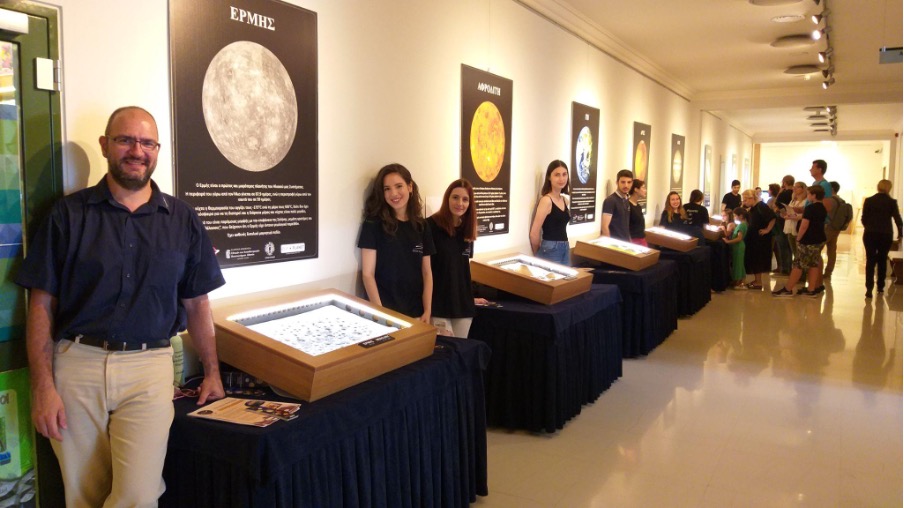
Planets in Your Hand
The Planets in Your Hand exhibition will be displayed on the Level 1 – Intermezzo of the EPSC2024 conference venue.
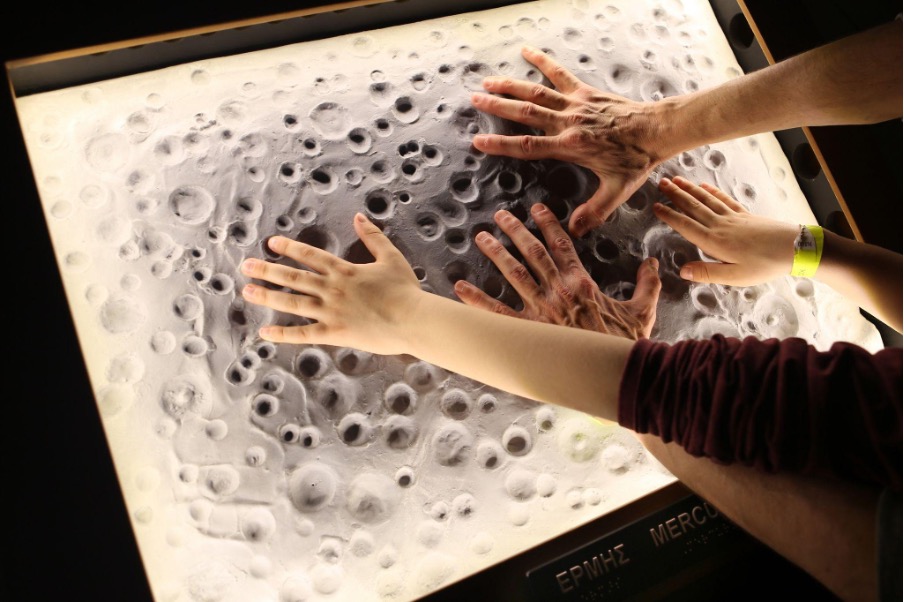
The Planets In Your Hand exhibition offers visitors the opportunity to see, learn and touch the special features of each planetary surface in our Solar System. At the same time, it contributes to the dissemination of the scientific knowledge we currently possess about planetary exploration to schools and the public, with a special focus on visually impaired people.
The Planets In Your Hand team is one of the most active science communication groups in the Department of Physics at the National and Kapodistrian University of Athens. The program and the team were founded in 2017 under the “Europlanet Funding Scheme 2017” organized by Europlanet, the European network of planetary science. Our proposal was evaluated, distinguished among many others and awarded, receiving funding for its implementation.
Planets In Your Hand program aims to highlight the different conditions that prevail in our Solar System. This has been done by building specially designed exhibits, where the surface and characteristics of each planet are simulated.
In the context of the proposal’s implementation, a website and social media channels (facebook, instagram) have been created
EPSC2024: Media Invitation to the Europlanet Science Congress (EPSC) 2024, 8-13 September 2024
The 2024 Europlanet Science Congress (EPSC2024) will take place at the Henry Ford Building of the Freie Universität Berlin, Germany, from 8–13 September 2024.
EPSC2024 covers the full spectrum of planetary research and technology across more than 60 scientific sessions, with topics including current and upcoming missions, the use of drones, AI and Machine Learning in planetary science, planetary defence and sample return. The programme is supplemented by keynotes, debates and community events. More than 1200 oral and poster presentations have been submitted and around 1200 planetary scientists from Europe and around the world are expected to attend the conference.
EPSC2024 will take place as a fully hybrid meeting, with the possibility of live virtual participation in all standard scientific sessions.
Press briefings will be livestreamed and press notices on presentations of interest to the media will be issued by the EPSC2024 Press Office during the meeting. Details of press briefings and livestream access will be circulated closer to the time.
Details of the scientific sessions and the presentation abstracts can be found at the official website: https://www.epsc2024.eu/
Media representatives are cordially invited to attend the EPSC2024 meeting. Media registration is free. Any bona fide media delegates can register by e-mailing aheward@europlanet-society.org.
The Europlanet Science Congress (https://www.epsc2024.eu/), established in 2006 as the European Planetary Science Congress, is the largest planetary science meeting in Europe and regularly attracts around 1200 participants. It covers the entire range of planetary sciences with an extensive mix of talks, workshops and poster sessions, as well as providing a unique space for networking and exchanges of experiences.
Follow on X/Twitter via @europlanetmedia and using the hashtag #EPSC2024.
About Europlanet
Europlanet (www.europlanet-society.org) is a not-for-profit association that provides the planetary science community with access to research infrastructure and services. The Europlanet Association Sans But Lucratif (AISBL), established in 2023, builds on the heritage of a series of projects funded by the European Commission between 2005 and 2024 to support the planetary science community in Europe and around the world. Today, Europlanet is an independent membership organisation that provides mobility programmes, community services and training.
Europlanet received funding from the European Union’s Horizon 2020 research and innovation programme under grant agreement numbers 871149 (Europlanet 2024 Research Infrastructure) and 654208 (Europlanet 2020 RI), FP7 under grant agreement number 228319 (Europlanet RI) and FP6 under grant agreement number RICA-CT-2004-001637 (European Planetology Network).
Europlanet is delighted welcome Noah Jäggi as the Europlanet Science Congress (EPSC) Incoming Vice Chair.
An introduction from Noah:
I am a space physicist with a background in geochemistry that connects laboratory experiments to numerical simulations. In 2019 I joined the Europlanet Early Career (EPEC) network and have been an active member since, co-organising early career focused events at EPSC and chairing the EPEC@EPSC working group from 2020 to 2022. In mid-2023 I completed my PhD and decided to become the EPEC treasurer to remain in contact with EPEC projects. Since then, I have moved to the USA for a two-year postdoctoral fellowship, continuing my services as a treasurer for EPEC, and I recently returned to EPEC@EPSC to organise another Science Flash at this year’s EPSC in Berlin. I am looking forward to serving as the EPSC vice chair going forward and am immensely grateful for the warm welcome I received from the EPSC committee.
Early Career Event: AbGradEPEC’24 – 8th September 2024
We are back! EPEC will once again team up with AbGradE for EPSC 2024, expanding network opportunities for early career scientists and students.
This year we invite you on Sunday, September 8th for a symposium at the Freie Universität comprising of science presentations and a workshop on professional development given by an ESA fellow and a former ESA intern. For a chance to meet your fellow early careers on the first day of EPSC for a career-focused workshop, and make those all important connections from day one, this is an event you don’t want to miss!
The deadline for registration is June 30th and can be accomplished with the following form. The event fee is 10 euros (including snacks, coffee and lunch provided), details on payment will be sent to you after the registration closes.
The extended deadline for abstracts is June 15th. For contributed talks, please send a short abstract (max. 200 words) using the template to abgrade@eana-net.eu. We invite early careers to present the work that they either present as a poster at EPSC2024 or any other project not presented at EPSC2024. Letters of acceptance will be sent out by mid-June.
Machine Learning for a Data Driven Era of Planetary Science
Stavro Ivanovski (INAF-Trieste Astronomical Observatory, Italy), Angelo Pio Rossi (Constructor University, Germany), Jeronimo Bernard-Salas (ACRI-ST, France), and Anita Heward (DFET, UK) look at how Machine Learning (ML) is revolutionising planetary science.
Planetary Perspectives: Meet the New Europlanet Society Board
This edition of Planetary Perspectives finds out more about interests, backgrounds and ambitions for the Europlanet Society of the members of the Executive Board elected and taking up new roles in November 2023.
Supporting Astronomy in Ukraine
Gražina Tautvaišienė (Vilnius University, Lithuania), describes how a Europlanet programme is supporting Ukrainian colleagues to continue their research.
ERIM 2023: A New Kind of Europlanet Meeting
Anita Heward (Chair of the ERIM Organising Committee and Europlanet Sustainability Committee) reports on how the Europlanet Research Infrastructure Meeting (ERIM) in Bratislava has helped to lay the foundations for a sustainable Europlanet.
EPEC Annual Week: A Melting Pot of Ideas
James McKevitt (University of Vienna, Austria and UCL, UK) reflects on the outcomes of the Europlanet Early Career event, EPEC Annual Week, held in Bratislava, Slovakia in June 2023.
Bridging the Gap Between Policy and Science
The Europlanet Policy Team reports on a policy workshop that took place as part of the Europlanet Research Infrastructure Meeting (ERIM) 2023 last June.
The Ecological Footprint of Astronomy
Thibaut Roger (University of Bern, Switzerland) reports on a session at ERIM to initiate a discussion about the ecological impact of astronomy and planetary research activities
ERIM Goes to Schools
Thibaut Roger (University of Bern, Switzerland) and Barbara Cavalazzi (University of Bologna, Italy) bring astrobiology and planetary science to schools in Bratislava.
Diving into the Heavens: The Solar System Scope Project
Jozef Bodlak (Solar System Scope) tells the story behind the Solar System Scope – an app that takes users on an immersive journey with the aim of bringing the grandeur of space to the fingertips of people around the world.
The Making of ‘The Making of Juice’
Maarten Roos-Serote (Lightcurve Films, Portugal) shares a unique view behind the scenes of the making of the Juice mission.
Molėtai Magic
Alejandro Luis García Muñoz reports on the Europlanet Summer School 2023 at the Molėtai Astronomical Observatory in Lithuania.
Orionids Workshop 2023
Miloš Obert, Chair of the Slovak Union of Astronomers, reports on the Orionids 2023 astro-camp on meteor observations.
Dusting the Moon
Karolien Lefever and Sylvain Ranvier (BIRA-IASB, Belgium) report on DUSTER, a project that gets to grips with lunar dust in preparation for future exploration missions.
Europlanet 2024 RI has received funding from the European Union’s Horizon 2020 research and innovation programme under grant agreement No 871149.
Europlanet AISBL (Association Internationale Sans But Lucratif – 0800.634.634) is hosted by the Department of Planetary Atmospheres of the Royal Belgian Institute for Space Aeronomy (BIRA-IASB), Avenue Circulaire 3, B-1180 Brussels, Belgium.