
Europlanet Distributed Research and Technology Infrastructure (RTI) Facility – Open University (OU) Dirty Mars Chamber (George)

Average Transnational Access (TA) visit: 12 days
Preferred timeframe for TA visits: April/May and December 2026
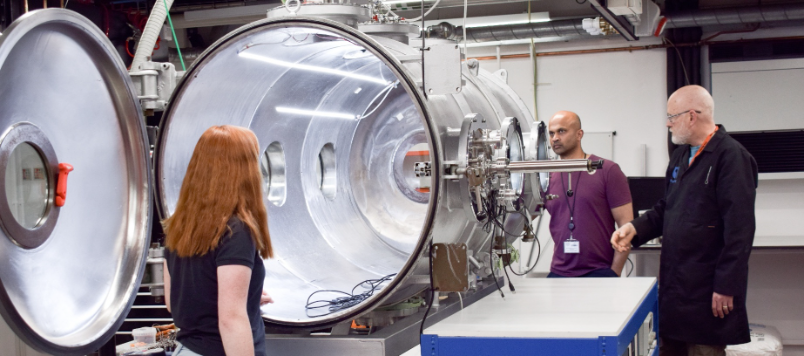
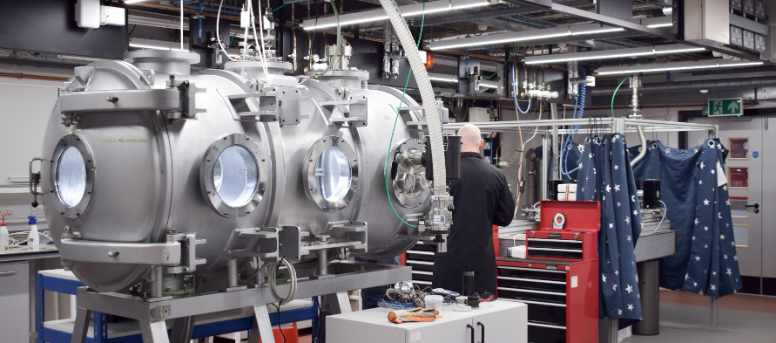
The Open University Mars Chamber (George) is a large, adaptable environmental simulation chamber suitable for a wide range of scientific and engineering investigations. At 1.8 m long and 0.9 m diameter, the chamber can recreate martian surface conditions for large-scale surface process studies, or for testing large instruments and equipment assemblies.
The temperature is fully controllable between -70ºC and 100ºC. Atmospheres are typically N2, CO2, air or bespoke mixtures. The chamber pressure can be reduced to 2 mbar, in as little as 5 minutes, with automated control and logging. Extra filtration and frequent pump maintenance enable experiments that work with large volumes of dust. Ongoing research includes simulations of mud-volcanism, surface runoff of both water and brine solutions on sediment slopes, CO2 sublimation-driven mass wasting on sediment slopes and CO2 sublimation-driven araneiform and dust plume simulations.
Contact
You must get in touch with the host facility (email the Facility Lead with the Administrative Contact in cc) to discuss the technical feasibility of your proposal before submitting an application. If you do not contact the host, your proposal will not be approved.
Lead Facility Contact: Manish Patel, School of Physical Sciences, Robert Hooke Building, Open University, Walton Hall, Milton Keynes, MK7 6AA. Manish.Patel@open.ac.uk
Administrative Contact: Louise Thomas. Louise.Thomas@open.ac.uk
Images
Publications
- Adler et al (2025), “Microclimate Governs the Morphology of Sediment Flows on Mars.” Nature Communications Earth & Environment 6, 841. https://doi.org/10.1038/s43247-025-02879-w
- Roelofs et al. (2024) “The dynamics of CO2-driven granular flows in gullies on Mars.” JGR Planets 129, 6. https://doi.org/10.1029/2024JE008319
- Philippe et al (2023). “Experimental study of sediment transport processes by liquid water and brine under Martian pressure.” Icarus, 395, 115475.
- Brož et al (2023). “Volumetric changes of mud on Mars: evidence from laboratory simulations. “Journal of Geophysical Research: Planets, 128, no. 12: e2023JE007950.
- Mc Keown et al (2021). “The formation of araneiforms by carbon dioxide venting and vigorous sublimation dynamics under martian atmospheric pressure.” Scientific Reports, 11, no. 1: 6445.