
Europlanet Distributed Research and Technology Infrastructure (RTI) Facility – DLR Planetary Spectroscopy Laboratory (PSL)

Average Transnational Access (TA) visit: 5-10 days
Preferred timeframe for TA visits: May-June or September-December
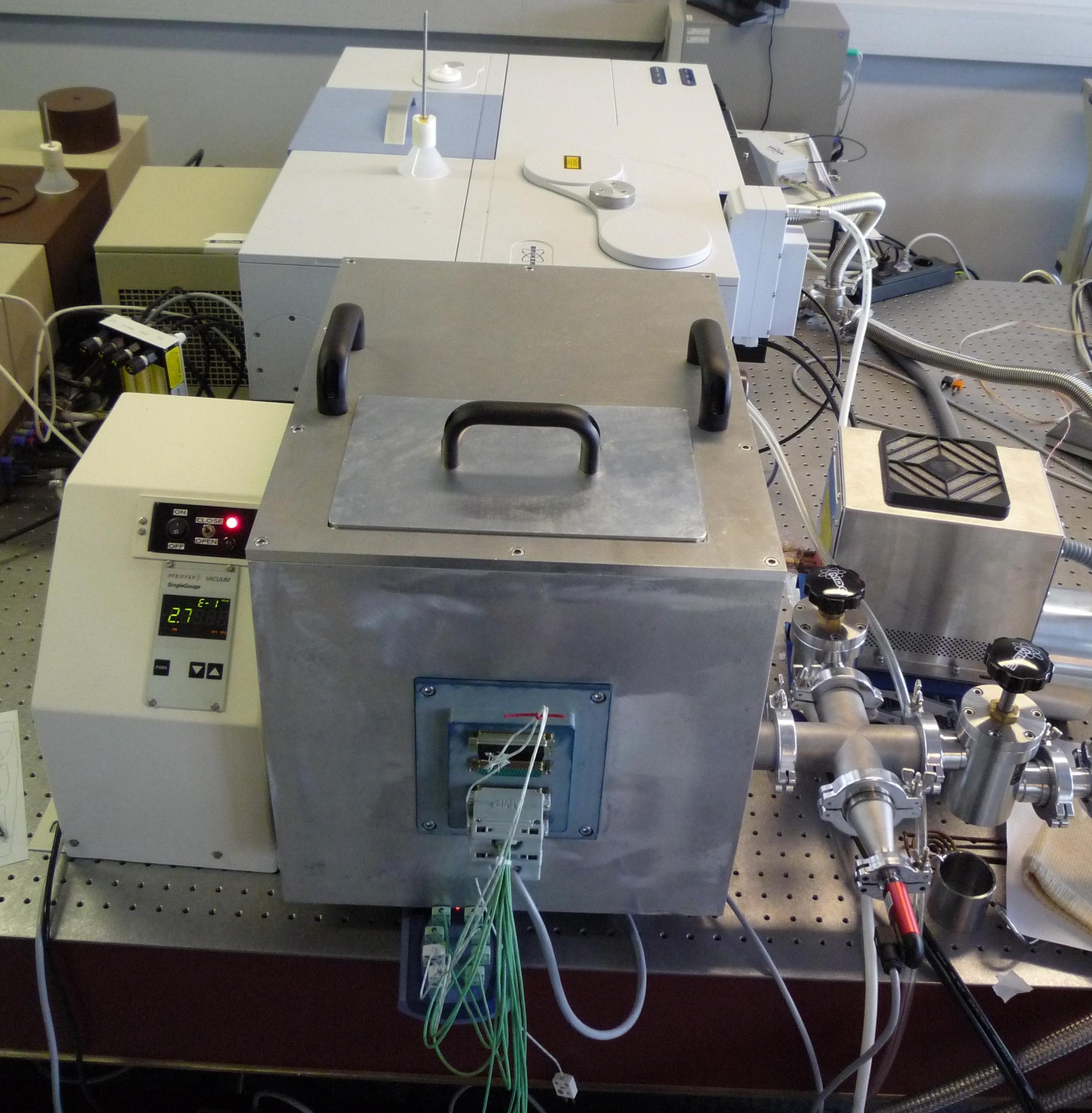
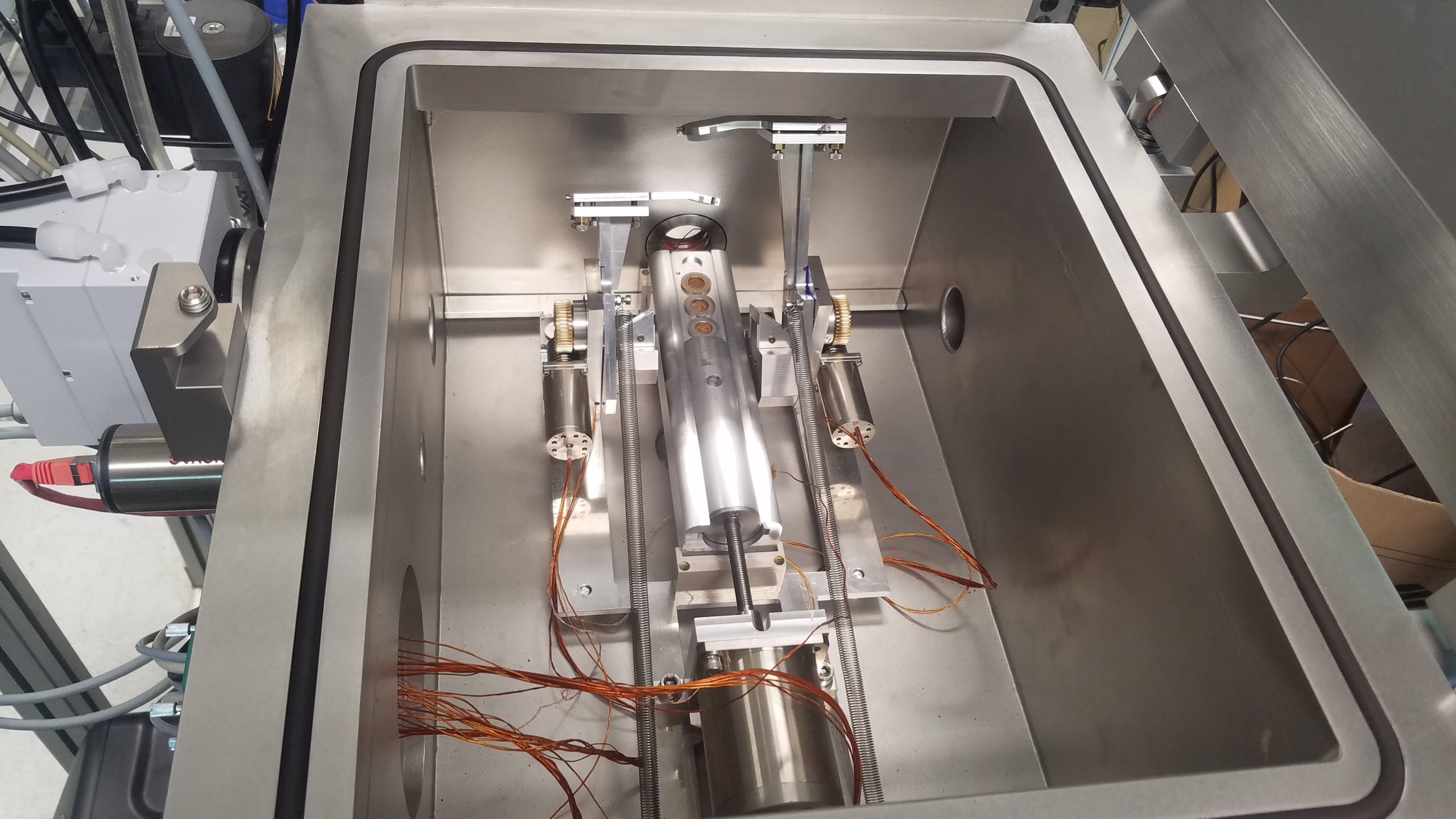
The Planetary Spectroscopy Laboratory (PSL) at the Institute of Space Research (WR) of DLR in Berlin is the only infrastructure in the world to offer the possibility to measure spectra of solid and powdered materials, in air and/or vacuum, from low to very high T (-200° to 1000°C), over an extended spectral range (0.25 to 100 µm) and in a climate-controlled room. PSL operates 3 identical Fourier Transform Infrared Spectrometers (FTIR) Bruker VERTEX 80V, equipped with internal and external chambers, to measure emissivity, biconical and hemispherical reflectance and transmittance spectra simultaneously and with the same setup. Biconical reflectance and transmission spectra are measured at room temperature along the whole UV to FIR spectral range (0.25 to 100 µm). Hemispherical reflectance is measured at room temperature by means of 2 separate integrating spheres allowing to cover the spectral range from VIS to MIR (0.4 to 20 µm). Emissivity of solid materials is measured for samples from 100°C to above 600°C surface temperature in the spectral range from VNIR to FIR (0.7 to 100 µm, starting value depending on the sample temperature). All measurements can be done under purged air or vacuum (approx. 0.7 mbar).
Micro-FTIR spectroscopy is also available thanks to a Bruker Hyperion2000 microscope attached to one of the spectrometers, to cover the spectral range from VIS to MIR (0.4 to 20 µm) by using 3 different detectors available.
The Raman Mineral- and Bio-Detection Laboratory (RMBL) is also available to complement the offer on spectroscopy. The Confocal Raman microscope (WITec Alpha 300) is also used to perform Atomic Force Microscopy (AFM). RMBL is additionally equipped with a bright field and fluorescence microscope for mineralogy on planetary analogue and extraterrestrial materials, and for detection and study of bio-signatures, ices, frozen salt solutions under ambient and different environmental conditions. Different environmental conditions (from 1 bar to 0.1 mbar in atmospheres with different composition, e.g. CO2, N2, and temperatures from 1500 K down to 5 K) can also be reproduced within corresponding cryo-stages.
Contact
You must get in touch with the host facility to discuss the technical feasibility of your proposal before submitting an application. If you do not contact the host, your proposal will not be approved.
Dr. Alessandro Maturilli, DLR Institute of Space Research, Rutherfordstraße 2, 12489 Berlin, Germany.
Images




Publications
- Kierra A. Wilk, J.L. Bishop, A. Maturilli, C.M. Pieters, J.F. Mustard, K. Robertson, Spectral hydration features in nominally anhydrous minerals & implications for lunar remote sensing, Icarus, Volume 438, 2025, 116651, https://doi.org/10.1016/j.icarus.2025.116651.
- Mireia Leon-Dasi, Sebastien Besse, Camille Cartier, Océane Barraud, Alessandro Maturilli, Alain Doressoundiram, Johannes Benkhoff, Laurie Llado, Effects of observation geometry and heating on the ultra-violet to near-infrared spectra of Mercury simulant, Icarus, Volume 436, 2025, 116582, https://doi.org/10.1016/j.icarus.2025.116582.
- Kimberly Paragas, Heather A. Knutson, Renyu Hu, Bethany L. Ehlmann, Giulia Alemanno, Jörn Helbert, Alessandro Maturilli, Michael Zhang, Aishwarya Iyer, and George Rossman, “A New Spectral Library for Modeling the Surfaces of Hot, Rocky Exoplanets.” The Astrophysical Journal, Volume 981, Number 2, 2025, DOI 10.3847/1538-4357/ada9eb
- T. Michalik, A. Maturilli, E. A. Cloutis, K. Stephan, R. Milke, K.-D. Matz, R. Jaumann, L. Hecht, H. Hiesinger, K. A. Otto, “Laboratory VIS–NIR reflectance measurements of heated Vesta regolith analogs: Unraveling the spectral properties of the pitted impact deposits on Vesta.” Meteoritics & Planetary Science, Volume 59, Issue 6, 2024, https://doi.org/10.1111/maps.14156
- Cristian Carli, Sabrina Ferrari, Alessandro Maturilli, Giovanna Serventi, Maria Sgavetti, Arianna Secchiari, Alessandra Montanini, and Jörn Helbert, “Laboratory Emissivity Spectra of Sulphide-Bearing Samples, New Constraints for the Surface of Mercury: Oldhamite in Mafic Aggregates.” Minerals, 14(1), 62, 2024, https://doi.org/10.3390/min14010062
