
Tumbleweed Rovers
A New Paradigm of Martian Exploration

James Kingsnorth, Head of Science at Team Tumbleweed (Netherlands), describes how a technological innovation by a startup could drive large-scale, low-cost exploration of the Red Planet.
Read article in the fully formatted PDF of the Europlanet Magazine.
Space exploration is amidst a revolution. According to the World Economic Forum, the global space industry is currently valued at over $500 billion and is projected to surpass $1.8 trillion by 2035. The ongoing commercialisation of space exploration is providing new synergies between national space agencies (e.g. ESA and NASA) and private companies. For the first time since the Apollo era, planetary exploration has returned to the forefront of strategic priorities and public attention.
Team Tumbleweed is a startup aiming to revolutionise Mars exploration by making access to the martian surface 100 times cheaper. Our multinational team is developing a swarm-based mission, composed of wind-driven, spheroidal rovers inspired by tumbleweed plants, that aims to bridge a critical capability gap in Mars science and exploration. Current missions face trade-offs between resolution and coverage: orbiters provide a broad planetary view but lack fine detail, while surface rovers, like Perseverance, offer high-resolution data but are confined to small areas. The Tumbleweed mission overcomes these limitations by deploying a fleet of free-rolling rovers that spread across Mars, collectively forming a distributed sensor array.
Mission Architecture
The Tumbleweed mission, on arrival at Mars, starts with the deployment and unfolding of 90 rovers in the midmartian atmosphere using their built-in sails as parachutes for Entry, Descent and Landing (EDL). Upon safe landing at an adequate terminal speed, the rovers will then distribute globally, starting from a suitable location on the martian surface. The rovers will gather valuable data as they traverse across the rugged terrain for an average lifetime of 90 martian sols (approx 92.6 terrestrial days).
According to our simulations, if 90 of our rovers were randomly deployed on the surface of Mars, the average distance traversed per individual rover would surpass 400 kilometres in less than 100 sols. While some rovers in our swarm would inevitably fail — whether due to instrument malfunctions, rough terrain, environmental hazards, or simple bad luck — the ones that succeeded would dramatically expand our understanding of the Red Planet.
A final, stationary phase involves collapsing the rovers into permanent measurement stations dotted around the surface of Mars, providing longterm scientific measurements and infrastructure for future missions, e.g. through an enhanced tracking system or as a network for distributed data transmission.


Tumbleweed Rover
The Tumbleweed rovers are spheroidal structures, over 5 metres in diameter, that can roll over diverse terrain, covering up to 25 kilometres in one sol. The lightweight (20 kilogramme) rovers, of which 5 kilogrammes are budgeted for the payload, are low-cost and produce large temporal-spatial datasets of Mars. We aim to release publicly-available datasets for the global planetary science community to use, aligning with our philosophy of making deep space accessible for everyone.
Tumbleweed prototypes have gone through many variations over time. The most recent prototype of the Tumbleweed rover has been designed solely as a platform for scientific instrumentation. The purpose of this half-scale rover, named the Science Testbed, is to prove the feasibility of carrying integrated scientific payloads onboard the rover. Demonstrating that all the proposed instruments can collect useful data onboard the Tumbleweed rover during a traverse will increase the Technology Readiness Level (TRL) of our platform and its payload. The current Science Testbed has a central payload bay encompassing a vertical tube which houses simple Commercial-Off-The-Shelf (COTS) sensors, including a magnetometer, integrated to a RaspberryPi5 computer. In 2025, the Science Testbed has already undergone an in-house run in the Delft (Netherlands) workshop. This has been followed by controlled experiments in an inactive quarry in Maastricht in April, where the magnetometer and PiCam were tested at different speeds by varying the initial position of the rover on the slope.
The largest test this year will be a field campaign in the Atacama Desert, Chile, in November 2025, involving a wide variety of bespoke instruments acquired from researchers at external partner organisations. A minimum of two rovers will operate in martian analogue conditions, to enable tests of trans-rover communications and a redundancy in data coverage, thus simulating the swarm-based nature of the Tumbleweed mission. The deployment will also focus on testing transmitter-receiver modules and power subsystems, including solar cell technology.
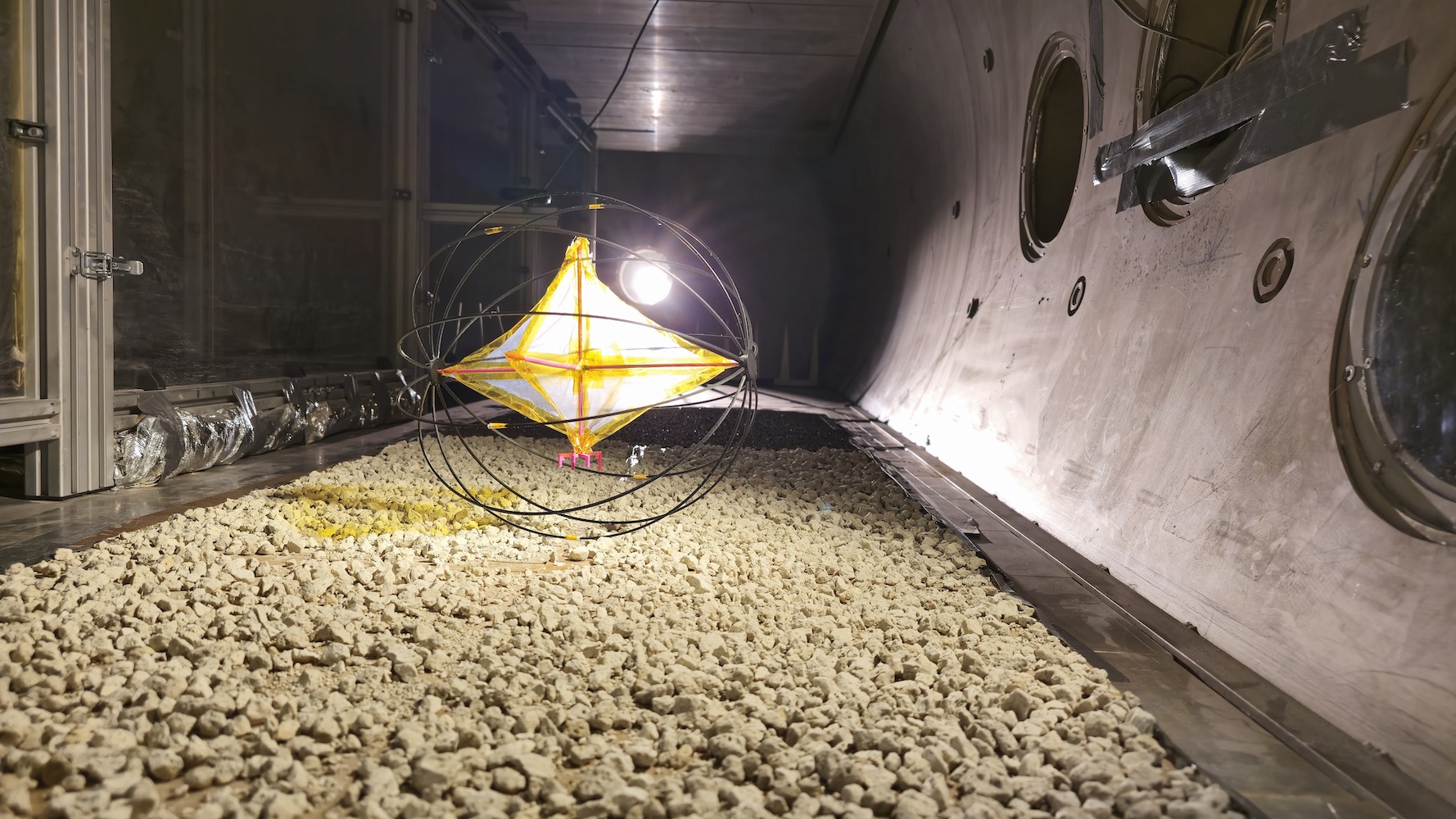
Further tests in the wind tunnel of the Planetary Environment Facility in Aarhus, Denmark – supported through the Europlanet Transnational Access programme – investigated predominantly rover dynamics in martian conditions. Static tests, varying the orientation and wind speeds, measured lift, drag, moment and torque acting on the rover. Dynamic tests of the rover, carrying a miniaturised Inertial Measurement Unit (IMU) onboard, assessed performance over surfaces of different roughness and morphology. Results will be presented at the EPSC-DPS Joint Meeting 2025 in Helsinki.


Science on Mars
Refining on goals set by the Mars Exploration Program Analysis Group (MEPAG), our mission scientists have defined three main exploration themes: martian atmopheric sciences, geology and geophysics, and martian habitability.
The absence of a global magnetic field at Mars has led to significant atmospheric degradation over time, contributing to the arid martian landscape. Investigating this radiative environment can offer valuable insights into Earth’s own climatic and atmospheric challenges.
Understanding the interactions between the martian atmosphere, surface and external influences is essential for unravelling the longterm evolution of the Red Planet’s meteorology. Our mission seeks to characterise these interactions through high-resolution mapping of wind dynamics and comprehensive weather profiling under varying conditions. By monitoring global dust storms and localised dust devils, we can analyse their electromagnetic properties. In addition, we can study longer-term seasonal climate effects through key weather parameters, such as temperature, pressure and wind speed, alongside tracking dust particle size.
A suite of specialised instruments will provide critical data on surfaceatmosphere interactions. In addition, imaging systems will monitor geological activity and astronomical phenomena, such as martian auroras, further enhancing our understanding of the planet’s environmental and electromagnetic characteristics. In particular, multi-spectral imaging will enable us to map trace element concentrations, providing crucial data on potential geological processes and/or biological signatures.
The mission will investigate both surface and subsurface features to uncover Mars’s geological history and activity. Geological and geomorphological features will be characterised through advanced imaging techniques, using a combination of a hand-lensstyle imager and a stereoscopic (multispectral) camera. High-resolution surface mapping of the remnant crustal magnetism in the southern highlands, using a triaxial fluxgate magnetometer, will shed light on the cause of the highly debated signatures, previously hypothesised to be of hot-spot or tectonic origin.
Martian habitability not only refers to preparations for the first human footsteps on Mars but also to studying the radiation environment and potential biosignatures. Current knowledge gaps could be tackled by a synergistic suite of instruments on-board a tumbling rover. For example, a neutron spectrometer combined with a magnetometer could characterise ionising radiation by broadly measuring neutrons and magnetic fields, while simultaneously achieving high-resolution mapping of biologically important elements near the surface, such as carbon or water. This, in turn, could provide new insights relevant for astrobiology, e.g. by identifying preferential locations for finding biosignatures that may be protected by mini-magnetospheres and where subsurface water might be available.
Next Steps
Alongside developing the critical capabilities required for the entry, descent and deployment of rovers on Mars, Team Tumbleweed is developing spaceflight hardware and in-house technology for potential users on a shorter timescale. Tumbleweed μg will enable users to carry out microgravity experiments in low-Earth orbit through a free-flyer capsule and service.
The Tumbleweed rover platform can also advance our knowledge of Earth, for instance in environmental monitoring of extreme environments where the local effects of global warming are more drastic and less understood. We are currently planning a field test to demonstrate the Tumbleweed rover’s potential as a low-cost, high-impact tool for studying climate change in polar regions.
Join In
The community is currently invited to submit instrumentation in an Open Call for the Science Testbed prototype. This opportunity for collaboration with the Tumbleweed mission allows collection of data on a rover heading to Mars, improving the TRL of both the instrument and platform, and will result in a peerreviewed paper. For details, contact: james@teamtumbleweed.eu.