

Please Note: The Europlanet 2024 RI project, which received funding from the European Union’s Horizon 2020 research and innovation programme under grant agreement No 871149, closed in July 2024. This archive page describes Transnational Access (TA) activities funded through the Europlanet 2024 RI project.
TA2 Facility 1 – VU Geology and Geochemistry radiogenic and non-traditional stable Isotope Facility (GGIF)
Average visit: 2 weeks
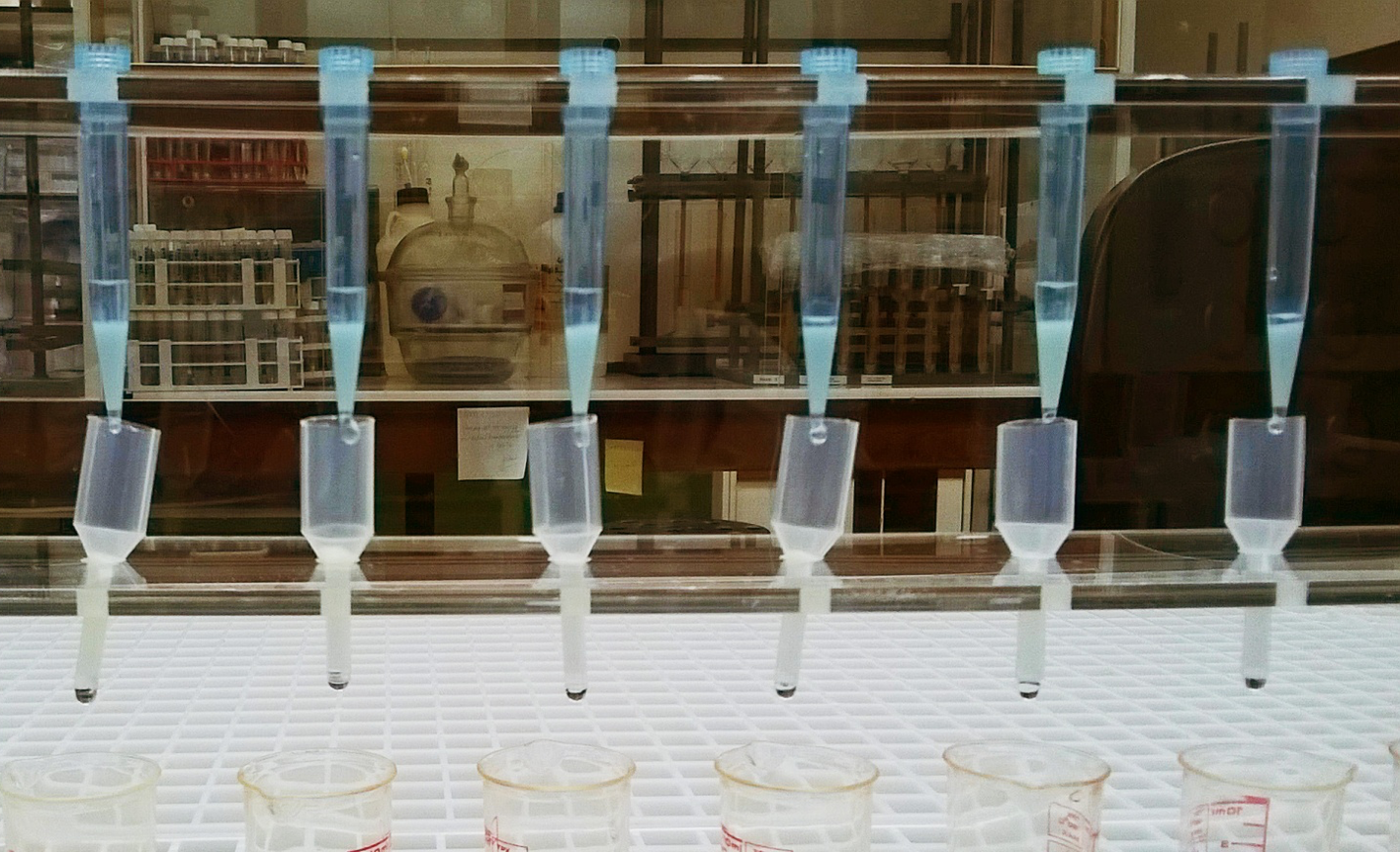
The GGIF facility comprises three multi-collector mass spectrometers, FinniganMat 262 RPQ plus, ThermoFinnigan TritonPlus & MC-ICPMS (Neptune), plus sample characterisation, mineral separation, sample preparation, fluid inclusion heating-freezing stages, Raman microscope, scanning electron microscope, electron microprobe and dedicated clean labs for elemental separation etc).
The facility is supported by a chemist and electronic and vacuum engineers. “Routine” analytical approaches include Sr-Nd-Pb-Hf-Si-Fe-Li-B isotope analyses and laser ablation Hf isotope determinations in minor phases such as zircon and high precision isotopic analyses of the extinct system 146Sm-142Nd. 1013 Ohm resistors on the Triton and Neptune can analyse as little as 10 pg of Sr-Nd-Pb, opening up totally new research directions [Koornneef et al. 2014]; e.g. individual melt inclusions in olivine and dust from Antarctic ice cores.
The Triton has 6 ion counters enabling multi-detector ion counting determination of small beams (e.g. Os, U-Series).
Much of the ground-breaking research relies on detailed sample characterisation and innovative sampling methodologies, e.g. micro- drilling, polishing for fluid-melt inclusion characterisation and the ability to use in situ laser ablation sampling prior to conventional Pb-Sr-Nd isotope analysis.
Additional capabilities include undertaking HP-HT experimental petrology experiments (TA2.2) coupled with isotope geochemistry.
On-going research focuses on planetary differentiation processes, early Earth environments, magma chamber processes and the application of isotope geochemistry in archaeology-art-forensic-ecology etc.
Koornneef JM, Bouman C, Schwieters JB, Davies GR (2014). Analytica Chimica Acta, 819, 49-55.
Contact:
Gareth R. Davies, Vrije Universiteit Amsterdam, De Boelelaan 1085, 1081 HV Amsterdam, Netherlands. g.r.davies@vu.nl




Report summaries of TA visits to facility

Publications related to TA2.1 facilities and visits
Back to the TA2 Distributed Planetary Laboratory Facility Page