EPSC-DPS2025: Mars’s Chilly North Polar Vortex Creates a Seasonal Ozone Layer
Joint Meeting of the Europlanet Science Congress and the American Astronomical Society’s Division for Planetary Science (EPSC-DPS2025) Press Release
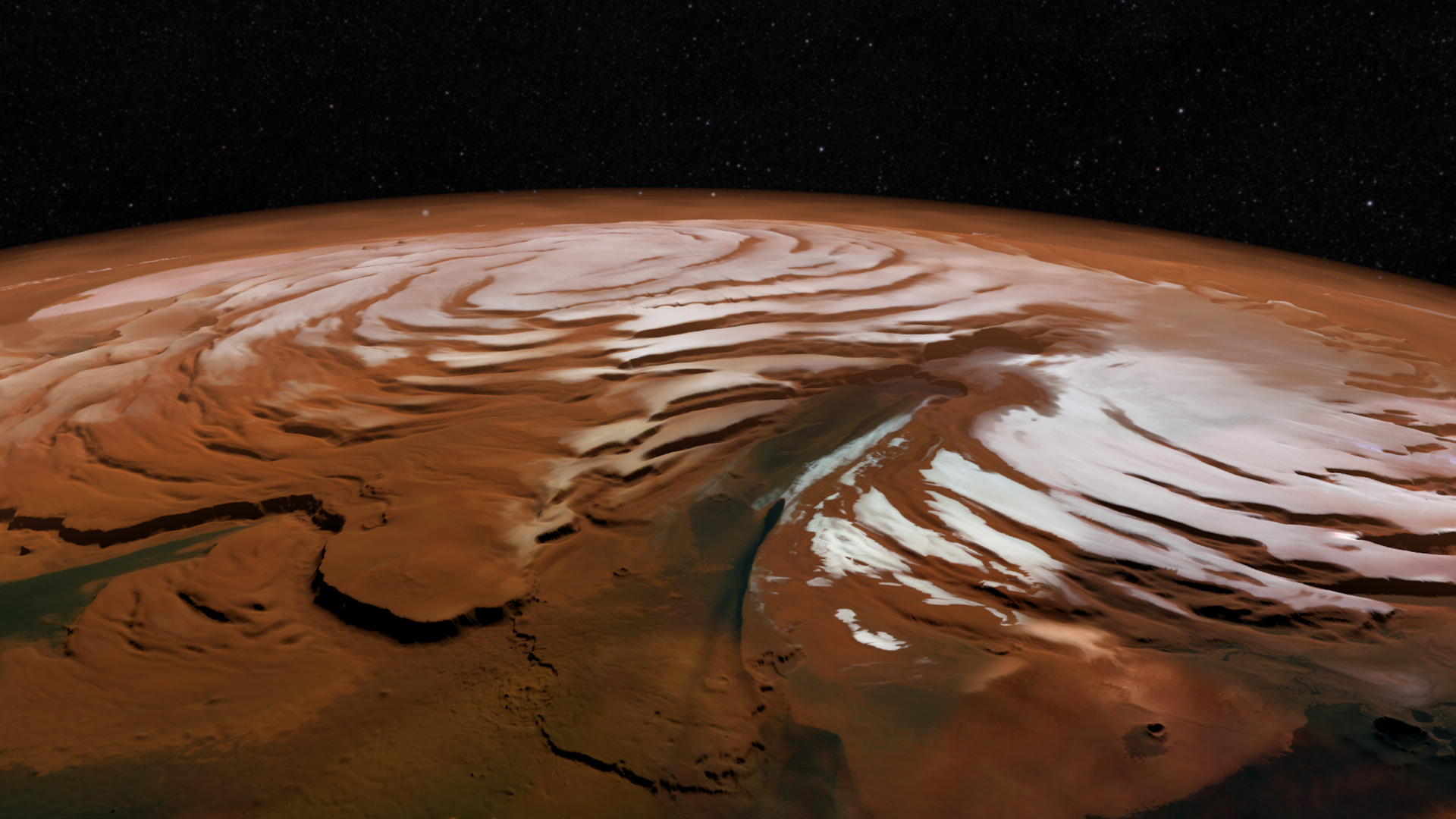
A rare glimpse into the wintry conditions of Mars’s north polar vortex has shown that temperatures inside the vortex are far colder than outside, and that the permanent darkness that winter brings to the martian north pole facilitates a surge in ozone in the atmosphere.
“The atmosphere inside the polar vortex, from near the surface to about 30 kilometres high, is characterised by extreme cold temperatures, about 40 degrees Celsius colder than outside the vortex,” said Dr Kevin Olsen of the University of Oxford, who presented the results at the EPSC-DPS2025 Joint Meeting in Helsinki last week.
At such frigid temperatures, what little water vapour there is in the atmosphere freezes out and is deposited onto the ice cap, but this leads to consequences for ozone in the vortex. Ordinarily ozone is destroyed by reacting with molecules produced when ultraviolet sunlight breaks down water vapour. However, with all the water vapour gone, there’s nothing for the ozone to react with. Instead, ozone is able to accumulate within the vortex.
“Ozone is a very important gas on Mars – it’s a very reactive form of oxygen and tells us how fast chemistry is happening in the atmosphere,” said Olsen. “By understanding how much ozone there is and how variable it is, we know more about how the atmosphere changed over time, and even whether Mars once had a protective ozone layer like on Earth.”
The European Space Agency’s ExoMars Rosalind Franklin rover, which is currently scheduled to launch in 2028, will search for evidence of past life on Mars. The possibility that Mars once had an ozone layer protecting the planet’s surface from the deadly influx of ultraviolet radiation from space would boost the chances that life could have survived on Mars billions of years ago substantially.
How Mars’s Polar Vortex Forms
The polar vortex is a consequence of Mars’s seasons, which occur because the Red Planet’s axis is tilted at an angle of 25.2 degrees. Just like on Earth, the end of northern summer sees an atmospheric vortex develop over Mars’s north pole and last through to the spring.
On Earth the polar vortex can sometimes become unstable, lose its shape and descend southwards, bringing colder weather to the mid-latitudes. The same can happen to Mars’s polar vortex, and in doing so it provides an opportunity to probe its interior.
“Because winters at Mars’s north pole experience total darkness, like on Earth, they are very hard to study,” says Olsen. “By being able to measure the vortex and determine whether our observations are inside or outside of the dark vortex, we can really tell what is going on.”
Probing the Vortex
Olsen works with ESA’s ExoMars Trace Gas Orbiter that is in orbit around Mars. In particular, the spacecraft’s Atmospheric Chemistry Suite (ACS) studies Mars’s atmosphere by gazing at the Red Planet’s limb when the Sun is on the other side of the planet and is shining through the atmosphere. The wavelengths at which the sunlight is absorbed give away which molecules are present in the atmosphere and how high above the surface they are.
However, this technique doesn’t work during the total darkness of martian winter when the Sun doesn’t rise over the north pole. The only opportunities to glimpse inside the vortex are when it loses its circular shape but, to know exactly when and where this is happening, requires additional data.
For this, Olsen turned to the Mars Climate Sounder instrument on NASA’s Mars Reconnaissance Orbiter to measure the extent of the vortex via temperature measurements.
“We looked for a sudden drop in temperature – a sure sign of being inside the vortex,” said Olsen. “Comparing the ACS observations with the results from the Mars Climate Sounder shows clear differences in the atmosphere inside the vortex compared to outside. This is a fascinating opportunity to learn more about martian atmosphere chemistry and how conditions change during the polar night to allow ozone to build up.”
Further information
EPSC-DPS2025-1438 What Goes On Inside the Mars North Polar Vortex?
Kevin Olsen, Bethan Gregory, Franck Montmessin, Lucio Baggio, Franck Lefèvre, Oleg Korablev, Alexander Trokhimovsky, Anna Federova, Denius Belyaev, Juan Alday and Armin Kleinböhl, https://doi.org/10.5194/epsc-dps2025-1438
Images

https://www.europlanet.org/wp-content/uploads/2025/09/Mars_PV_from_orbit-scaled.png

Contacts
Dr Kevin Olsen, University of Oxford
kevin.olsen@physics.ox.ac.uk
EPSC-DPS2025 Press Office
press@europlanet.org
Notes for Editors
About the Joint Meeting of the Europlanet Science Congress and the Division of Planetary Sciences (EPSC-DPS)
The Europlanet Science Congress (EPSC), established in 2006 as the European Planetary Science Congress, is the largest planetary science meeting in Europe. It covers the entire range of planetary sciences, with an extensive mix of talks, workshops and poster sessions, as well as providing a unique space for networking and exchanges of experiences.
EPSC joined forces for the first time with the American Astronomical Society’s Division for Planetary Sciences (DPS) for a joint meeting in Nantes, France, in 2011. This was followed by DPS-EPSC 2016 in Pasadena, EPSC-DPS 2019 in Geneva, and the return to the United States for the DPS-EPSC 2023 meeting in San Antonio. This year marks the third iteration of a joint European-based meeting. The intent of the joint meetings is not only to connect the European and North American planetary science communities, but also to consolidate two major meetings and motivate planetary scientists from all over the globe to attend. With over 1800 participants joining in person and online, EPSC-DPS2025 is the largest planetary science meeting held to date in Europe. https://www.epsc-dps2025.eu
Follow on social media (Bluesky, X and LinkedIn) with the hashtag #EPSC-DPS2025 for updates on the meeting.
About Europlanet
Europlanet (europlanet.org) is a non-profit association and membership organisation that provides the planetary science community with access to research infrastructure, services and training. The Europlanet Association Sans But Lucratif (AISBL), established in 2023, builds on the heritage of a series of projects funded by the European Commission between 2005 and 2024 (Grant Numbers 871149, 654208, 228319 and RICA-CT-2004-001637) to support the planetary science community in Europe and around the world.
About the DPS
The Division for Planetary Sciences (DPS), founded in 1968, is the largest special-interest Division of the American Astronomical Society (AAS). Members of the DPS study the bodies of our own solar system, from planets and moons to comets and asteroids, and all other solar-system objects and processes. With the discovery that planets exist around other stars, the DPS has expanded its scope to include the study of extrasolar planetary systems as well. The American Astronomical Society (AAS), established in 1899, is the major organization of professional astronomers in North America. The mission of the AAS is to enhance and share humanity’s scientific understanding of the universe as a diverse and inclusive astronomical community, which it achieves through publishing, meeting organization, science advocacy, education and outreach, and training and professional development.