Amateur observations to support Parker Solar Probe flyby of Venus
NASA’s Parker Solar Probe will flyby Venus on 11th July 2020. The mission will obtain observations of Venus that will be coordinated with the Akatsuki mission (JAXA), currently in a long eliptic orbit around the planet.
Scientists studying Venus have requested amateur observers to help by providing ground-based data on Venus’s atmosphere to put the mission data into context. This event will be followed up with a campaign of observations in July, August and October in support of the ESA/JAXA BepiColombo Mission, which will flyby Venus in October 2020.
The Europlanet Telescope Network is supporting a campaign to provide amateur support for these flybys and we are actively requesting Venus observations from the amateur community.
Calling all PhD students – showcase your research in #PlanetaryScience4All video contest
The Europlanet Early Career (EPEC) Communication working group is giving all PhD students involved in planetary science the opportunity to showcase their research through a 4-minute video contest called #PlanetaryScience4All.
The deadline for submissions is 31 August 2020. All the videos submitted will be shown during a dedicated session during the Europlanet Science Congress (EPSC) 2020, which is being held as a virtual meeting for the first time from 21 September – 9 October. The winner will be announced at the end of the virtual conference.
The winner of the competion will receive a free registration for EPSC 2021, which will be held Helsinki, Finland, from 19-24 September 2021. The winning video will be also shared via the Europlanet website, newsletters and social media and will be used to inspire young people in future EPEC outreach activities.
In this EPEC Inspiring Outreach Story, Dr Billy Edwards, Twinkle Project Scientist and Research Associate on the Ariel space mission, describes how he is bringing cutting-edge exoplanet research into UK classrooms.
Last year I became involved in the Original Research by Young Twinkle Students (ORBYTS) programme. This educational scheme aims to allow secondary school pupils to work on new, exciting research linked to the Twinkle Space Mission under the tuition of PhD students and other young scientists (http://www.twinkle-spacemission.co.uk/edutwinkle/). To achieve this, ORBYTS connects science researchers with secondary schools, where, through fortnightly school visits over an academic year, the students are taught undergraduate-level physics. These classes allow the researchers to engage students with the subjects they themselves are studying. The ultimate goal of this project is to give students the opportunity to use this new knowledge to contribute towards publishable research.
The core idea is that pupils get hands on experience of scientific research and work closely with young scientists. By bringing together schools and researchers, the programme aims to not only improve student aspirations and scientific literacy, but also help to address diversity challenges by dispelling harmful stereotypes, challenging any preconceptions about who can become a scientist and I found the relative informality of the classes to a powerful way of connecting with the students. While projects have been run on a number of topics, mine focused on one of the core science targets for the Twinkle mission: exoplanets.
We currently know of over 4000 planets, which orbit stars other than our Sun. These range from small, cool rocky worlds such as those in the TRAPPIST-1 system to massive, hot gaseous planets such as WASP-76 b where it is thought to rain iron. However, while we have had some tentative insights, much about these alien worlds remains a mystery. Future space-based telescopes, such as the James Webb Space Telescope, Twinkle and Ariel will use spectroscopy to study their atmospheres, detecting the molecules present to give us a deep understanding of the planet.
However, in recent years, a problem has begun to develop. With so many known planets, keeping track of the exact time at which they are going to transit has become harder and harder. In the coming years, this is only going to get more difficult as surveys such TESS, the Transiting Exoplanet Survey Satellite, will find thousands more exoplanets. The only way to keep the ephemerides of these planets fresh is to frequently re-observe them and this will require an increasing amount of telescope time.
In this project, we used a robotic ground-based telescope network to observe planets which had high uncertainties in their orbital parameters. The students were given free rein to choose the planets they wished to observe and then planned the observations before reducing and analysing the subsequent data. However, given the expected number of planet discoveries, professional telescope networks may not be enough to keep the transit times fresh.
Luckily, help is at hand in the form of citizen astronomers. As many of these planets are around bright stars, even modest telescopes can capture the transit event and in recent years the number of citizen astronomers contributing light curves has increased drastically. As part of this ORBYTS project we also analysed data obtained by a number of citizen astronomers and contributing to the ExoClock initiative (www.exoclock.space). The students approached the project with real enthusiasm, analysing the transits of several planets. This work was recently published in the Monthly Notices of the Royal Astronomical Society (MNRAS) with all the students and citizen astronomers as authors.
For me, this programme was challenging but extremely rewarding. Teaching your first class is always a scary moment, even when it is on a topic you know well. However, the classes soon became the highlight of my week and, as the programme progressed, the increased participation and engagement by the students was hugely gratifying. While they may not all become astrophysicists, it is my hope that this project has inspired them to embark on scientific careers or, at the very least, to make them consider their place in the universe.
Do you like this story and want more? Browse our archive of EPEC Inspiring Stories and get inspired!
Please Note: The Europlanet 2024 RI project, which received funding from the European Union’s Horizon 2020 research and innovation programme under grant agreement No 871149, closed in July 2024. This archive page describes activities funded through the Europlanet 2024 RI project.
Europlanet Telescope Network launched to support planetary research and build global pro-am collaboration
A new collaboration between telescopes around the world has been launched to provide coordinated observations and rapid responses in support of planetary research. The Europlanet Telescope Network will provide professional and trained amateur observers with access to telescopes located around the globe and ranging from 0.25 – 2m in diameter.
Initially linking 15 observatories, the network plans to draw in additional facilities and build new collaborations, particularly in geographical regions that are currently under-represented in the planetary science community.
The study of planets, asteroids and comets can require long-term monitoring or very precise timing by ground-based observatories. This combination of characteristics produces a unique set of challenges, as it matters both where on the Earth one observes from and precisely when.
“Relatively small telescopes can produce first-rate planetary science,” said Manuel Scherf, the coordinator of the Europlanet Telescope Network. “Our aim with this new network is to support a global community that can react fast and effectively to observational alerts and participate in coordinated observational campaigns related to objects in our Solar System and planets orbiting distant stars.”
Examples of research that could be supported via the network include monitoring of how atmospheric features on planets evolve, or how a comet’s activity changes as it orbits the Sun. The network will also be used in studies that require significant amounts of observing time, like searches for lunar impact flashes, and observations from multiple locations simultaneously, such as to reveal the size, shape and orbit of asteroids that might be hazardous to Earth.
“As planets and smaller bodies of our Solar System move against the background of distant stars, we can gather information about their physical properties and orbits,” explained Colin Snodgrass of the University of Edinburgh, deputy coordinator of the network and chair of its scientific advisory board. “A network of telescopes that can make long-term or time-sensitive observations from different locations across Europe and beyond will be very valuable for planetary astronomy.”
Professional and amateur astronomers can now apply to visit the facilities participating in the Europlanet Telescope Network and have their expenses covered for the time needed to make their observations, which can range from hours to several weeks. Visits will start from the autumn, subject to any local travel restrictions due to the Covid-19 pandemic. The project is coordinated through the Europlanet 2024 Research Infrastructure, which is funded by the European Commission’s Horizon 2020 programme.
Grazina Tautvaisiene, Director of the Institute of Theoretical Physics and Astronomy in Lithuania, said, “There are many small telescopes in facilities around the world, and particularly in Eastern Europe, that are under-used. By networking these diverse observatories, we can take advantage of their geographical spread and relative lack of time constraints to carry out exciting, cutting-edge research.”
The network also aims to strengthen collaborations between professional and amateur astronomers and provide training to widen participation in planetary research.
“Amateur astronomers are playing an increasingly important role in planetary research and in supporting missions to study objects in our own Solar System and planets orbiting other stars. The Europlanet Telescope Network aims to empower skilled amateurs to use professional facilities and to participate in international campaigns,” said Ricardo Hueso of the Universidad del País Vasco/Euskal Herriko Unibertsitatea.
The observatories participating in the project are:
Pic du Midi Observatory, IMCCE, Observatoire de Paris, CNRS, France: 1.06m-telescope
Moletai Astronomical Observatory, Vilnius University, Institute of Theoretical Physics and Astronomy, Lithuania: 1.65m-telescope and 35/51cm-telescope
Kryoneri Observatory, National Observatory of Athens, Greece: 1.2m-telescope
Skalnate Pleso Observatory, Astronomical Institute of the Slovak Academy of Sciences, Slovakia: 1.3m-telescope and 61cm-telescope
Faulkes Telescope Project, UK (accessing the Las Cumbres Observatory, LCO, global network): Two 2m-robotic telescopes, nine 1m-robotic telescopes, and ten 40cm-robotic telescopes
Tartu Observatory, University of Tartu, Tartu Observatory, Estonia: 1.5m telescope, 60cm telescope, 30cm robotic telescope
Danish 1.54m telescope at ESO La Silla Observatory (Chile), Copenhagen University, Niels Bohr Institute, Denmark: 1.54m mirror telescope
Beacon Observatory, University of Kent, UK: 42cm remote controllable astrograph
Observatorie del Teide, Instituto de Astrofisica de Canarias, Spain : 82cm IAC-80 telescope, 45cm telescope
Calar Alto Observatory, Junta de Andalucia and the Instituto de Astrofisica de Andalucia, Spain : 1.23m telescope
Lisnyky Observation Station, AO KNU, Ukraine: 70cm telescope
Chuguev Observatory, Institute of Astronomy of V.N. Karazin Kharkiv National University, Ukraine: 70cm telescope
Terskol Peak Observatory, International Center for Astronomical, Medical and Ecological Research of the National Academy of Sciences of Ukraine (IC AMER), Ukraine: 2m telescope, 60cm telescope
Konkoly Observatory, Research Centre for Astronomy and Earth Sciences, Hungary: 1m telescope, 80cm telescope
Rozhen Observatory, Institute of Astronomy and National Astronomical Observatory, Bulgarian Academy of Sciences, Bulgaria: 2m telescope, 60cm telescope, 50/70cm telescope
Observatorio Astrofísico de Javalambre, Centro de Estudios de Física del Cosmos de Aragón (CEFCA), Spain, 80 cm telescope.
Günter Kargl Space Research Institute Austrian Academy of Sciences Graz, Austria na2@europlanet-society.org
Gražina Tautvaišienė Institute of Theoretical Physics and Astronomy Vilnius University Vilnius, Lithuania grazina.tautvaisiene@tfai.vu.lt
Ricardo Hueso Alonso Escuela Técnica Superior de Ingeniería Universidad del País Vasco/Euskal Herriko Unibertsitatea Bilbao ricardo.hueso@ehu.eus
Media Contact Anita Heward Europlanet Media Centre Tel: +44 7756 034243 anita.heward@europlanet-eu.org
About Europlanet
Since 2005, Europlanet has provided Europe’s planetary science community with a platform to exchange ideas and personnel, share research tools, data and facilities, define key science goals for the future, and engage stakeholders, policy makers and European citizens with planetary science.
The Europlanet 2024 Research Infrastructure (RI) has received funding from the European Union’s Horizon 2020 research and innovation programme under grant agreement No 871149 to provide access to state-of-the-art research facilities and a mechanism to coordinate Europe’s planetary science community. The project builds on a €2 million Framework 6 Coordination Action (EuroPlaNet), a €6 million Framework 7 Research Infrastructure (Europlanet RI) and a €10 million Horizon 2020 Research Infrastructure (Europlanet 2020 RI) funded by the European Commission.
The Europlanet Society promotes the advancement of European planetary science and related fields for the benefit of the community and is open to individual and organisational members. The Society’s aims are:
To expand and support a diverse and inclusive planetary community across Europe through the activities of its 10 Regional Hubs.
To build the profile of the sector through outreach, education and policy activities
To underpin the key role Europe plays in planetary science through developing links at a national and international level.
Is anyone out there? From the possibility of microbial life on Mars and elsewhere in the solar system across the multitude of exoplanets all the way to the Fermi Paradox, astrobiology tries to find the answer to this age-old question and more – like how life originated here on Earth, what are its physical limits and what forms might life take under different conditions.
A new freely available anthology released by the European Astrobiology Institute delves into these questions via Science Fiction (SF) stories by world-renowned authors, followed by essays about the science of each story.
The anthology, titled Strangest of All (a nod to H. G. Wells’s War of The Worlds), was edited by the author, editor and scientist Julie Nováková, who leads the outreach working group of the European Astrobiology Institute. The book contains reprint SF stories by G. David Nordley, Geoffrey Landis, Gregory Benford, Tobias S. Buckell, Peter Watts and D. A. Xiaolin Spires, plus a bonus story by the editor.
Nordley’s “War, Ice, Egg, Universe” takes readers to an aquatic civilization inhabiting a Europa-like world with an ice-covered ocean, and the accompanying essay focuses on what we know about conditions for life on Europa, Enceladus, Ganymede and other ocean worlds. In “Into The Blue Abyss” by Landis, the protagonist dives into an entirely different ocean – the high-pressure liquid water layer on Uranus, where chemistry signifying possible life had been observed. Could life really exist in such conditions – and could high-pressure environments actually be one of the most common habitats in the universe?
Continuing the journey outward of the Sun, “Backscatter” by Benford finds life in an improbable place: an icy asteroid in the Kuiper Belt. The follow-up essay provides background on the possibility of life in asteroids and comets, and dives into the topic of exotic silicon-based life in such cold places with no liquid water.
In Buckell’s “A Jar of Goodwill”, we leave solar system and environments similar to it entirely, visiting a strange exoplanet where plants metabolize chlorine – but the main problem the hero faces is whether its ant-like inhabitants are intelligent creatures. Halogen-based photosynthesis was actually proposed in theory – so we can look at where we could expect such exotic life. Even more exotic is the titular creature in Watts’s novelette “The Island”: a live Dyson sphere. In the essay, we look at how we can search for Dyson spheres, what the surveys yielded up-to-date, and whether we could presume anything about the origin and thought processes of a nigh-impossible being like the Island.
Benford returns with a microstory “SETI for Profit”, an interesting take on how to revive interest in SETI. What efforts to listen to potential extra-terrestrial messages have been taken so far, and what can we expect in the future? The topic of SETI is inextricably linked with the Fermi Paradox, one of the themes of Spires’s “But, Still, I Smile”. How can we explain the paradox with what we know so far, and how does the explanation in the story relate to our world? Finally, in the bonus story by Nováková, “Martian Fever”, we look at Mars exploration gone awry – and the risks of interplanetary biological contamination and the question of planetary protection.
Each story is followed not only by the science essay complete with references for readers craving more, but also a couple of ideas for classroom discussions or tasks (best-suited for higher high school grades or undergraduate university students), such as thinking of how to devise a message for a potentially listening alien civilization, bearing in mind what we know of sensory and cognitive differences between species here on Earth. For most of the questions, there is no definitive answer – but all the more curiosity should they elicit.
Strangest of All is the first of major outreach projects coming from the European Astrobiology Institute (EAI). EAI was founded in 2019 with the aims to support interdisciplinary research in astrobiology across Europe and beyond, disseminate scientific results and promote education and outreach in astrobiology and related fields by organizing summer schools, supporting the AbGradE forum for graduate students and creating materials such as this book, among other ways. Astrobiology is an exciting and booming scientific field, and science fiction is a perfect tool to bring it closer to people and enable them to imagine the incessant drive of curiosity and the joy of discovery that are at the heart of both science and SF. More such efforts are considered by EAI’s project team “Science Fiction as a tool for Astrobiology Outreach and Education”, which also welcomes new members who are interested in developing similar outreach materials.
The anthology Strangest of All can be downloaded for free in several formats on the websites of the European Astrobiology Institute and the editor, Julie Nováková.
For the final interview in our series of Motivational Journeys, we talk to Dr. Carol Raymond, Manager of JPL’s Small Bodies Program.
Dr Raymond started out studying started out studying geology and geophysics and joined JPL in 1990. She has served as Deputy Principal Investigator (PI) on the NASA Dawn Discovery Mission to Vesta and Ceres, two protoplanets in the Main Asteroid Belt, and as Dawn’s PI for the second extended mission.
In this interview, she tells us how her key piece of advice has been to stay flexible in following the path of your interest, and shares the positive experience of how collaborative teamwork can make great things can happen.
An investigation of how mud flows at very low temperatures and under the reduced atmospheric pressure of Mars, undertaken through a Europlanet 2020 RI Transnational Access visit, has been published in the journal Nature Geoscience. Research carried out at the Open University’s Mars Chamber in 2018 has shown that mud flowing under martian conditions behaves in a similar way to lava in volcanic areas of Hawaii or Iceland.
Water-rich mud was poured over a cold sandy surface in hostile, Mars-like conditions, with multiple cameras capturing the results. The experiments revealed that the instability of water within the mud changes the way the mud flows on Mars, compared to on Earth.
Liquid mud spills from ruptures in the frozen muddy crust, then refreezes to form “lobes”. The findings suggests that martian mud volcanoes may be substantially different in shape and look very different from their terrestrial equivalents. This work has wide implications for understanding cryovolcanism on icy bodies in the Solar System.
Lead author of the study, Dr. Petr Brož from the Institute of Geophysics of the Czech Academy of Sciences, said, “This is a very exciting and unexpected result. We have a tendency to expect that geological processes, like mud movement, would be operating elsewhere in the Solar system in a similar fashion as on Earth. Our experiments clearly show that, in reality, this simple process would be very different on Mars.”
Europlanet Telescope Network issues 1st Alert – A new north polar spot in Saturn
On 30th March 2020, amateur astronomer Andy Casely from Australia obtained images of the planet Saturn that showed the presence of a white spot at Saturn’s North polar latitudes, just on the edge of the famous Saturn’s hexagon.
An observational alert was released through the PVOL data service provided by Europlanet 20204 Research Infrastructure (RI) and the HST-Jupiter e-mail list, both followed by many amateur astronomers and planetary scientists.
Since then, the spot has been observed several times allowing its scientific study. This bright spot has developed two years after the eruption of several convective storms in Saturn at the same latitude (Sánchez-Lavega et al., Nature Astronomy, 2020) and the new possible storm is a surprise that shows the importance of amateur observations in the monitoring of the atmospheres of the planets and in the discovery of new phenomenon.
The Europlanet 2024 RI’s new Europlanet Telescope Network will work continuously in cooperation with amateur astronomers to provide an observational alert for unexpected astronomical events that could be followed quickly through a world-class collaboration.
One of Europlanet 2024 RI’s Transnational Access facilities has contributed to a new analysis of pigments used by Vermeer to add highlights to his famous painting, “Girl with a Pearl Earring”.
The ratio of lead isotopes in individual layers of the paint were analysed at the Geology and Geochemistry Isotope Facility (GGIF) at the Vrije University Amsterdam, to try to identify the pigment’s geographical origin. The study revealed that the lead in white paint and primer used by Vermeer all came from a mine located in the Peak District in Derbyshire, UK.
The research is part of “The Girl in the Spotlight”, an international study of the painting led by the Mauritshuis museum in The Hague. Researchers from VU Amsterdam, including Paolo D’Imporzano and Gareth Davies, analysed samples from loose fragments of paint collected during restoration and cross sections taken from the edge of the painting. The researchers compared the lead isotope ratios in different paint layers with data from lead mines across Europe, which have distinct regional signatures as a result of variations in the geological settings. The team found that the source of the pigment in the “Girl with a Pearl Earring” was constant and consistent with the lead used in other Dutch paintings from the 17th century. The question now facing art historians is: does this mean that Vermeer’s studio processed the white lead to produce a range of pigments, or were the different pigments purchased from a single supplier?
D’Imporzano and Davies are currently working with the Rijksmuseum to build up a detailed database of 17th-century Dutch paintings with a view to understanding how the source of lead varied over time and to determine whether lead isotope analysis can help identify when a particular work was painted.
Read the paper: van Loon, A., Vandivere, A., Delaney, J.K. et al. Beauty is skin deep: the skin tones of Vermeer’s Girl with a Pearl Earring. Herit Sci7, 102 (2019). https://doi.org/10.1186/s40494-019-0344-0
Image: Detail of Johannes Vermeer, Girl with a Pearl Earring, c. 1665, oil on canvas, Mauritshuis, The Hague (inv nr 670), showing the face of the Girl and sample locations 39 and 40. a Visible light image. René Gerritsen Art & Research Photography. Corresponding MA-XRF maps (0.4 mm/pixel): b, c lead (Pb-L), d iron, e lead (Pb-M), f mercury, gpotassium, h calcium, i copper. Credit: René Gerritsen Art & Research Photography / van Loon et al
In early April, as the European-Japanese BepiColombo spacecraft was approaching our home planet ahead of the first flyby in its seven-year journey to Mercury, mission scientists invited amateur astronomers to observe the event from Earth and share their photos of this unique event. The authors of the three best images of the flyby – the best glimpse, the best track and the last glimpse – selected by the jury will receive a scale model of BepiColombo.
Over thirty observers from around the world participated in the campaign. The jury, composed of BepiColombo mission experts, was very positively impressed by all entries, both on aesthetical grounds and because of the good quality of the astronomical observations, and wishes to thank all participants who observed the Mercury explorer as it crossed our sky and immortalized it in their beautiful images and sequences.
The winning photos are:
A view of BepiColombo passing through a deep sky object – the Blue Horsehead Nebula – taken in the early hours of 10 April by S. Silva in Porto Feliz, São Paulo, Brazil, which was selected as the ‘best glimpse’ of the flyby;
A sequence of images of BepiColombo moving through a stellar field, featuring a ‘guest’ appearance of a piece of space debris – a decommissioned geostationary satellite – captured in the evening of 10 April from the Northolt Branch Observatories by G. Welles and D. Bamberger in London, UK, which was selected as ‘the best track of BepiColombo’ during its passage above the horizon;
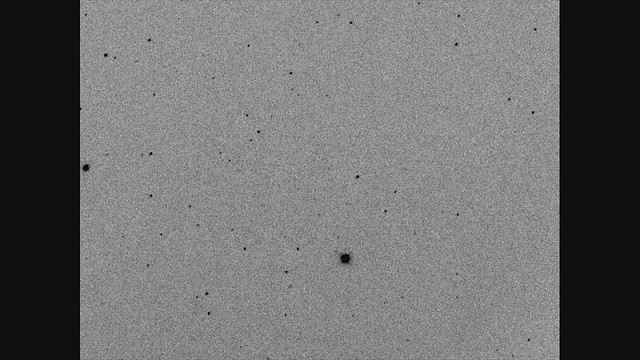
A parting view of the spacecraft, a dot against the tracks of distant stars, taken on 19 April from the Rikubetsu Space and Science Museum observatory in Ashoro District, Hokkaido, Japan, which was selected as the ‘last glimpse’ of BepiColombo.
The jury also acknowledges the following contributions with a special mention: Gianluca Masi, Virtual Telescope Project; Alain Maury, Jean Marc Mari and Joaquin Fabrega; Inoue Takeshi; Kenichi Shirakami; Masanori Mizutani; T. Oribe, Saji Observatory; Nicolas Biver.
BepiColombo reached its closest approach to Earth at 04:24:57 UTC on 10 April, flying only 12 689 km above our planet’s surface. The manoeuvre – the first of nine planetary flyby and the only one of Earth – tightened the spacecraft’s orbit towards the inner Solar System, where it is scheduled to meet Venus on 15 October for the first of two flybys of this planet on the way to Mercury.
Image captions
The last glimpse of BepiColombo
This image shows a parting view of the ESA/JAXA BepiColombo spacecraft, taken from Japan more than a week after the mission performed its Earth on 10 April 2020. The spacecraft is visible as a dot (circled) against the tracks of distant stars.
Captured between 12:43:19 and 13:18:23 UTC on 19 April from the Rikubetsu Space and Science Museum observatory in Ashoro District, Hokkaido, Japan, the image was selected as the ‘last glimpse’ of the BepiColombo flyby as part of a photographic contest aimed at amateur astronomers.
The jury appreciated that the observers tried until the very end, nine days after closest approach, and succeed in obtaining an appealing image – even in colour – of the spacecraft as it departed from our planet.
The colour image is a stack of 32x 60-second exposures obtained using a 1.15m f/5.6 Ritchey-Chretien telescope and Canon EOS 6D.
Credit: Rikubetsu Space and Science Museum
BepiColombo passing through the Blue Horsehead Nebula
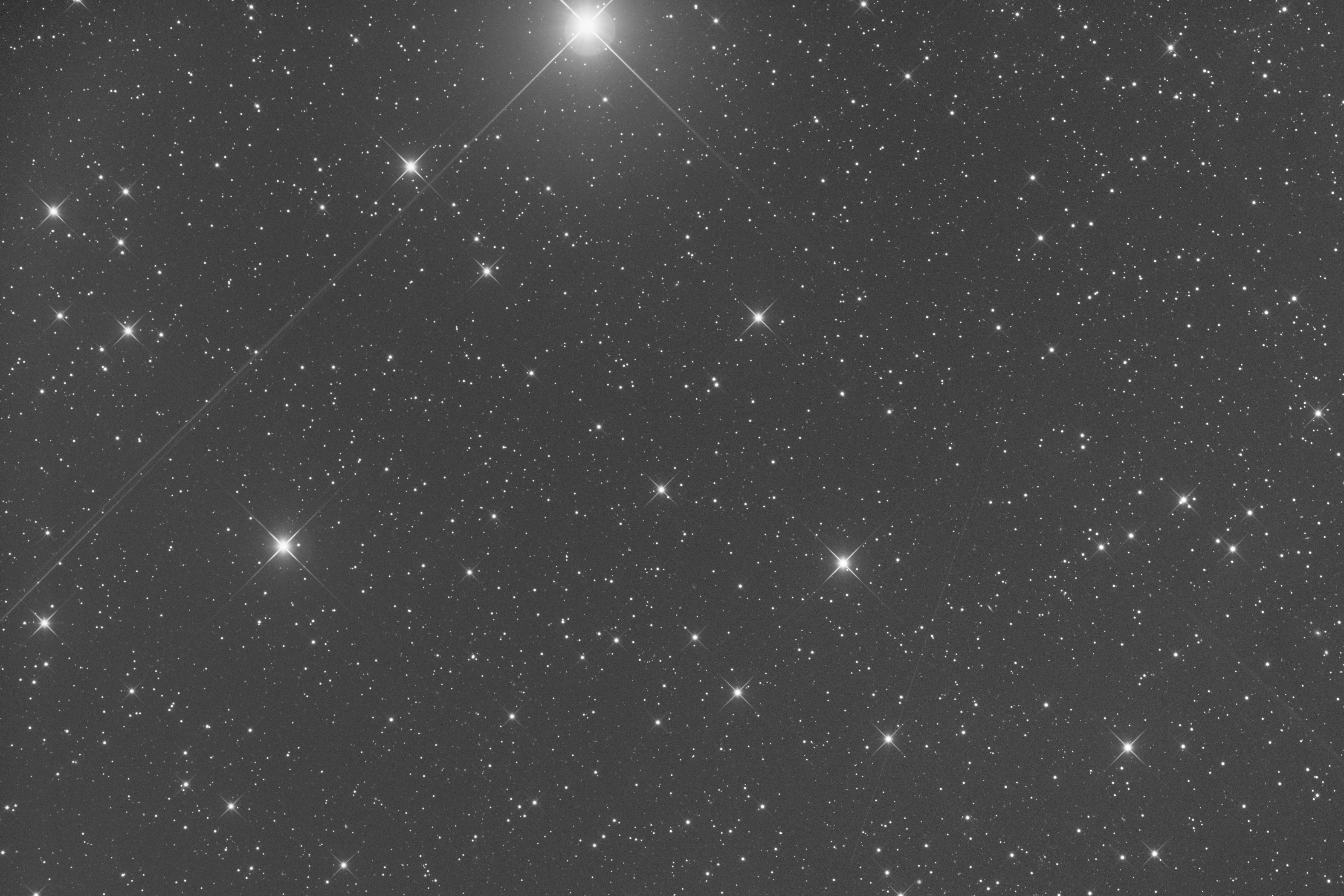
This image shows the ESA/JAXA BepiColombo spacecraft moving across the sky as viewed from Brazil during its Earth flyby on 10 April 2020. The moving spacecraft is visible as a series of four diagonal lines crossing the frame from top left to bottom right against a field of stars featuring a beautiful deep sky object, the reflection nebula known as Blue Horsehead Nebula, or IC 4592.
The flyby was captured by Sergio Silva from Porto Feliz, São Paulo, Brazil, at 04:39:58 UTC on 10 April. The flyby observation comprises four 15-second exposures as part of a 3-hour long exposure to image the nebula.
The jury appreciated the choice to combine the flyby, not far from Earth, and a distant nebula, observing the event against a deep sky object, as well as the fine quality of the image and processing.
The image was obtained using a Celestron C11 Edge HD telescope with a Hyperstar lens, a iOptron CEM60 mount and a ZWO ASI071MC-Pro camera.
Credit: S. Silva
A tale of two spacecraft: BepiColombo and the INSAT 2D satellite
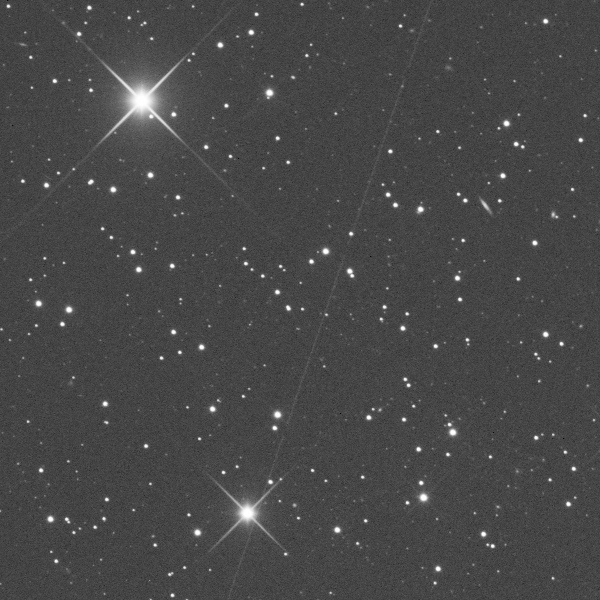
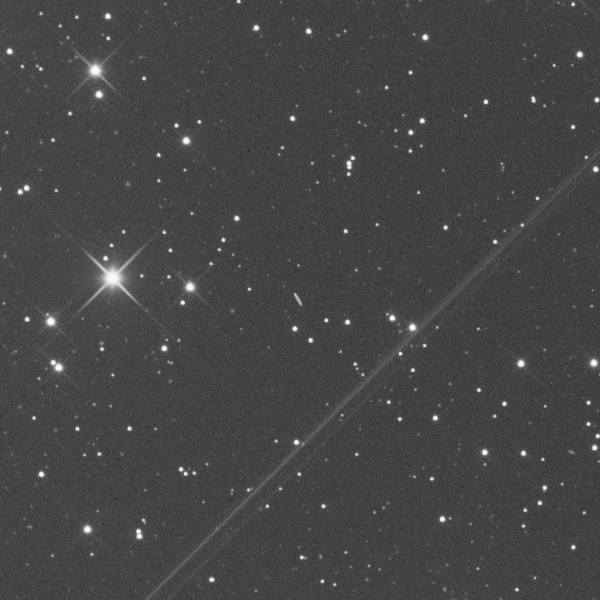
This sequence of images shows the ESA/JAXA BepiColombo spacecraft during its Earth flyby on 10 April 2020, crossing the sky as viewed from the UK. The spacecraft is visible as a moving dot in the frame of stars, making its way from the lower right towards the upper left; halfway through the observations, another satellite also made an appearance, moving from the right towards the left in the upper part of the frame.
The sequence was captured at 21:13 UTC on 10 April by G. Welles and D. Bamberger from the Northolt Branch Observatories, a British-German collaboration of astrophotographers with telescopes located in London, UK.
The jury appreciated the nice tracking sequence, the serendipitous coincidence that another satellite was caught in the observations, and the effort to identify the piece of space debris as the decommissioned geostationary satellite INSAT 2D.
The image was obtained using the observatory’s 0.25m Ritchey-Chretien telescope and a QHY42 CMOS camera.
Call for Nominations of Paolo Farinella Prize 2020 now open
** DEADLINE EXTENDED TO 1 JUNE**
To honor the memory and the outstanding figure of Paolo Farinella (1953-2000), an extraordinary scientist and person, a prize has been established in recognition of significant contributions in one of the fields of interest of Paolo, which spanned from planetary sciences to space geodesy, fundamental physics, science popularization, security in space, weapons control and disarmament.
The prize was proposed during the “International Workshop on Paolo Farinella, the scientist and the man“, held in Pisa in 2010, and the 2020 edition is supported by the Europlanet Society.
The tenth Paolo Farinella Prize will be awarded to a young scientist with outstanding contributions in the field of planetary science concerning “Structure, Physics and Dynamics of Giant Planets”, including work on the composition, atmospheric dynamics, and interior structure of giant planets inside or outside of our solar system. The award winner will be honoured during the Europlanet Science Congress (EPSC) 2020. It will also honor the outstanding scientific contributions of Adam Showman (1968-2020) who had accepted to be a member of the prize committee and passed away unexpectedly twenty years after Paolo Farinella.
For the 10th “Paolo Farinella” Prize the terms and rules are as follows:
A competition is announced to award the “Paolo Farinella” Prize for the year 2020. The prize consists of a plate, a certificate and the amount of 1500 €. The winner is expected to give a Prize lecture during EPSC 2020.
The winner will be selected on the basis of his/her overall research results in the field of “Structure, Physics and Dynamics of Giant Planets”.
The nominations for the “Paolo Farinella” Prize can be made by any researcher that works in the field of planetary sciences following the indications in the attached form. Self nominations are acceptable. The candidates should have international and interdisciplinary collaborations and should be not older than the age of Paolo when he passed away, 47 years, on May 15, 2020.
The winner of the prize will be selected before June 20 by the “Paolo Farinella” Prize Committee composed of outstanding scientists in planetary sciences, with specific experience in the field.
The Prize Committee will consider all the nominations, but will be entitled to autonomously consider other candidates.
Previous recipients of the “Paolo Farinella Prize” were:
2011: William F. Bottke, for his contribution to the field of “Physics and dynamics of small solar system bodies”
2012: John Chambers, for his contribution to the field of “Formation and early evolution of the solar system “
2013: Patrick Michel, for his contribution to the field of ” Collisional processes in the Solar System”
2014: David Vokrouhlicky, for his contribution to the field of “Non gravitational forces in the Solar System”
2015: Nicolas Biver, for his contribution to the field of “Dynamics and physics of comets”
2016: Kleomenis Tsiganis, for his contribution to the field of “Applications of celestial mechanics to the natural bodies of our solar system”.
2017: Simone Marchi, for his contribution to the field of “Physics and dynamics of the inner planets of the solar system and their satellites”
2018: Francis Nimmo, for his contribution to the field of “Giant planets satellite systems”
2019: Scott Sheppard and Chad Trujillo, jointly, for their contribution to the field of “The Trans-Neptunian Population”
Inspiring Stories – A picture is worth a thousand words
In this EPEC Inspiring Story, Maike Brigitte Neuland, an early career scientist at the Swedish Institute of Space Physics (IRF) in Kiruna/Sweden, shares her experience preparing and organising an international painting challenge for kids.
Language, spoken or written, is the only way to communicate and discuss scientific questions, complex solutions, and to share experience and knowledge. Several thousand languages are spoken worldwide. Working in a field of science and/or technology, we naturally hold meetings and read publications in English. In between, we may take notes of measurement results and conclusions, or send a text to our family, in our mother tongue.
“Most of the fundamental ideas of science are essentially simple, and may, as a rule, be expressed in a language comprehensible to everyone.”
Albert Einstein
Breaking down our research field, and scientific topics in general, into a simple language that is understandable also to children is already a difficult task, at least for many of us. And if doing outreach projects with children, we are bound to our mother tongue, plus English, plus some other languages we might know.
The General Assembly of the European Geosciences Union (EGU) is a conference with more than 10,000 participants every year. For scientists who are parents, the conference offers child care where kindergarten workers take care of children with a vast range of ages, while their parents attend the meeting. Together with a group of early career scientists of the EGU Planetary and Solar System Sciences (PS) division, we had the idea to organise a painting competition for the children staying at the EGU child care in 2017. The topic of this drawing contest should be, of course, related to space research. To inspire the kids and to give them an idea of what they should draw for us, I wrote a little text in English:
Expedition to space
Far away from Earth, there exist endless other planets, stars and galaxies. Years ago, humans successfully travelled to the Moon for the first time. The astronauts landed there and measured what the air and the soil there are made of. What do you think? Will humans also travel to planets, where the journey takes much more time than to the Moon?
What do these people do on the Moon or on other planets? They are interested in how it looks like there, if plants are growing there, what the soil is composed of and if perhaps it would be possible to live there. How do you imagine such a journey in space? What does a research station on another planet look like? And what do the people, who are working there, look like? Which tools and which vehicles do they use to explore their surrounding?
Help us to design such a research station! Make a drawing of the researchers during their life in space, of their work and their adventures!
But of course, as the nationalities of the conference participants were diverse, so were the languages spoken by their children. So the problem we were facing, was how to communicate the topic to all children.
“I feel it is unnatural and immoral to try to teach science to children in a foreign language. They will know facts, but they will miss the spirit.”
C. V. Raman
As diverse as the languages spoken at a conferences, so are the nationalities and mother tongues of my current and former work colleagues, and my friends. With the help of many people, I reached out to get my little text translated into 20 more languages! And with help from the parents at the conference, reading the text to their children in their mother tongue, it was fantastic to see how children imagine space research. And finally, it was an amazing experience for me to realise that even though I could not speak the language of a child, it still was possible to ask them what their drawing means and to get an answer that I could understand.
The painting competition was appreciated very much by everybody, and it also took place as “Cosmo Paint” in 2018, and became an established event at the conference child care. But since the divisions of EGU cover a wide range of geo- and planetary sciences, the topic of the event is now moving around through all divisions. In 2019 we could see many drawings of penguins, arctic ships and snowflakes (Cryospheric Sciences division, CR). And the “Volcanic Paint” at the next EGU general assembly will cover the world of geochemistry, mineralogy, petrology and volcanology (GMPV division).
“The finest language is mostly made up of simple unimposing words.”
George Eliot
Entry in Expedition to space by Daniel, 8 years old.
Entry in Expedition to space by Daniel, 8 years old.
Entry in Expedition to space by Selma, 4 years old.
Entry in Expedition to space by Fiona, 8 years old.
Entry in Expedition to space by Tom, 7 years old.
Note: You can find the booklet with all translations for download. Please do not use it without citing the author, but have fun using it.
“What is that we human beings ultimately depend on? We depend on our words. We are suspended in language. Our task is to communicate experience and ideas to others.”
Niels Bohr
Do you like this story and want more? Browse our archive of EPEC Inspiring Stories and get inspired!
At 04:25 UTC this morning, BepiColombo made its closest approach to Earth at a low altitude of 12,700 km. This was its first and only flyby of Earth. BepiColombo, the first ESA mission to Mercury, will make a series of nine gravity-assist manoeuvres to reach its final destination. The next two flybys will be of Venus in October 2020 and August 2021.
BepiColombo makes its closest approach to Earth. Credit: ESA
Below are images of the flyby submitted by observers around the world for the BepiColombo Earth Flyby Photo Competition. The closing date for the competition is Sunday 19 April – 23:59 CEST.
Credit: KURASHIKI SCIENCE CENTER
Location of image or observation: Hattoji, Okayama, Japan ( 134d15m6s [E], 34d54m50.0s [N], Altitude: 376m )
Time of image or observation: 11:57 – 12:09 UTC, 10 April 2020
Time zone: GMT+9 JST
Description: Image taken by Kazuhisa Mishima (Planetarium Director)
Telescope: Takahashi Epsilon E-180ED Astrograph(f=500mm)
Camera: NIKON D850 (ISO6400)
Exposure: 30 sec. x 19
Name: Go Murakami and Seiko Takagi (Credit: JAXA/Hokkaido Univ.)
Location of image or observation: 157-1 Nisshin, Nayoro-shi, Hokkaido 096-0066, Japan
Time of image or observation: 19:45-19:59 on 10 April 2020 (JST)
Time zone: JST
Social media contacts: Twitter: @gomuramura
About your image or observation: Taken by using Pirka Telescope (1.6 m) of Hokkaido University
V-band
10sec exposure each, 70 images
Name: Nayoro Observatory, Hokkaido University
Location of image or observation: 142 28 58.01 E, 44 22 25.10 N
Time of image or observation: 2020 April 19.48402 UT
Time zone: Japan Standard Time (JST)
Social media contacts: @kitasubaru
Description: The image was taken using the 1.6-m Pirka telescope + MSI (unfiltered) with the exposure time of 120 sec.
Name: Hiroyuki Naito, Nayoro Observatory
Location of image or observation: 142 28 58.01 E, 44 22 25.10 N
Time of image or observation: 2020 April 19.51414 UT
Time zone: Japan Standard Time (JST)
Social media contacts: @kitasubaru
Description: Using a 40-cm Chura telescope + unfiltered CCD camera (STL-1001E).
The image is combined with 30 frames (a total exposure time is 30 minutes).
Credit: Rikubetsu Space and Science Museum
Location of image or observation: Uenbetsu Rikubetu-cho,Ashoro-gun,Hokkaido,Japan (E 143.770 N 43.453)
Time of image or observation: 2020/04/19 12:43:19~13:18:23(UT)
Time zone: Japan(+9)
Social media contacts: @ginganomori_obs
About your image or observation: 1.15m f/5.6 Ritchey-Chretien telescope and Canon EOS 6D. Stack of 32x 60-second exposures.
Name: Yasuo Sano
Location of image or observation: Nyoro Hokkaido Japan, E 142.446890 N 44.353290
Time of image or observation: 2020/04/10 11h02m49s(UT) – 11h09m17s(UT)
Time zone: UTC + 9
Twitter Handle name 佐野康男
About your image or observation: SCT-0.36m FL3850mm F11, 10secX34 , CCD FLI ML1001E
Credit: Yasuo Sano
Location of image or observation: Nyoro Hokkaido Japan, E 142.446890 N 44.353290
Time of image or observation: 2020/04/10 10h13m46s(UT) – 10h19m04s(UT)
Time zone: UTC + 9
Twitter Handle name 佐野康男
About your image or observation:SCT-0.36 m FL3850mm F11, 5secX48 , CCD FLI ML1001E
Credit: T. Oribe @ Saji Observatory
Location of image or observation: N35 20 31 E134 07 10
Time of image or observation: 2020 04 10.4868 UT, 2020 04 11.4738 UT, 2020 04 14.4651 UT, 2020 04 16.5468 UT
Time zone: +9h
About your image or observation: 1.03-m reflector F4.6, STL-11000M, V filter
Name: Masanori Mizutani
Location of image or observation: E 134.25 N 34.91 Okayama Japan
Time of image or observation: 2020 04 10 10:52 ~ 12:08 UT
Time zone: UT + 9:00
Social media contacts: Nozomigaoka Observatory
About your image or observation: OTA : 200mmRC 1600mm
Mount: Takahashi EM-400
Camera: MoravianG2 KAF 8300
Name: Yuji Tanaka
Location of image or observation: Koryou-cho, Kitakatsuragi-gun, Nara, Japan
Time of image or observation: 2020′ 04/10 20:40:36
Time zone: JST
About your image or observation: Telescope: 0.20m Reflector F3.8 (C8N + Closeup lens AC No.4)
Camera: ASI174MM
Name: Northolt Branch Observatories
Location of image or observation: 51.554679, -0.372070
Time of image or observation: 10-04-2020 21:08-21:20 UTC
Time zone: British Summer Time (GMT+1)
Social media contacts: Twitter: @NBObservatories, Facebook: www.facebook.com/NBObservatories/
About your image or observation: BepiColombo, imaged on the evening of April 11th, using Northolt Branch Observatories’ 0.25m f/8 Ritchey-Chretien telescope and QHY42 CMOS camera.
The data collected for this image, even though it was submitted to the Minor Planet Center as artificial satellite 2018-080A (BepiColombo’s official designation), led to it being mistaken for a Near Earth asteroid. The “discovery”, announced by the Minor Planet Center as asteroid 2020 GL2, was retracted soon after (https://minorplanetcenter.net/mpec/K20/K20G97.html).
This was the third time a spacecraft had been mistakenly announced as a “new asteroid” during an Earth flyby, after Rosetta a.k.a. 2007 VN84 and Gaia a.k.a. 2015 HP116. Incidentally, all three of these are ESA missions.
Name: Hiroki Fukuyama
Location of image or observation: N34.69 E135.76
Time of image or observation: 2020/4/10 10:48:25(UT) 19:48:25(JST)
Time zone: Japan(+9)
Description: Celestron C8+Meade F3.3 FocalReducer+Vixen GP2 Equipmount
ZWO ASI174MC Gain254 3.0s×4 flames
Name: Gianluca Masi
Location of image or observation: Ceccano (FR), ITALY
Time of image or observation: 10 Apr. 2020, 03:40:32 UTC
Time zone: GMT+2 DST
Description: I managed to track the exciting BepiColombi flyby. Incredibly, we grabbed the spacecraft while it was imaging planet Earth and our telescope location, exactly at the same time.
The image puts together several pieces. First of all, we have an image of our planet captured by BepiColombo, with parts of the probe in the foreground. It is part of a stunning movie released by the European Space Agency (ESA) and by the Japan Aerospace Exploration Agency (JAXA). In this image, we indicated with an arrow where the Virtual Telescope Project (VTP) is placed on the Earth (Central Italy). On the left, there is a snapshot of the simulated approach of the probe, again from ESA. On the bottom left, you see an image of BepiColombo we captured with our robotic telescope, where the spacecraft is indicated by an arrow. Incredibly, both the images (the Earth by BepiColombo and BepiColombo by the Virtual Telescope on Earth) were taken at the very same time: 10 Apr. 2020, 03:40:32 UTC. Of course the snapshot from the simulator comes from the same moment. We find this to be a truly inspiring mutual glance, bringing us a very special feeling of global connection, so precious in the critical moment we are facing all together. Godspeed, BepiColombo!
Credit: Kenichi Shirakami
Location of image or observation: N:34.9140231 E:134.2515778
Time of image or observation: 11:05:00-11:40:00
Time zone: UT
Facebook: Kenichi Shirakami
Description: TAKAHASHI ε-250 FL:854mm F3.4
Canon EOS 60Da ISO6400
70set of 28sec exp. + 2sec interval
70 flames composite
Credit: KURASHIKI SCIENCE CENTER
Location of image or observation: Hattoji, Okayama, Japan ( 134d15m6s [E], 34d54m50.0s [N], Altitude: 376m )
Time of image or observation: 11:10:15 – 11:33:58 UTC, 10 April 2020
Time zone: GMT+9 JST
Description: Image taken by Kazuhisa Mishima (Planetarium Director)
Telescope: Takahashi Epsilon E-180ED Astrograph(f=500mm)
Camera: NIKON D850 (ISO6400)
Exposure: 30 x 40 sec.
Name: Cyprien Pouzenc
Location of image or observation: Lat: 44° 00′, Long: 5° 29′
Time of image or observation: 2020-04-10, from 20:24 TU to 22:23 TU
Time zone: Paris/France
Description: Instrument: télescope ASA Astrograph 10N 254 mm F/3,6
Camera: Sbig STL11K
Exposure: 10 min. by unit (binning 1×1)
Processing in Siril and Darktable.
Asteroid (4904) Makio is on the picture too.
Full-size picture: https://www.cypouz.com/sites/default/files/imagerie/200410_-_BepiColombo_Pollux.jpg
Crop on BepiColombo: https://www.cypouz.com/sites/default/files/styles/large/public/imagerie/200410_-_bepicolombo_-_pollux_-_crop_1.jpg
Crop on (4904) Makio: https://www.cypouz.com/sites/default/files/styles/large/public/imagerie/200410_-_bepicolombo_-_pollux_-_crop_2.jpg
Webpage: https://www.cypouz.com/imagerie/200410/bepicolombo-4904-makio
Credit: Northolt Branch Observatories
Location of image or observation: 51.554679, -0.372070
Time of image or observation: 11-04-2020 21:18-21:34 UT
Time zone: British Summer Time (GMT+1)
Social media contacts: Twitter: @NBObservatories, Facebook: www.facebook.com/NBObservatories/
Description: We used the observatories’ 0.25m Ritchey-Chretien and QHY42 CMOS camera to collect further astrometry of the spacecraft as it moves away from Earth. Each image in the sequence is a stack of 15x 10-second exposures, stacked on the spacecraft’s apparent motion using synthetic tracking.
24 hours after our last observations, and about 40 hours after the flyby, BepiColombo has faded to 16.9 mag.
Name: Nick James
Location of image or observation: 51 44′ N 0 29′ E
Time of image or observation: 2020-04-11 21:54
Time zone: UTC
Social media contacts: www.nickdjames.com
Description: Image obtained using a HD11 SCT, FLI6303 camera and measured in Astrometrica. Astrometry from the image:
BEPICO KC2020 04 11.91010 09 02 55.12 +04 37 09.7 16.6 R 970
BEPICO KC2020 04 11.91547 09 02 50.88 +04 37 23.1 16.9 R 970
Name: Sergei Schmalz
Location of image or observation: Astronomical Observatory of Castelgrande (MPC code L28), latitude = 40.817566, longitude = 15.463387, altitude = 1256.21
Time of image or observation: April 10, 2020 between 18:59:27 UT and 20:18:30 UT
Time zone: CET
Twitter: @SergeiSchmalz
Description: BepiColombo was observed by me on April 10, 2020 at the Astronomical Observatory of Castelgrande (MPC code L28) in Italy with a 22-cm telescope equipped with a FLI ML 09000 CCD camera; the observation lasted from 18:25:00 till 00:16:32. The presented animation is made of a selection of 49 subsequent images with exposure time of 15 seconds each. Original FITS images were fully calibrated in a typical procedure. During the observation BepiColombo was in the star field of the Hydra constellation. In the animation Bepi is passing by from the upper right to the lower left corner.
Name: Northolt Branch Observatories
Location of image or observation: 51.554679 N, 0.372070 W
Time of image or observation: 2020-04-10 21:13-21:16 UT
Time zone: British Summer Time (GMT+1)
Twitter: @NBObservatories, Facebook: facebook.com/NBObservatories
Description: “A tale of two spacecraft”: As we were observing BepiColombo, we caught a second man-made object passing by. We identify it as an old geostationary satellite.
Image taken with the observatories’ 0.25m f/8 Ritchey-Chretien telescope and QHY42 CMOS camera. Stack of 25x 5-second exposures.
Name: Kiso Observatory, UTokyo
Location of image or observation: Kiso, Nagano, Japan ( 137d37m31.5s [E], 35d47m50.0s [N], Altitude: 1132m )
Time of image or observation: 2020:04:10 20:56 – 21:08 (JST)
Time zone: JST (UTC+9)
YouTube: https://www.youtube.com/channel/UCb716QkXJ0hLaa3c2reytdw
About your image or observation: This image was taken by the wide-field CMOS camera Tomo-e Gozen on 1.0-m Kiso Schmidt telescope without a wavelength-selective filter with a 12-min exposure from 11:56 on Apr. 10th 2020 (UT). The field-of view is 31.7′ x 17.8′. The center of the image is located at (RA, Dec) = (9:42:23, -0:13:26). North is up.
Credit: INOUE Takeshi
Location of image or observation: US – Mayhill, New Mexico
Time of image or observation: 2020 April 10 / 5:50:57 UTC / an exposure of 30 sec
Time zone: +6h
About your image or observation: I am Director of Akashi Municipal Planetarium, JAPAN.
I took this image remotely with iTelescope T11 (20″ Planewave)
https://go.itelescope.net/Default.aspx
The central objects are Antennae Galaxies,(NGC 4038 / NGC 4039).
I made an observation plan using Stella Navigator 11, excellent astronomical software.
Special thanks to all concerned.
Name: Sergio Silva
Location of image or observation: Porto Feliz, SP, Brazil
Time of image or observation: 2020-04-10UT04:39:58
Time zone: GMT-3
About your image or observation: I looked at the ephemerids of the flyby and realized it would cross a region I’ve been photographing recently at the Blue Horsehead Nebula (IC4592). I pointed the telescope and trusted newtons laws… Sure enough, at 1:40AM local time in Porto Feliz, SP, Brazil the BepiColombo craft passed trough the field.
Equipment :
Telescope : Celestron C11 Edge HD
Lens: Hyperstar
Camera: ZWO ASI071MC-Pro
Mount: iOptron CEM60
Exposure: 3 hours for IC4592, 4×15 sec. for BepiColombo
Credit: Edgar J. Kaiser
Location of image or observation: 54.353222° N, 10.279056 E
Time of image or observation: 2020-04-10, 16:15 UTC
Time zone: CEST
About your image or observation: My first acquisition of Bepi-Colombo’s X-band downlink signal after the flyby. Trees were obstructing in the beginning. Looks like all is in good shape. See also: https://twitter.com/df2mz/status/1248703447664414721
Credit: Gianluca Masi – Virtual Telescope Project. BepiColombo is a sharp dot of light, perfectly tracked. This man-made interplanetary traveler is “flying” in front of the stars on the background.
I decided to use the main telescope available at the Virtual Telescope Project’s site in Ceccano, Italy, 90 km south of Rome, where I live. The fact that the observatory is fully remote made possible for me to plan and handle this complex task from Rome, so respecting the Covid-19 pandemic lockdown.
The robotic unit I used is named “Elena” (PlaneWave 17″+Paramount ME+SBIG STL-6303E) and it has, like the other telescope part of the project, the capability to track any object of known ephemeris. I managed to prepare the latter via the JPL’s HORIZONS system and made the data available to the telescope: at this point, I could only wait and hope.
The flyby time was in the morning twilight, making more complex to image something on the eastern horizon; furthermore a very bright Moon did not help. Finally, most the South-Eastern horizon of my observing site is not clear below 12 degrees of altitude, so I only had a very narrow window to try capturing this extremely demanding target.
At 03:20 UTC, when the target had to be in the clear part of my SE horizon, I did send to the remote telescope the command to slew to the BepiColombo expected position, asking it to track at the expected motion rates. Once the scope finished slewing and begun tracking, I started capturing images and… Bepicolombo was inside the field of view! It was breathtaking, to say the least. It was a sharp dot of light, perfectly tracked. Image after image, I could see this man-made interplanetary traveler “flying” in front of the stars on the background.
I managed to capture a few tens of images before BepiColombo disappeared behind an obstacle I have in the SE direction. The last image I could capture was at 03:41:27 UTC, when the spacecraft was at about 22.300 km from my telescope. At that very moment, the motion rate of BepiColombo as seen from my observatory was of more than 54 deg/hour.
Using 44 images taken back to back between 03:34:48 and 03:40:44 UTC, I managed to make this animation, where the spacecraft is moving 81X times faster than in reality.
Credit: Edgar J. Kaiser. It was a very short encounter with Bepi-Colombo. The spectrogram shows the x-band signal on 8420.44 MHz. There is only a short blip at 03:55 and a 10 min long faint trace afterwards. The prognosed elevation was only 3° maximum and thus the spacecraft probably remained behind local obstructions and I only saw scatter signals. The blip was strong though. So see you later this afternoon Bepi Colombo.
Credit: Edgar J. Kaiser. It was a very short encounter with Bepi-Colombo. The spectrogram shows the x-band signal on 8420.44 MHz. There is only a short blip at 03:55 and a 10 min long faint trace afterwards. The prognosed elevation was only 3° maximum and thus the spacecraft probably remained behind local obstructions and I only saw scatter signals. The blip was strong though. So see you later this afternoon Bepi Colombo.
Mercury watching and hoping to catch a glimpse of BepiColombo. Credit: Helen Usher.
Image by Edgar J. Kaiser. Location of image or observation: 54.353222° N, 10.279056° E. Time of image or observation: 2020-04-04, 19:48:04 UTC
Time zone: CEST. I observed Bepi-Colombo’s X-band downlink signal on 8420.43 MHz. I am using a 1 m parabolic dish antenna. I am planning to go ahead with these observations in the days ahead and I might have a short time window even during the flyby a few minutes before perigee. I am also planning to stream my observation live on Youtube during the flyby. For me Bepi-Colombo will not be out of “sight” after the flyby!
Submitted images and videos with their full descriptions:
Credit: Kiso Observatory, UTokyo Location of image or observation: Kiso, Nagano, Japan ( 137°37″31’5 [E], 35°47″50’0 [N], Altitude: 1132m ) Time of image or observation: 2020:04:10 20:56 – 21:08 (JST) Time zone: JST (UTC+9) YouTube About your image or observation: This image was taken by the wide-field CMOS camera Tomo-e Gozen on 1.0-m Kiso Schmidt telescope without a wavelength-selective filter with a 12-min exposure from 11:56 on Apr. 10th 2020 (UT). The field-of view is 31.7′ x 17.8′. The center of the image is located at (RA, Dec) = (9:42:23, -0:13:26). North is up.
Credit: Alain Maury, Jean Marc Mari and Joaquin Fabrega Location: IAU site number W94, or close to 22°57’09.8” South and 68°10’48.7” West Time zone : Right now UT-4h (winter time) The video is made mostly from individual frames taken with a 40cm telescope. I also included some of the ESA images because I thought they are quite impressive.
Credit: Northolt Branch Observatories Location: 51.554679, -0.372070 Time: 10-04-2020 21:13 UTC Time Zone: British Summer Time (GMT+1) We used the observatories 0.25m Ritchey-Chretien and QHY42 CMOS camera to obtain astrometry on BepiColombo before it left the vicinity of Earth. A piece of space debris also passes through the field of view. We identified it as INSAT 2D, a defunct geostationary satellite.
Credit: KURASHIKI SCIENCE CENTER Location of image or observation: Hattoji, Okayama, Japan ( 134d15m6s [E], 34d54m50.0s [N], Altitude: 376m ) Time of image or observation: 11:57 – 12:09 UTC, 10 April 2020 Time zone: GMT+9 JST Description: Image taken by Kazuhisa Mishima (Planetarium Director) Telescope: Takahashi Epsilon E-180ED Astrograph(f=500mm) Camera: NIKON D850 (ISO6400) Exposure: 30 sec. x 19Name: Go Murakami and Seiko Takagi (Credit: JAXA/Hokkaido Univ.) Location of image or observation: 157-1 Nisshin, Nayoro-shi, Hokkaido 096-0066, Japan Time of image or observation: 19:45-19:59 on 10 April 2020 (JST) Time zone: JST Social media contacts: Twitter: @gomuramura About your image or observation: Taken by using Pirka Telescope (1.6 m) of Hokkaido University V-band 10sec exposure each, 70 imagesName: Hiroyuki Naito, Nayoro Observatory Location of image or observation: 142 28 58.01 E, 44 22 25.10 N Time of image or observation: 2020 April 19.51414 UT Time zone: Japan Standard Time (JST) Social media contacts: @kitasubaru Description: Using a 40-cm Chura telescope + unfiltered CCD camera (STL-1001E). The image is combined with 30 frames (a total exposure time is 30 minutes).Name: Nayoro Observatory, Hokkaido University Location of image or observation: 142 28 58.01 E, 44 22 25.10 N Time of image or observation: 2020 April 19.48402 UT Time zone: Japan Standard Time (JST) Social media contacts: @kitasubaru Description: The image was taken using the 1.6-m Pirka telescope + MSI (unfiltered) with the exposure time of 120 sec.Credit: Rikubetsu Space and Science Museum Location of image or observation: Uenbetsu Rikubetu-cho,Ashoro-gun,Hokkaido,Japan (E 143.770 N 43.453) Time of image or observation: 2020/04/19 12:43:19~13:18:23(UT) Time zone: Japan(+9) Social media contacts: @ginganomori_obs About your image or observation: 1.15m f/5.6 Ritchey-Chretien telescope and Canon EOS 6D. Stack of 32x 60-second exposures.Credit: Yasuo Sano Location of image or observation: Nyoro Hokkaido Japan, E 142.446890 N 44.353290 Time of image or observation: 2020/04/10 11h02m49s(UT) – 11h09m17s(UT) Time zone: UTC + 9 Twitter Handle name 佐野康男 About your image or observation: SCT-0.36m FL3850mm F11, 10secX34 , CCD FLI ML1001ECredit: Yasuo Sano Location of image or observation: Nyoro Hokkaido Japan, E 142.446890 N 44.353290 Time of image or observation: 2020/04/10 10h13m46s(UT) – 10h19m04s(UT) Time zone: UTC + 9 Twitter Handle name 佐野康男 About your image or observation:SCT-0.36 m FL3850mm F11, 5secX48 , CCD FLI ML1001ECredit: T. Oribe @ Saji Observatory Location of image or observation: N35 20 31 E134 07 10 Time of image or observation: 2020 04 10.4868 UT, 2020 04 11.4738 UT, 2020 04 14.4651 UT, 2020 04 16.5468 UT Time zone: +9h About your image or observation: 1.03-m reflector F4.6, STL-11000M, V filterCredit: Masanori Mizutani Location of image or observation: E 134.25 N 34.91 Okayama Japan Time of image or observation: 2020 04 10 10:52 ~ 12:08 UT Time zone: UT + 9:00 Social media contacts: Nozomigaoka Observatory Description: OTA : 200mmRC 1600mm Mount: Takahashi EM-400 Camera: MoravianG2 KAF 8300Name: Yuji Tanaka Location of image or observation: Koryou-cho, Kitakatsuragi-gun, Nara, Japan Time of image or observation: 2020′ 04/10 20:40:36 Time zone: JST Description: Telescope: 0.20m Reflector F3.8 (C8N + Closeup lens AC No.4) Camera: ASI174MMCredit: Northolt Branch Observatories Location of image or observation: 51.554679, -0.372070 Time of image or observation: 10-04-2020 21:08-21:20 UTC Time zone: British Summer Time (GMT+1) Twitter: @NBObservatories, Facebook Description: BepiColombo, imaged on the evening of April 11th, using Northolt Branch Observatories’ 0.25m f/8 Ritchey-Chretien telescope and QHY42 CMOS camera. The data collected for this image, even though it was submitted to the Minor Planet Center as artificial satellite 2018-080A (BepiColombo’s official designation), led to it being mistaken for a Near Earth asteroid. The “discovery”, announced by the Minor Planet Center as asteroid 2020 GL2, was retracted soon after (https://minorplanetcenter.net/mpec/K20/K20G97.html). This was the third time a spacecraft had been mistakenly announced as a “new asteroid” during an Earth flyby, after Rosetta a.k.a. 2007 VN84 and Gaia a.k.a. 2015 HP116. Incidentally, all three of these are ESA missions.Name: Hiroki Fukuyama Location of image or observation: N34.69 E135.76 Time of image or observation: 2020/4/10 10:48:25(UT) 19:48:25(JST) Time zone: Japan(+9) About your image or observation: Celestron C8+Meade F3.3 FocalReducer+Vixen GP2 Equipmount ZWO ASI174MC Gain254 3.0s×4 flamesName: Gianluca Masi Location of image or observation: Ceccano (FR), ITALY Time of image or observation: 10 Apr. 2020, 03:40:32 UTC Time zone: GMT+2 DST Twitter: @virtualtelescop, @masi_gianluca Description: I managed to track the exciting BepiColombi flyby. Incredibly, we grabbed the spacecraft while it was imaging planet Earth and our telescope location, exactly at the same time. The image puts together several pieces. First of all, we have an image of our planet captured by BepiColombo, with parts of the probe in the foreground. It is part of a stunning movie released by the European Space Agency (ESA) and by the Japan Aerospace Exploration Agency (JAXA). In this image, we indicated with an arrow where the Virtual Telescope Project (VTP) is placed on the Earth (Central Italy). On the left, there is a snapshot of the simulated approach of the probe, again from ESA. On the bottom left, you see an image of BepiColombo we captured with our robotic telescope, where the spacecraft is indicated by an arrow. Incredibly, both the images (the Earth by BepiColombo and BepiColombo by the Virtual Telescope on Earth) were taken at the very same time: 10 Apr. 2020, 03:40:32 UTC. Of course the snapshot from the simulator comes from the same moment. We find this to be a truly inspiring mutual glance, bringing us a very special feeling of global connection, so precious in the critical moment we are facing all together. Godspeed, BepiColombo!Credit: Kenichi Shirakami Location of image or observation: N:34.9140231 E:134.2515778 Time of image or observation: 11:05:00-11:40:00 Time zone: UT Facebook: Kenichi Shirakami Description: TAKAHASHI ε-250 FL:854mm F3.4 Canon EOS 60Da ISO6400 70set of 28sec exp. + 2sec interval 70 flames compositeCredit: KURASHIKI SCIENCE CENTER Location of image or observation: Hattoji, Okayama, Japan ( 134d15m6s [E], 34d54m50.0s [N], Altitude: 376m ) Time of image or observation: 11:10:15 – 11:33:58 UTC, 10 April 2020 Time zone: GMT+9 JST Description: Image taken by Kazuhisa Mishima (Planetarium Director) Telescope: Takahashi Epsilon E-180ED Astrograph(f=500mm) Camera: NIKON D850 (ISO6400) Exposure: 30 x 40 sec.Name: Cyprien Pouzenc Location of image or observation: Lat: 44° 00′, Long: 5° 29′ Time of image or observation: 2020-04-10, from 20:24 TU to 22:23 TU Time zone: Paris/France Description: Instrument: télescope ASA Astrograph 10N 254 mm F/3,6 Camera: Sbig STL11K Exposure: 10 min. by unit (binning 1×1) Processing in Siril and Darktable. Asteroid (4904) Makio is on the picture too. Full-size picture Crop on BepiColombo Crop on (4904) Makio WebpageName: Nick James Location of image or observation: 51 44′ N 0 29′ E Time of image or observation: 2020-04-11 21:54 Time zone: UTC www.nickdjames.com Description: Image obtained using a HD11 SCT, FLI6303 camera and measured in Astrometrica. Astrometry from the image: BEPICO KC2020 04 11.91010 09 02 55.12 +04 37 09.7 16.6 R 970 BEPICO KC2020 04 11.91547 09 02 50.88 +04 37 23.1 16.9 R 970Name: Northolt Branch Observatories Location of image or observation: 51.554679 N, 0.372070 W Time of image or observation: 2020-04-10 21:13-21:16 UT Time zone: British Summer Time (GMT+1) Twitter: @NBObservatories, Facebook Description: “A tale of two spacecraft”: As we were observing BepiColombo, we caught a second man-made object passing by. We identify it as an old geostationary satellite. Image taken with the observatories’ 0.25m f/8 Ritchey-Chretien telescope and QHY42 CMOS camera. Stack of 25x 5-second exposures.Credit: Northolt Branch Observatories Location of image or observation: 51.554679, -0.372070 Time of image or observation: 11-04-2020 21:18-21:34 UT Time zone: British Summer Time (GMT+1) Social media contacts: Twitter: @NBObservatories, Facebook Description: We used the observatories’ 0.25m Ritchey-Chretien and QHY42 CMOS camera to collect further astrometry of the spacecraft as it moves away from Earth. Each image in the sequence is a stack of 15x 10-second exposures, stacked on the spacecraft’s apparent motion using synthetic tracking. 24 hours after our last observations, and about 40 hours after the flyby, BepiColombo has faded to 16.9 mag.Name: Sergei Schmalz Location of image or observation: Astronomical Observatory of Castelgrande (MPC code L28), latitude = 40.817566, longitude = 15.463387, altitude = 1256.21 Time of image or observation: April 10, 2020 between 18:59:27 UT and 20:18:30 UT Time zone: CET Twitter: @SergeiSchmalz Description: BepiColombo was observed by me on April 10, 2020 at the Astronomical Observatory of Castelgrande (MPC code L28) in Italy with a 22-cm telescope equipped with a FLI ML 09000 CCD camera; the observation lasted from 18:25:00 till 00:16:32. The presented animation is made of a selection of 49 subsequent images with exposure time of 15 seconds each. Original FITS images were fully calibrated in a typical procedure. During the observation BepiColombo was in the star field of the Hydra constellation. In the animation Bepi is passing by from the upper right to the lower left corner.Image by Gianluca Masi – Virtual Telescope Project Location of image or observation: Ceccano (FR) – ITALY Time of image or observation: between 03:34:48 and 03:40:44 UTC, 10April 2020 Time zone: GMT+2 DST At 03:20 UTC, when the target had to be in the clear part of my SE horizon, I did send to the remote telescope the command to slew to the BepiColombo expected position, asking it to track at the expected motion rates. Once the scope finished slewing and begun tracking, I started capturing images and… Bepicolombo was inside the field of view! It was breathtaking, to say the least. It was a sharp dot of light, perfectly tracked. Image after image, I could see this man-made interplanetary traveler “flying” in front of the stars on the background. I managed to capture a few tens of images before BepiColombo disappeared behind an obstacle I have in the SE direction. The last image I could capture was at 03:41:27 UTC, when the spacecraft was at about 22.300 km from my telescope. At that very moment, the motion rate of BepiColombo as seen from my observatory was of more than 54 deg/hour. Using 44 images taken back to back between 03:34:48 and 03:40:44 UTC, I managed to make this animation, where the spacecraft is moving 81X times faster than in reality. (Full Description) Image by Sergio Silva Location of image or observation: Porto Feliz, SP, Brazil Time of image or observation: 2020-04-10UT04:39:58 Time zone: GMT-3 I looked at the ephemerids of the flyby and realized it would cross a region I’ve been photographing recently at the Blue Horsehead Nebula (IC4592). I pointed the telescope and trusted newtons laws… Sure enough, at 1:40AM local time in Porto Feliz, SP, Brazil the BepiColombo craft passed trough the field. Equipment : Telescope : Celestron C11 Edge HD Lens: Hyperstar Camera: ZWO ASI071MC-Pro Mount: iOptron CEM60 Exposure: 3 hours for IC4592, 4×15 sec. for BepiColomboImage by INOUE Takeshi Location of image or observation: US – Mayhill, New Mexico Time of image or observation: 2020 April 10 / 5:50:57 UTC / an exposure of 30 sec Time zone: +6h I am Director of Akashi Municipal Planetarium, JAPAN. I took this image remotely with iTelescope T11 (20″ Planewave) https://go.itelescope.net/Default.aspx The central objects are Antennae Galaxies,(NGC 4038 / NGC 4039). I made an observation plan using Stella Navigator 11, excellent astronomical software. Special thanks to all concerned.Image by Edgar J. Kaiser Location of image or observation: 54.353222° N, 10.279056 E Time of image or observation: 2020-04-10, 16:15 UTC Time zone: CEST My first acquisition of Bepi-Colombo’s X-band downlink signal after the flyby. Trees were obstructing in the beginning. Looks like all is in good shape. See also: https://twitter.com/df2mz/status/1248703447664414721Image by Edgar J. Kaiser. Location of image or observation: 54.353222° N, 10.279056 E
Time of image or observation: 2020-04-10, 04:10 UTC
Time zone: CEST It was a very short encounter with Bepi-Colombo. The spectrogram shows the x-band signal on 8420.44 MHz. There is only a short blip at 03:55 and a 10 min long faint trace afterwards. The prognosed elevation was only 3° maximum and thus the spacecraft probably remained behind local obstructions and I only saw scatter signals. The blip was strong though. So see you later this afternoon Bepi Colombo.Image by Edgar J. Kaiser. Location of image or observation: 54.353222° N, 10.279056° E. Time of image or observation: 2020-04-04, 19:48:04 UTC Time zone: CEST. I observed Bepi-Colombo’s X-band downlink signal on 8420.43 MHz. I am using a 1 m parabolic dish antenna. I am planning to go ahead with these observations in the days ahead and I might have a short time window even during the flyby a few minutes before perigee. I am also planning to stream my observation live on Youtube during the flyby. For me Bepi-Colombo will not be out of “sight” after the flyby!
Official Kick-off for the Europlanet Telescope Network
The Europlanet 2024 Research Infrastructure (RI) not only builds on but also extends the ambitious programme of its predecessor project Europlanet 2020 RI. The establishment of a network of small telescope facilities within Europe and beyond is one of these new activities that will be carried out within the course of the project.
To achieve this goal, a new Work Package, called “NA2 – Coordination of Ground-based Observations” was set-up, which officially started its activity on March 30, 2020, with a full-day virtual Kick-Off Meeting. The web-conference was attended by 37 participants representing Europlanet 2024 RI and the Work Package team but also a diverse set of different telescope facilities from all over Europe.
Besides introducing these observatories, the main goal of the kick-off meeting was to discuss the aims and goals of NA2 for the upcoming four project years. These contain the development of a central website for observational alerts and the organization of coordinated compaigns, amateur training workshops, and the establishment of the Europlanet Telescope Network itself. But besides building a network, NA2 will also provide a broad set of support and funding opportunities such as supporting:
scientists or amateurs who want to observe at specific facilities,
observatories who observe in coordinated observation campaigns
workshops for the organisation of such campaigns.
An unbureaucratic application system through which researchers will be able to apply for funding will be set-up by the team of NA2 and its Scientific Advisory Panel and is expected to go online in May 2020.
While the current Europlanet Telescope Network comprises about 20 different facilities, this number is going to be expanded during the course of the project. We are not a closed club – any observatory that wants to join is highly welcome to get involved in the Europlanet Telescope Network!
Manuel Scherf, the Work Package Leader of the NA2 Europlanet Telescope Network said, “The NA2 Kick-Off Meeting was a successful starting point of a new and exciting activity. Let’s together take this opportunity to build a new network, bringing in new communities and fostering the coordination of ground-based observation campaigns in Europe and beyond.“
If you are interested to become part of the Europlanet Telescope Network, feel free to contact Manuel Scherf: manuel.scherf@oeaw.ac.at.
Spot BepiColombo during its ‘goodbye flyby’ – Share your pictures and you could win a prize
On 10 April, BepiColombo will be visible to amateur and professional astronomers during its first – and only – Earth flyby, as the spacecraft makes its way to Mercury, the innermost planet of the Solar System.The best place to spot it is the Southern Hemisphere, but observers in southern locations of the Northern Hemisphere might also catch a parting view of the spacecraft.
Share your pictures taken during the flyby and you could win a scale model of the spacecraft!
By the time of the flyby, BepiColombo will have travelled almost 1.4 billion km – roughly nine times the distance between Earth and the Sun – since the European-Japanese mission was launched in October 2018. Yet, passing over at an altitude of just 12 700 km, it will come within just a couple of thousand kilometres of our planet’s exosphere, the outermost layer of the atmosphere, providing us with the last chance to say hello – and goodbye.
This is the first of a series of nine gravity-assist manoeuvres that the spacecraft will use to reach its final destination. The next two flybys will see BepiColombo proceed towards Venus in October 2020 and August 2021, respectively, followed by six flybys of Mercury itself to further adjust the trajectory. Eventually, the mission’s two science orbiters – ESA’s Mercury Planetary Orbiter and Mio, the Mercury Magnetospheric Orbiter of the Japan Aerospace Exploration Agency (JAXA) – will separate from the Mercury Transfer Module in late 2025 and start their scientific operations at Mercury in early 2026.
Say goodbye to BepiColombo
BepiColombo will make its closest Earth approach at 05:24:58 BST (06:24:58 CEST) on 10 April 2020 as it crosses the sky from East to West. The spacecraft will not be visible to the naked eye, but observers with access to a small telescope, binoculars or a camera might be able to catch the Mercury explorer as it bids farewell to our home planet.
“The flyby has an emotional effect,” says Johannes Benkhoff, BepiColombo Project Scientist. “It’s the last time that we can see the spacecraft from Earth, so we are inviting amateur and professional astronomers to observe it before it goes.”
The scheduled flyby takes place as billions of people across the world face an exceptional situation caused by the ongoing coronavirus pandemic, which limits human movement and therefore also the access to many professional telescopes. Amateur astronomers in suitable locations, far from large cities, can contribute from their home terrace or garden.
“BepiColombo should be visible with a small telescope, accessible to amateur astronomers in the Southern Hemisphere or in southern parts of the Northern Hemisphere,” adds Joe Zender, BepiColombo Deputy Project Scientist.
“If you live in southern Europe – south of Rome or Madrid, for example – you might be able to glimpse it for a moment, and the further south you are, the longer you should be able to see it. If something appears as a moving star in the field of view of your telescope or camera, that will be Bepi.”
The planets Jupiter, Saturn and Mars – visible to the naked eye – will also be in the sky in the early hours of 10 April, providing an interesting configuration for astro-photographers. Unfortunately, another bright source will be in the sky too, the Moon, making BepiColombo more challenging to observe.
“BepiColombo will be also visible from Japan in the late hours of 10 April, as it moves away from our planet,” says Go Murakami, BepiColombo Project Scientist at JAXA. “The conditions are not the best but some professional observatories will try to observe it, along with amateur astronomers.”
Besides their symbolic value, the observations will be useful for scientists to calibrate some of the onboard instruments and check their science operations tools.
You can compute your own plot of BepiColombo’s motion across the sky for your location, by adding your latitude and longitude in this tool developed by a team of BepiColombo scientists from the National Institute for Astrophysics in Italy: https://bepicolombo.iaps.inaf.it.
BepiColombo Photo Contest by Lelio Bonaccorso, a Sicilian comics artist and illustrator.
Under all circumstances, please remember to obey the appropriate social distancing rules and regulations of the country you reside in.
For anyone at northern latitudes or without access to telescopes and binoculars, follow @BepiColombo, @esascience and @esaoperations on Twitter for live updates. The three spacecraft modules also have personalised accounts (@ESA_Bepi, @JAXA_MMO, and @ESA_MTM) that you may follow for extra content and a unique take on the mission.
Look out too for the real-time animation on the Heavens-Above website depicting the spacecraft’s position, as it edges closer and then disappears into the dark sky forever: https://www.heavens-above.com/Flyby/Flyby.aspx
More information
Around closest approach, BepiColombo will have a magnitude of 8, meaning that it will not be visible to the naked eye (the faintest sources in the sky visible to the naked eye have a magnitude of 6, with lower magnitude values indicating brighter objects).
Covid-19 – Impacts on Europlanet Society and Europlanet 2024 Research Infrastructure
Europlanet is monitoring the global Covid-19 outbreak, with the aim of supporting international efforts to slow the spread of the virus and ensure the safety of individuals and communities.
08 May – new update onEuroplanet Science Congress (EPSC) 2020: EPSC2020 will be held as a virtual meeting. Full details of the format of the meeting and the relaunch of abstract submission will be announced before the end of May here and on the EPSC2020 website.
Europlanet Society Executive Office and Europlanet 2024 RI Office: The teams in both Europlanet Offices are working remotely and will endeavour to respond to any queries you may have about the impact of Covid-19 on the Europlanet Society or Europlanet 2024 RI.
Europlanet 2024 RI Transnational Access Call for Applications: The first Call for Applications has now closed. The time period during which the TA visits can be undertaken has been extended to the end of 2021.
Europlanet Society Committee Funding Scheme: The review panel will take into account the possibility of timelines in submitted proposals changing due to Covid-19. Results will be announced by the end of May.
Europlanet Early Careers (EPEC) Annual Week 2020: The EPEC Annual Week has been postponed from June 2020.
Europlanet 2024 RI: Where possible, meetings and workshops are being held virtually. Other events and programmes requiring travel will be delayed until a time when it is safe for them to go ahead. If severe restrictions continue into autumn 2020, many deliverables and activities of the project will be disrupted. The Europlanet 2024 RI Management team will continue to monitor the changing situation and revise plans where necessary to maximise support for the community over the duration of the project, while ensuring the safety of those involved.
For the sixth interview in our series of Motivational Journeys, we talk to Dr Murthy Gudipati, an astrochemist working at NASA JPL-Caltech.
Dr. Murthy Gudipati’s research focuses on understanding the physics and chemistry of interstellar and Solar System ices through laboratory simulations, observations and instrumentation or simply evolution of ices in the Universe. Originally from a small village in southern India, Dr Gudipati tells us about the journey that his career has taken him on.
His key pieces of advice include to be resilient, think out of the box, keep reprioritising your activities and make sure that you have back-up plans.
EPSC2020 will take place at the Palacio de Congresos de Granada, Granada, Spain, from 27 September to 2 October 2020.
The Europlanet Science Congress (formerly the European Planetary Science Congress) is the annual meeting place of the Europlanet Society. With a track record of 14 years and regularly attracting around 1000 participants, the Europlanet Science Congress is the largest planetary science meeting in Europe. It covers the entire range of planetary sciences with an extensive mix of presentations and workshops while providing a unique space for networking and exchange of experiences.
The current list of sessions is organised around the following Programme Groups:
Information on registration and social event, as well as a separate online request form for splinter meetings & workshops will also be available soon on the meeting web site.
Funding Scheme Launched to Support Society Committees and Membership
The Europlanet Society has launched a new funding scheme to support its Committees and Membership.
Applications can be submitted by any of the Society’s Regional Hubs, Committees (EPEC, Diversity) or Working Groups in support of their activities or those of the Society Membership.
The scheme is designed to support projects with funds of between 1000-5000 €. The proposals should further the aims of the Europlanet Society and actively involve Society members.
The scope of the funding scheme is deliberately broad to enable the community to propose diverse and innovative projects.
Members of the Society may approach their Regional Hub (or any of the other Committees or Working Groups) with suggestions for projects, which may be submitted on their behalf.
The closing date for applications is 31st March 2020.
For the fifth interview in our series of Motivational Journeys, we talk to Dr Athena Coustenis, Director of Research with the National Centre for Scientific Research (CNRS) of France, working at Paris Observatory in Meudon, specialising in Planetology.
Athena’s research focuses on planetary atmospheres and surfaces, with an emphasis on outer Solar System bodies – in particular icy moons like Titan, Enceladus, Ganymede and Europa that have a high astrobiological potential. She is Co-Investigator of three of the instruments (CIRS, HASI, DISR) aboard the Cassini/Huygens space mission to Saturn and Titan and is a member of the Science Working Team and Co-I of the JANUS camera for the JUICE mission to Jupiter’s icy moons.
In this interview, Athena tells us about how she managed to study two degrees at a time – in English literature and astronomy – and excel in both.
Post-doctoral position at the Early Life traces and Evolution-Astrobiology labororatory (University of Liège)
In the frame of the FNRS project “Life in Archean coastal environments” and the ICDP project BASE “Barberton Archean Surface Environments”, we are looking for a postdoctoral researcher with experience and interest in:
Astrobiology, Geobiology and Paleobiology (traces of life, microfossils, microbial mats)
Analyses of organics and minerals using light and electron microscopy (TEM), and Raman and FTIR micro-spectroscopy
Fieldwork and/or drill core sampling
In-situ analyses of C and N stable isotopes
Analyses using SR-XRF and SR-XANES
The project aims to characterize the past
morphological and geochemical traces of early life preserved in fresh pristine
cores drilled in the 3.2 Ga Moodies Group, Barberton Greenstone Belt, South
Africa, the oldest best preserved siliciclastic succession preserving coastal
sediments, from marine to terrestrial environments. The expected outcomes include
a better understanding of early Earth habitability and evolution of the early
microbial biosphere in coastal siliciclastic ecosystems, as well as a
refinement of biogenicity criteria and fossilization (taphonomic) processes.
This approach is also relevant to refine strategies for the detection of
possible fossil life traces on early Mars during the ESA EXOMARS 2020 mission,
which will use similar instruments in a siliciclastic setting on Mars (Oxia
planum, with 4 Ga bedded clay-rich sediments in channels and plain), but also for
the future NASA Mars 2020 sample return mission that will allow geochemical
analyzes on Earth in clean labs.
Candidates should have a PhD degree in
sciences, preferably in geosciences, biology and/or analytical chemistry. The
ideal candidates will show scientific curiosity, ability to work in collaboration,
and interests in early life evolution and astrobiology. The working language is
English. The fellowship is competitive and allows comfortable living in
Belgium. The fellowship will be exempted from taxes but subject to the employee
social security. The researcher will be based in the laboratory Early Life
traces and Evolution-Astrobiology at the University of Liège (promotor Prof E
Javaux), and will also work in collaboration with the Laboratoire G-Time at the
Université Libre de Bruxelles (co-promotor Prof V Debaille) and with the
international teams of the ICDP BASE project. Appointment is for 1 year,
renewable up to 2 times (3 years in total) depending on results and progress.
The researcher in “international mobility” shall not have resided or
carried out his/her main activity (job, studies…) in Belgium for more than 24
months during the last 3 years directly before the first stay as a Postdoctoral
fellow. The first hiring period shall start at the latest exactly 6 years after
obtaining the academic degree of doctor, after defense of a PhD thesis. The
maximum period of time mentioned above is extended for one additional year per
childbirth and/or adoption occurring after obtaining the PhD.
To apply, send your CV with a motivation letter in English, clearly indicating which of the skills above you have to offer (plus 2 potential referees) to the promotor of the project Emmanuelle Javaux (ej.javaux[at]uliege.be), before March 15th 2020. The position starts in July 2020 but the starting date can be adapted.
Europlanet 2024 RI has received funding from the European Union’s Horizon 2020 research and innovation programme under grant agreement No 871149.
Europlanet AISBL (Association Internationale Sans But Lucratif – 0800.634.634) is hosted by the Department of Planetary Atmospheres of the Royal Belgian Institute for Space Aeronomy (BIRA-IASB), Avenue Circulaire 3, B-1180 Brussels, Belgium.