Europlanet provides the research and technology infrastructure (RTI) needed to address the major scientific and technological challenges facing modern planetary science and space exploration.
Our distributed RTI provides access to state-of-the-art facilities for simulation of planetary and wider space environments, analysis of planetary samples, testing and development of space technologies, and support of interdisciplinary studies.
Transnational Access
Europlanet’s flagship Transnational Access (TA) programme is designed to allow researchers from anywhere in the world, and at all career stages, to have access to facilities to support scientific and technological excellence in planetary/space research and to foster international collaborations.
Facilities offered through the Europlanet Transnational Access programme include the Accelerator Mass Spectrometry Carbon-14 Dating (AMS C14) at Isotoptech Zrt, the Atomki Ice Chamber for Astrophysics/Astrochemistry (ICA) at Atomki and SHRIMP at the Korean Basic Science Institute.
Contact
To find out more about accessing or contributing a facility to the Europlanet RTI, please contact:
Please Note: The Europlanet 2024 RI project, which received funding from the European Union’s Horizon 2020 research and innovation programme under grant agreement No 871149, closed in July 2024. This archive page describes activities funded through the Europlanet 2024 RI project.
Networking Activities (NA)
Europlanet 2024 RI organises training sessions, workshops and services to support community. There are two Networking Activities.
The Europlanet Spain & Portugal Regional Hub, is the Iberian node of Europlanet.
Its main objective is to support the Spanish and Portuguese planetary science community, with >400 planetary researchers and engineers, promoting the collaboration between all scientific and technology development institutions, private industries and space agencies, reinforcing the participation of Iberian scientists and engineers in national and international space research programmes.
The Europlanet Switzerland Regional Hub was established in 2019 to promote planetary science and related fields for the benefit of the Swiss and wider European community, within Europlanet.
Contact Thibaut Roger at thibaut.roger@unibe.ch to get involved.
The Europlanet Southeast Europe Regional Hub was established in 2018 to promote planetary science and related fields for the benefit of the scientific communities of Albania, Bosnia, Bulgaria, Croatia, Greece, Kosovo, North Macedonia, Montenegro, Romania, and Serbia, and wider European community, within Europlanet.
Members of the Committee of the Southeast Europe Hub are:
Chair: Nick Sergis (Hellenic Space Center)
Advisor: Ioannis Daglis (Hellenic Space Center)
Vice-Chairs: Anezina Solomonidou (Hellenic space Center), Veneta Guineva (Bulgarian Academy of Sciences), Constantinos Constantinou (University of Cyprus), Giuli Verbanac (University of Zagreb), Dan Alin Nedelcu (Romanian Academy of Sciences), Aleksandra Nina (University of Belgrade)
Early Career Officer: Christos Katsavrias (National and Kapodistrian University of Athens)
Diversity Officer: Marina Molla (9th Elementary School, Komotini)
Industry Officer: Ingmar Sandberg (Space Applications & Research Consultancy)
Policy Officer: Eleni Chatzichristou (European Institute of Law, Science and Technology)
Outreach Officer: Nantia Motsouroufi (National and Kapodistrian University of Athens)
The Europlanet Germany Regional Hub was established in 2019 to promote planetary science and related fields for the benefit of the German and wider European community within Europlanet.
Chair: Heike Rauer (DLR)
Vice Chair: Vacant
Secretary: Vacant
Outreach Officer: Nimisha Verma (DLR)
EPEC Officer: Thomas O’Sullivan (Freie Universität Berlin)
The Europlanet France Regional Hub was established in 2019 to promote planetary science and related fields for the benefit of the French and wider European community within Europlanet.
Members of the Committee of the France Hub are:
Chair:
Susan Conway (CNRS LPG Nantes)
Secretary: Anthony Guimpier (SEMECCEL, visitor centre, Guiana Space Centre)
The Europlanet Benelux Regional Hub was established in 2019 to promote planetary science and related fields for the benefit of the Belgian, Dutch, Luxembourg and wider European communities within Europlanet.
The Europlanet Ireland & UK Regional Hub was established in 2019 to promote planetary science and related fields for the benefit of the Irish, UK and wider European community, within Europlanet.
Members of the Committee of the Ireland & UK Hub are:
Chair: Jack Wright (University of Leicester)
Vice Chair: Chrysa Avdellidou (University of Leicester)
Secretary: Connor Hoad (Royal Holloway, University of London)
Outreach Officer: Niamh Shaw
EPEC Officer: TBD
Hub Website Officer: Joe McNeil (Natural History Museum)
Europlanet Research Infrastructure Meeting (ERIM) 2023 and EPEC Annual Week
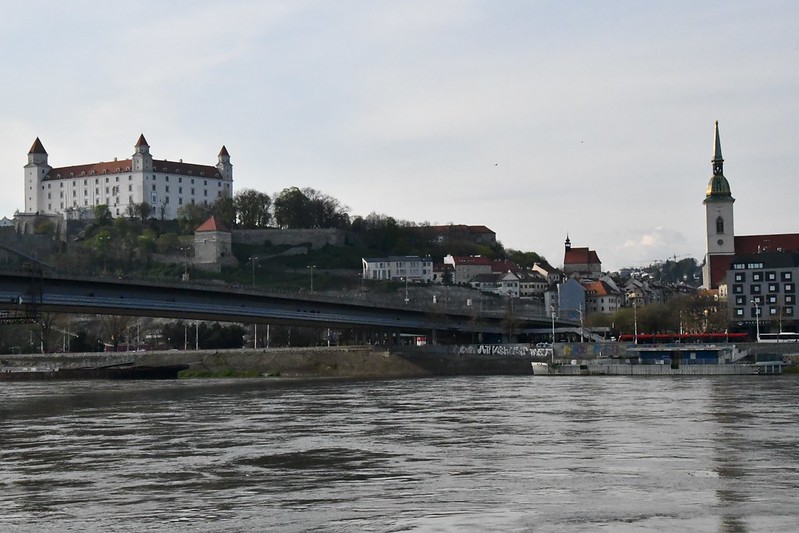
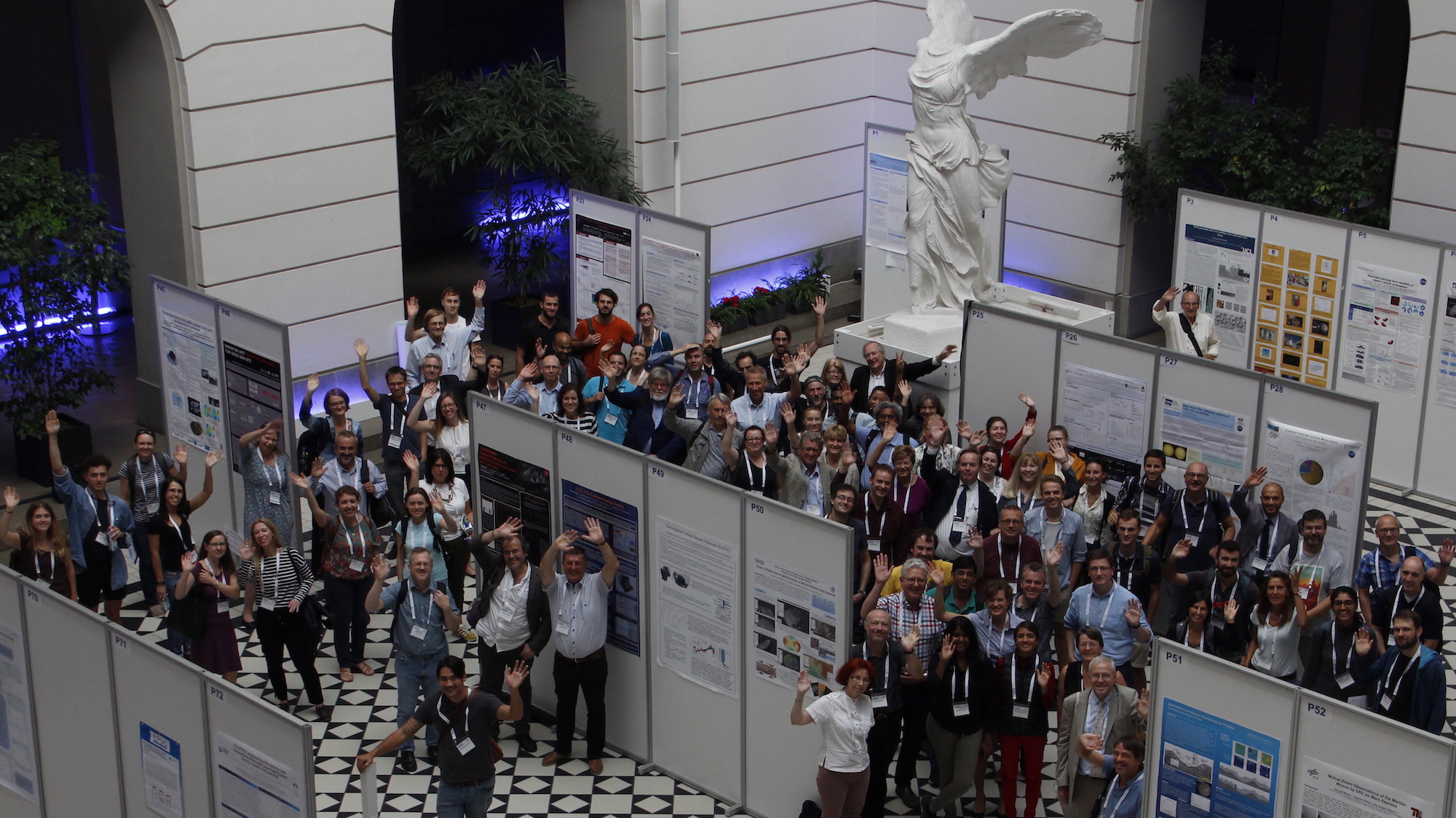
The first Europlanet Research Infrastructure Meeting (ERIM), co-hosted with the fifth Europlanet Early Career Network (EPEC) Annual Week, took place from 19-23 June 2023 in hybrid format at the Hotel Sorea in Bratislava, Slovakia, and online. 137 participants joined us for the meeting in Bratislava, with a further 94 following the meeting online. Of these, 45 participated in the hybrid EPEC Annual Week training school.>
Image credit: E. Polischuk (CC BY-SA 4.0)
ERIM 2023 brought together a range of planetary science and Europlanet community workshops, including interactive sessions on geological mapping, planetary space weather, the Europlanet Telescope Network, industry engagement, innovations in outreach tools.
The Europlanet Early Career (EPEC) Annual Week was co-hosted with ERIM, along with Europlanet Society meetings of the Regional Hubs and the Europlanet General Assembly to promote
Europlanet promotes the advancement of planetary science and related fields for the benefit of the community, by encouraging the creation of new knowledge, by promoting education, by stimulating innovation and enhancing accessibility and transparency. We are open to individual and organisational members. Anyone with an active interest in planetary science (whether academic or industrial, professional or amateur) is welcome to join.
Our Aims:
Supporting the planetary science community through the activities of Europlanet and its structures, including EPSC;
Establishing strategic collaborations to support planetary science;
Developing and maintaining infrastructures to support planetary sciences.
Background:
Europlanet is the parent body of the annual Europlanet Science Congress (EPSC) the largest annual meeting on planetary science in Europe.
Europlanet builds on the heritage of 20 years of Europlanet projects funded by the European Commission and provides a sustainable legacy for infrastructure, including transnational access to facilities, virtual access services and tools, training and other services developed through these activities.
Over the past decade, efforts have focused on developing a sustainability plan to ensure Europlanet’s activities continue independently of EC funding. The launch of the Europlanet Society for individual members in 2018 marked the first step, and this was followed by the establishment of the Europlanet Association Sans But Lucratif (AISBL) in 2023, which provides Europlanet with a sustainable legal entity. In January 2025, we introduced a new organisational membership programme that aims to provide a solid foundation for us to deliver our core programmes for decades to come.
Europlanet is governed by an elected Executive Board and our activities are supported by Committees and Working Groups drawn from our membership.
Europlanet Membership Benefits and Fees
Find out about the benefits and fees when joining as an:
If you would like to find out more about joining Europlanet, please contact us.
The launch of the Europlanet Society at EPSC2018. Credit: L GiacominiMembers of the Europlanet Society gathered for the General Assembly at EPSC2022. Credit: Europlanet/T Roger.
The Europlanet Regional Hubs support the development of planetary science at a national and regional level, particularly in countries and areas that are currently under-represented within the community.
Our Hub Committees organise networking events and workshops to support the research community, as well as to build links with amateur astronomers, industrial partners, policymakers, educators, the media and the wider public. Europlanet Society members are welcome to participate in the activities of one or more Hubs.
The 10 Regional Hubs established in Europe to date are:
The Europlanet Early Career (EPEC) network is organised by early-career researchers, for early-career researchers, and includes volunteers from across the Europlanet international community. The EPEC network is open to all students, doctoral candidates and early-career planetary scientists and space professionals whose last degree (e.g. MSc or PhD) was obtained a maximum of 7 years ago (excluding parental leave, serious illness and similar delays).
One of the main objectives of EPEC is to form a strong network between young professionals by organising early-career-relevant events and by engaging in different projects amongst different focus areas (outreach, diversity, early career support). Furthermore, the EPEC community aims to bring a young voice into Europlanet Society to shape the future of planetary and space sciences and engineering.
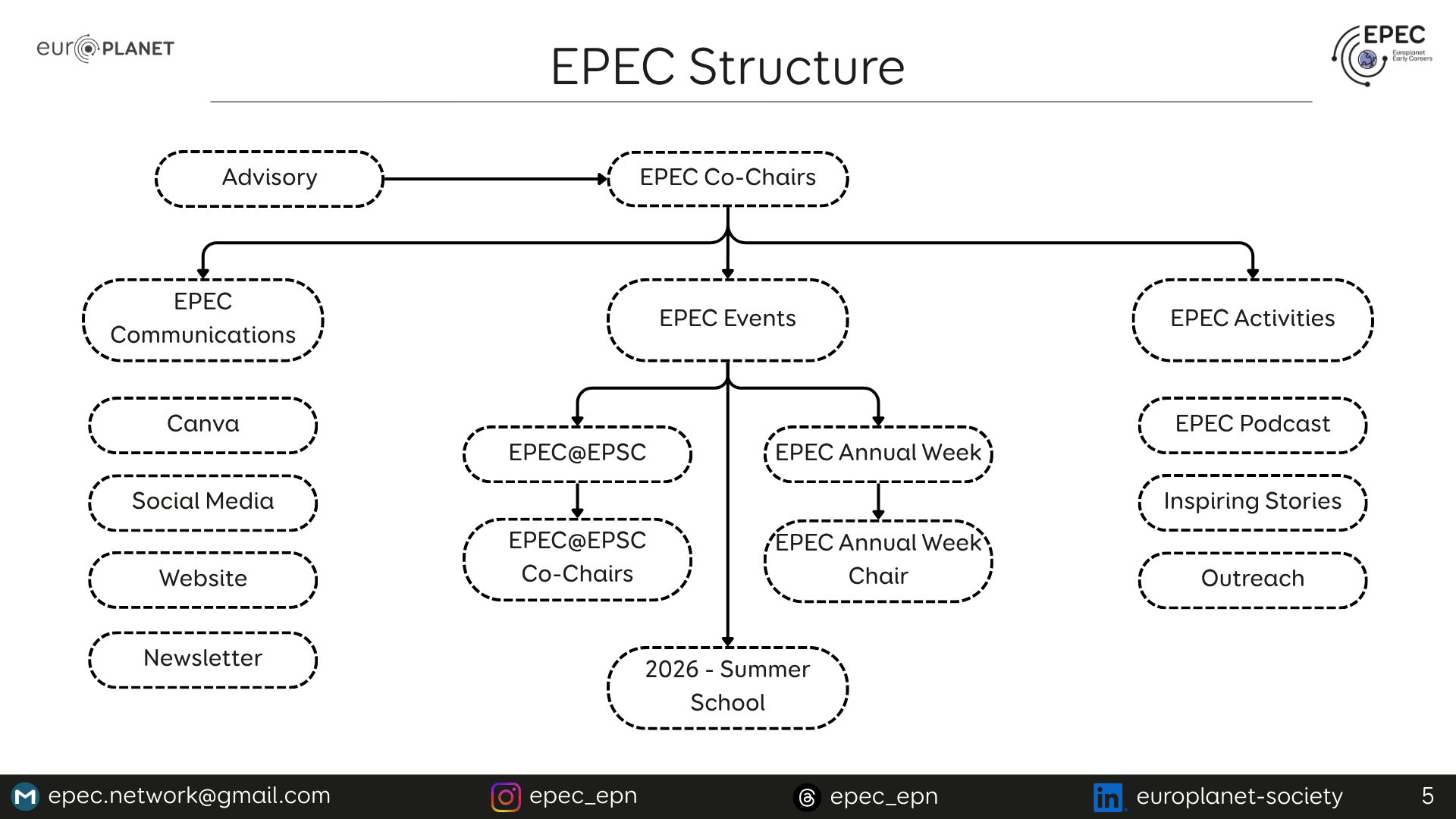
Previously, EPEC was formed of working groups, whereas today we exist in a simplified structure after implementing feedback from our members. EPEC is led by chairs who oversee day-to-day operations as well as (co-)chairs who sit on the committee, jointly responsible for an event or activity. In order for our events and activities to run, we are grateful to the help and support of volunteers, who are led by helpful committee chairs to facilitate the running of one of our early career focused activities or events. Any EPEC venture is a focused effort to involve our members, to network, to learn and most importantly to enjoy themselves with our community of planetary scientists and related disciplines.
[Credit – Nimisha Verma]
Get involved with EPEC!
The EPEC Committee are constantly looking for interested early-career professionals who are willing to spend some of their academic time with the organising elements of various EPEC activities. By getting involved with the EPEC Committee, as a committee chair or volunteer, you not only get a chance to build a diverse professional network across Europe and abroad, but also build important soft-skills such as leadership qualities and management experience by working with a very friendly and energetic community.
For any questions and enquiries, and interest to join us in building a stronger early career network, please contact us on Discord (making sure to select the ‘early career’ role} or email epec.network@gmail.com.
If you would like to simply become a member of EPEC: to get attend our events, take part in our activities and benefit from our thriving community, please sign up to the newsletter (see below) and be sure to join us on social media (Instagram, Discord, Threads, LinkedIn) for the latest updates.
Upcoming Events
Follow our newsletter (below) and join us on social media so you do not miss out!
EPEC Newsletter
If you would like to receive news (e.g., about the annual EPEC week or the next activities planned at EPSC), sign into your Europlanet account (the account is free) and toggle the Early Career (EPEC) option in the Subscriptions tab. We will not spam you with emails but send only relevant information regarding signups to major events and activities (co-)organized by EPEC.
Current EPEC Committee
EPEC
Nimisha Verma – EPEC Co-Chair
Thomas O’Sullivan – EPEC Co-Chair
Events
Jules Bourdelle de Micas – EPEC@EPSC Co-Chair
Aurelie Van den Neucker – EPEC@EPSC Co-Chair
Gabriel Maynard – EPEC Annual Week 2026 Chair, EPEC Profiles
Since it’s inception, EPEC formerly was composed of nine working groups, which focused on areas from Outreach, Diversity, Early Career Support, Communications and Annual Week. You will see that these have been reincorporated into EPEC today though our Events and Activities, keeping true to the original mission of EPEC. Find out more about our previous structure here and how EPEC has historically existed as the early career arm of Europlanet.
Hello, Central European space scientists, space engineers, amateurs, teachers and students!
We are a group of volunteers from Central European countries coming together regularly through telecons and brainstorming about possible activities that could promote Central European space research. We are organising workshops and networking events in order to connect industry and academia, to help early-career scientists and promote outreach.
The member states of Europlanet’s Central European Hub include Austria, the Czech Republic, Hungary, Poland, Slovakia and Slovenia.
Don’t hesitate to join our hub by becoming a member of Europlanet → Here.
Europlanet Statement on Equality, Diversity and Inclusivity
Europlanet is committed to building a diverse, inclusive planetary science community in Europe and to ensuring that individuals within that community experience equal opportunity, regardless of gender, disability, ethnic origin, religion or belief, sexual orientation, marital status, age, nationality or socioeconomic background.
Europlanet Diversity Committee
The Europlanet Diversity Committee acts as a strategic task force to advise, coordinate and champion activities across Europlanet that further the association’s commitment to equality, diversity and inclusivity.
Chair: Solmaz Adeli (DLR)
Vice-chair: Arianna Piccialli (BIRA-IASB)
Secretary: Marina Molla
Regional Hub and Committee Diversity Officers:
Benelux Hub: Arianna Piccialli (BIRA-IASB)
Central Europe Hub: Anna Łosiak (University of Exeter)
French Hub: Lea Bonnefoy (Cornell)
Germany Hub: Open
Italy Hub: Federica Duras (INAF)
Ireland and UK Hub: Open
Northern Hub: Markus Ambrosch(Vilnius University)
Southeast Europe Hub: Marina Molla
Spain and Portugal Hub: João Faria (IA, Porto)
Switzerland Hub: Open
EPEC Representative: Open
Executive Board Representative: Ann Carine Vandaele
The Europlanet Science Congress (EPSC) is the major European meeting on planetary science.
About EPSC
The Europlanet Science Congress (EPSC) is the major European meeting on planetary science. Originally known as the European Planetary Science Congress, the first EPSC was held in Berlin in 2006. EPSC is the main dissemination platform for the European planetary science community and is the annual meeting of Europlanet. EPSC meetings cover the entire scope of planetary sciences and have a distinctively interactive style, with an extensive mix of talks, workshops and posters, intended to provide a stimulating environment for the community to meet.
EPSC2026 will be held at the Amare Venue in The Hague, The Netherlands from 6-11 September 2026: https://www.epsc2026.eu
EPSC2026 will be held at Amare in The Hague. Credit: Europlanet.
Europlanet offers bursaries to support early career scientists from Europe and participants from under-represented countries; the application process has been integrated into abstract submission for the EPSC2026 Meeting (deadline 13 May 2026).
EPSC Outstanding Poster Competition
The EPSC Outstanding Poster Competition (OPC) is an opportunity for early career researchers to have their work recognised at EPSC.
EPSC 2027 will be held at the Pierre Baudis Congress Centre in Toulouse, France, from 19-24 September 2027.
EPSC2028 will be held at the Padova Congress, Padova, Italy, from 17-22 September 2028
EPSC2029 will take place in Messe Graz, Graz, Austria, from 9-14 September 2029.
Outreach and Education at EPSC
The Europlanet Science Congress (EPSC) is an opportunity for sharing the latest developments in planetary science with communities hosting Europlanet’s annual meeting and around the world, as well as a platform for discussing tools, approaches, outcomes and innovations within the planetary outreach and education community.
For over a decade, Europlanet had actively engaged with both policy makers and Industry and Academia groups. We continue to leverage collaborations, synergies with experts and policy makers to engage them with the cutting-edge science and technological challenges of planetary science and exploration.
For more information about our Policy and Industry activities:
The Europlanet Italy Regional Hub was established in October 2018 to promote planetary science and related fields for the benefit of the Italian and European community within Europlanet.
Italy participates as a beneficiary of the Europlanet 2024 Research Infrastructure (RI) project (here the Italian webpage related to the project) with different institutions: INAF (Istituto Nazionale di Astrofisica) Universita Degli Studi Gabriele D’annunzio di Chieti-Pescara Università di Bologna University of Padova
Members of the Committee of the Italy Hub:
Chair: Stavro Ivanovski (INAF- OATS)
Vice Chair: Alice Lucchetti (INAF-OAPD)
Advisor: Maria Cristina De Sanctis (INAF-IAPS)
Industry Officer: Vacant
Outreach Officers: Livia Giacomini (INAF) and Federica Duras (INAF)
Diversity Officer: Vacant
Early Career Officer: Giovanni Munaretto (INAF-OAPD)
Please Note: The Europlanet 2024 RI project, which received funding from the European Union’s Horizon 2020 research and innovation programme under grant agreement No 871149, closed in July 2024. This archive page describes activities funded through the Europlanet 2024 RI project.
About the Europlanet 2024 Research Infrastructure (RI)
The Europlanet 2024 Research Infrastructure (RI) provided free access to the world’s largest collection of planetary simulation and analysis facilities, data services and tools, a ground-based observational network and programme of community support activities.
The project was funded through the European Commission’s Horizon 2020 programme and ran for four years from February 2020 until July 2024. The Europlanet 2024 RI consortium was led by the University of Kent, UK, and had over 50 beneficiary institutions from 24 countries in Europe and around the world, with a further 44 affiliated partners. The project drew on the resources of the Europlanet Society to disseminate activities and outcomes and develop a more diverse community of users.
Europlanet 2024 RI provided:
Transnational Access to 24 laboratories in Europe and seven field sites, as well as additional facilities in South Korea and China.
If you have recieved funding from Europlanet 2024 RI, please add the official acknowledgement below to each publication and dissemination activity:“Europlanet 2024 RI has received funding from the European Union’s Horizon 2020 research and innovation programme under grant agreement No 871149.”
Objectives of Europlanet outreach and public engagement
Europlanet’s outreach activities aim to raise the profile of planetary science amongst European citizens, policy-makers, industry and the media, and support planetary scientists in engaging different audiences with their research.
Why engage with planetary science?
Planetary science has a direct relevance to our understanding of our own planet, its origins, its past and future evolution, the conditions needed for life, and threats from our space environment, such as solar storms or Near-Earth Asteroids. Europlanet aims to engage European citizens in dialogue about this research and to communicate the scientific, social, economic and cultural impact of planetary science.
Exploration and planetary science can act as a hook to inspire the next generation to pursue careers in science, technology, engineering, arts and mathematics (STEAM). Europlanet aims to create and curate high-quality teaching resources and activities for use in classrooms and informal learning settings.
Educational Resources
Europlanet provides resources to support the use of planetary science to inspire and engage students and teachers with STEM.
Outreach Services
Europlanet offers the following services to support outreach and education initiatives within the planetary science community:
Prize: we award an annual prize for public engagement in planetary science.
Funding Scheme: we provide seed funding for new and innovative outreach projects.
Europlanet Evaluation Toolkit: we have developed easy-to-use evaluation tools to help assess the impact and outcomes of education and outreach activities.
Resources: we aim to collate some of the best outreach and education resources related to planetary science to share with the community. Through the Europlanet 2024 RI project, we also created educational resources about Mars and the icy moons of Jupiter.
Training: we run workshops to equip planetary scientists with the skills to convey their work effectively to different audiences and support members of the outreach community to develop their own training workshops to deliver via the Europlanet Regional Hub network.
Best practice: we coordinate sessions and workshops to share knowledge within the community. Our annual meeting, the Europlanet Science Congress (EPSC), includes several sessions related to different aspects of outreach and education in planetary science.
The Europlanet Northern Europe Regional Hub was established in 2019 to promote planetary science and related fields for the benefit of the Danish, Estonian, Finnish, Icelandic, Latvian, Lithuanian, Norwegian, Swedish and wider European community, within Europlanet.
The Europlanet Northern Hub (EPSC 2022, Granada, Spain) (Left to right): Stefanus Schroder (Sweden), Erika Kaufmann (Sweden), Maria Hieta (Finland), Maria Genzer (Finland), Harri Haukka (Finland, Chair), Grazina Tautvaisiene (Lithuania, Vice Chair ), Veikko Makela (Finland), Jonathan P. Merrison (Denmark, former Chair), Edita Stonkute (Lithuania), Heleri Ramler (Estonia), Stas Barabash (Sweden) and Yoshifumi Futaana (Sweden).
Committees and national representatives
Members of the Committee of the Northern Europe Hub are:
Chair: Harri Haukka (Finnish Meteorological Institute) – harri.haukka@fmi.fi
Europlanet 2024 RI has received funding from the European Union’s Horizon 2020 research and innovation programme under grant agreement No 871149.
Europlanet AISBL (Association Internationale Sans But Lucratif – 0800.634.634) is hosted by the Department of Planetary Atmospheres of the Royal Belgian Institute for Space Aeronomy (BIRA-IASB), Avenue Circulaire 3, B-1180 Brussels, Belgium.