EPSC-DPS2025: JWST Reveals Dark Beads and Lopsided Star Patterns in Saturn’s Atmosphere
Joint Press Release of Northumbria University and the Joint Meeting of the Europlanet Science Congress and the American Astronomical Society’s Division for Planetary Science (EPSC-DPS2025)
A study of Saturn’s atmospheric structure using data from the James Webb Space Telescope (JWST) has revealed complex and mysterious features unseen before on any planet in our Solar System. The results were presented last week by Prof Tom Stallard of Northumbria University, UK, at the EPSC-DPS2025 Joint Meeting in Helsinki.
“This opportunity to use JWST was the first time we have ever been able to make such detailed near-infrared observations of Saturn’s aurora and upper atmosphere. The results came as a complete surprise,” said Stallard.
“We anticipated seeing emissions in broad bands at the various levels. Instead, we’ve seen fine-scaled patterns of beads and stars that, despite being separated by huge distances in altitude, may somehow be interconnected – and may also be linked to the famous hexagon deeper in Saturn’s clouds. These features were completely unexpected and, at present, are completely unexplained.”
The international team of researchers, comprising 23 scientists from institutions across the UK, US and France, made the discoveries during a continuous 10-hour observation period on 29 November 2024, as Saturn rotated beneath JWST’s view.
The team focused on detecting infrared emissions by a positively charged molecular form of hydrogen, H3+, which plays a key role in reactions in Saturn’s atmosphere and so can provide valuable insights into the chemical and physical processes at work. JWST’s Near Infrared Spectrograph allowed the team to simultaneously observe H₃⁺ ions from the ionosphere, 1,100 kilometres above Saturn’s nominal surface, and methane molecules in the underlying stratosphere, at an altitude of 600 kilometres.
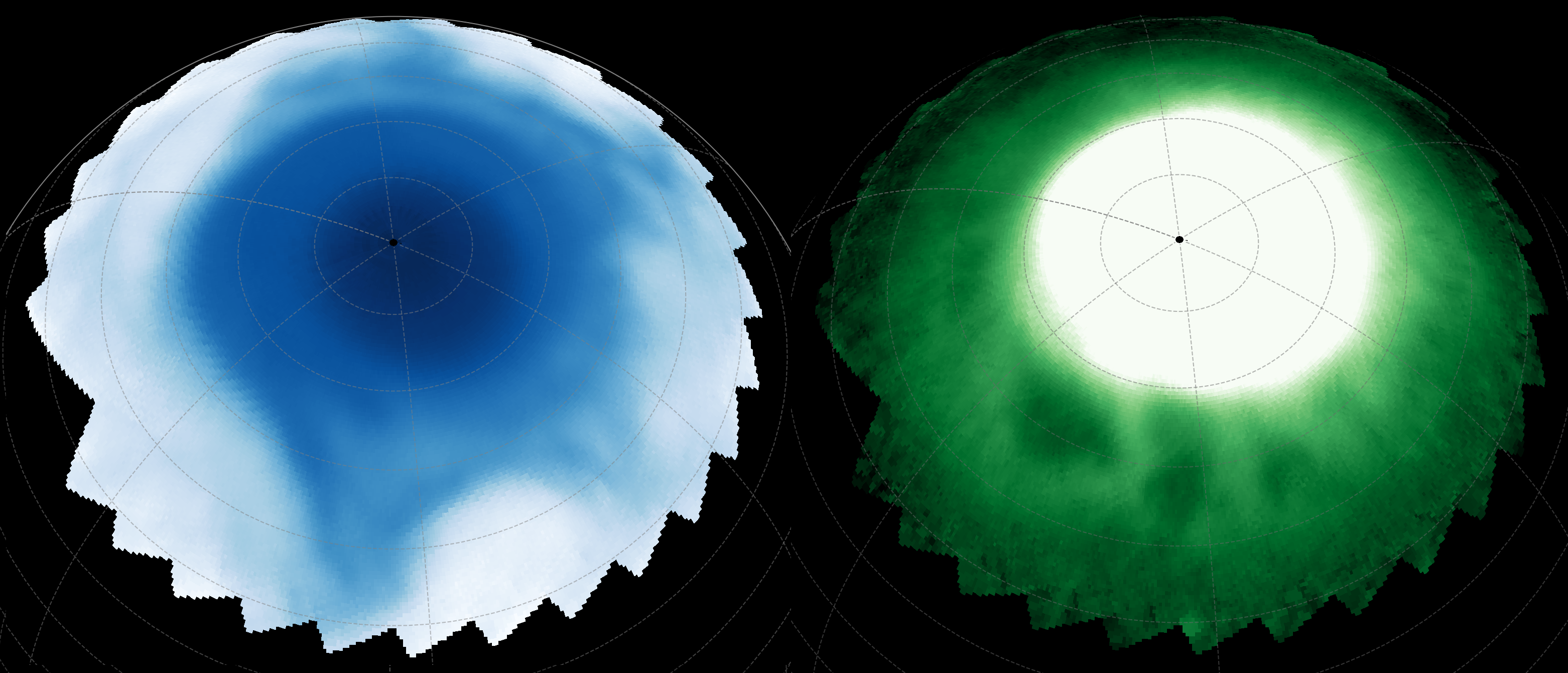
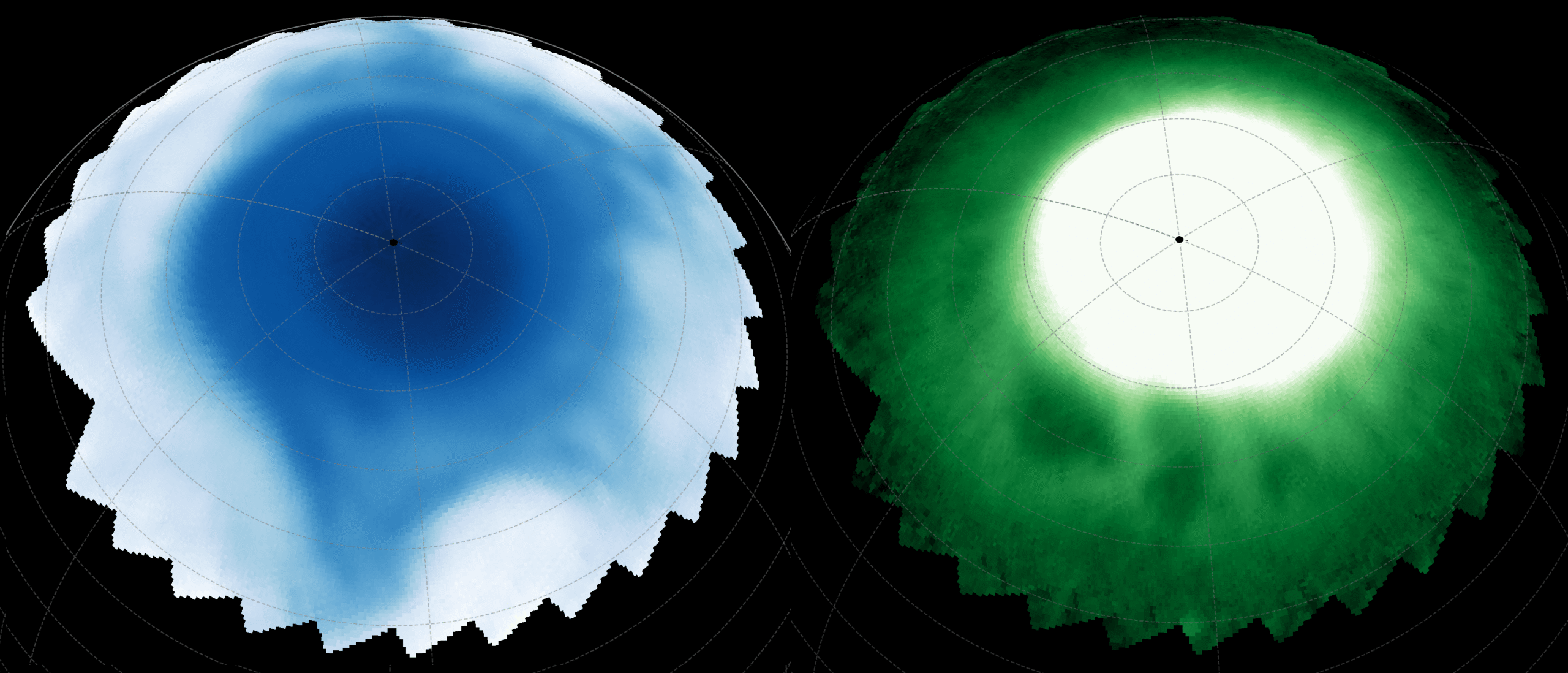
In the electrically-charged plasma of the ionosphere, the team observed a series of dark, bead-like features embedded in bright auroral halos. These structures remained stable over hours but appeared to drift slowly over longer periods.
Around 500 kilometres lower, in Saturn’s stratosphere, the team discovered an asymmetric star-shaped feature. This unusual structure extended out from Saturn’s north pole towards the equator. Only four of the star’s six arms were visible, with two mysteriously missing, creating a lopsided pattern.
“Saturn’s upper atmosphere has proven incredibly difficult to study with missions and telescope facilities to date due to the extremely weak emissions from this region,” said Stallard. “JWST’s incredible sensitivity has revolutionised our ability to observe these atmospheric layers, revealing structures that are completely unlike anything we’ve seen before on any planet.”
The team mapped the exact locations of the features and found that they overlaid the same region of Saturn at different levels, with the star’s arms appearing to emanate from positions directly above the points of the storm-cloud-level hexagon. This suggests that the processes that are driving the patterns may influence a column stretching right through Saturn’s atmosphere.
“We think that the dark beads may result from complex interactions between Saturn’s magnetosphere and its rotating atmosphere, potentially providing new insights into the energy exchange that drives Saturn’s aurora. The asymmetric star pattern suggests previously unknown atmospheric processes operating in Saturn’s stratosphere, possibly linked to the hexagonal storm pattern observed deeper in Saturn’s atmosphere,” said Stallard.
“Tantalisingly, the darkest beads in the ionosphere appear to line up with the strongest star-arm in the stratosphere, but it’s not clear at this point whether they are actually linked or whether it’s just a coincidence.”
While both features could have significant implications for understanding atmospheric dynamics on gas giant planets, more work is needed to provide explanations for the underlying causes.
The team hopes that additional time may be granted in future to carry out follow-up observations of Saturn with JWST to further explore the features. With the planet at its equinox, which occurs approximately every 15 Earth years, the structures may change dramatically as Saturn’s orientation to the Sun shifts and the northern hemisphere moves into autumn.
“Since neither atmospheric layer can be observed using ground-based telescopes, the need for JWST follow-up observations during this key time of seasonal change on Saturn is pressing,” Stallard added.
Further Information
Abstract: EPSC-DPS2025-817. Tom Stallard, Henrik Melin, Luke Moore, Emma Thomas, Katie Knowles, Paola Tiranti and James O’Donoghue.
https://doi.org/10.5194/epsc-dps2025-817
The paper JWST/NIRSpec detection of complex structures in Saturn’s sub-auroral ionosphere and stratosphere was published in Geophysical Research Letters on 28 August 2025.
DOI: https://doi.org/10.1029/2025GL116491
Visit the Northumbria University Research Portal to find out more about Professor Tom Stallard’s work.
The Saturn research was supported by grants from the Science and Technology Facilities Council (STFC), NASA Solar System Workings program, and the European Research Council. The study represents part of JWST’s ongoing revolutionary observations of our solar system’s planets.
Images and Animations
Download link: https://www.swisstransfer.com/d/c8e96f72-8794-421e-bf60-ab31d5d07188
Montage of Dark Beads in Saturn’s Ionosphere

https://www.europlanet.org/wp-content/uploads/2025/09/dark_beads_montage.png
Animation of Dark Beads in Saturn’s Ionosphere
This video of Saturn’s ionosphere highlights the contrast in brightness between JWST’s infrared observations of the aurora and the dim bead features. The aurora itself is relatively weak, almost impossible to image from Earth, needing hours of integration time to observe using ground-based data. However, the auroral features are at least four times brighter than the brightest parts of the dark bead features, so to properly show the hidden features, the aurora are completely saturated. Credit: NASA/ESA/CSA/Stallard et al 2025.
Montage of Star Arms in Saturn’s Stratosphere

https://www.europlanet.org/wp-content/uploads/2025/09/star_arms_montage.png
Montage of Star Arms in Saturn’s Stratosphere
This video of Saturn’s stratosphere shows a complex and highly surprising star-shaped structure, revealed for the first time by JWST’s unprecedented sensitivity. Four dark bands extend away from the polar region, appearing to make up four out of six arms that align with Saturn’s famous hexagon within the lower atmosphere. At this point, it is unknown why the dark arms are flowing towards the equator, or why two of the arms are missing, but the causes may be associated with the complex bead structures observed many hundreds of kilometres above in the ionosphere. Credit: NASA/ESA/CSA/Stallard et al 2025.
Dark Beads and Star Arms in Saturn’s Upper Atmosphere
https://www.europlanet.org/wp-content/uploads/2025/09/beads_and_star_arms.png
Dark Beads and Star Arms in Saturn’s Upper Atmosphere
This video shows how the structures observed in Saturn’s ionosphere and stratosphere relate to one another. Starting with the aurora at 1100 km, the brightness is increased to reveal the dark bead-like features. The video then fades into the star-arm shapes within the underlying 600 km layer. The darkest beads in the ionosphere appear to line up with the strongest arm underneath it, but it is not clear if this is co-incidental, or if it suggests coupling between Saturn’s lowest and highest layers of the atmosphere. Credit: NASA/ESA/CSA/Stallard et al 2025.
Notes for Editors
About the Joint Meeting of the Europlanet Science Congress and the Division of Planetary Sciences (EPSC-DPS)
The Europlanet Science Congress (EPSC), established in 2006 as the European Planetary Science Congress, is the largest planetary science meeting in Europe. It covers the entire range of planetary sciences, with an extensive mix of talks, workshops and poster sessions, as well as providing a unique space for networking and exchanges of experiences.
EPSC joined forces for the first time with the American Astronomical Society’s Division for Planetary Sciences (DPS) for a joint meeting in Nantes, France, in 2011. This was followed by DPS-EPSC 2016 in Pasadena, EPSC-DPS 2019 in Geneva, and the return to the United States for the DPS-EPSC 2023 meeting in San Antonio. This year marks the third iteration of a joint European-based meeting. The intent of the joint meetings is not only to connect the European and North American planetary science communities, but also to consolidate two major meetings and motivate planetary scientists from all over the globe to attend. With over 1800 participants joining in person and online, EPSC-DPS2025 is the largest planetary science meeting held to date in Europe. https://www.epsc-dps2025.eu
Follow on social media (Bluesky, X and LinkedIn) with the hashtag #EPSC-DPS2025 for updates on the meeting.
About Europlanet
Europlanet (europlanet.org) is a non-profit association and membership organisation that provides the planetary science community with access to research infrastructure, services and training. The Europlanet Association Sans But Lucratif (AISBL), established in 2023, builds on the heritage of a series of projects funded by the European Commission between 2005 and 2024 (Grant Numbers 871149, 654208, 228319 and RICA-CT-2004-001637) to support the planetary science community in Europe and around the world.
About the DPS
The Division for Planetary Sciences (DPS), founded in 1968, is the largest special-interest Division of the American Astronomical Society (AAS). Members of the DPS study the bodies of our own solar system, from planets and moons to comets and asteroids, and all other solar-system objects and processes. With the discovery that planets exist around other stars, the DPS has expanded its scope to include the study of extrasolar planetary systems as well. The American Astronomical Society (AAS), established in 1899, is the major organization of professional astronomers in North America. The mission of the AAS is to enhance and share humanity’s scientific understanding of the universe as a diverse and inclusive astronomical community, which it achieves through publishing, meeting organization, science advocacy, education and outreach, and training and professional development.